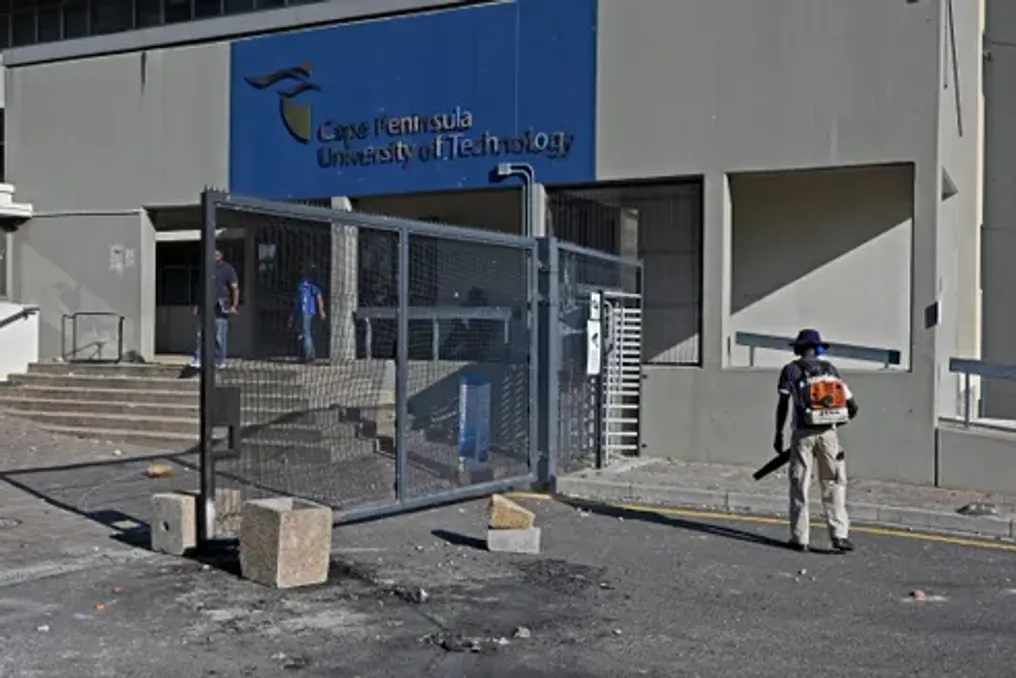
CPUT Students Protest at Parliament Over Tuition Fees and Campus Closures
Read more
IOL
iol.co.za

CPUT Students Protest at Parliament Over Tuition Fees and Campus Closures

Students from the Cape Peninsula University of Technology (CPUT) marched to Parliament on Tuesday, demanding legislative support in their dispute with university management, as the institution has descended into chaos.

Dissatisfied students are engaging in destructive and violent confrontations with the institution's administration regarding tuition costs. The weekly protest was accompanied by demonstrations and infrastructure damage at campuses in District Six, as well as in Welton and Bellville in Cape Town.

On Tuesday, CPUT announced the complete suspension of all campus and student dormitory operations after a fire broke out on the Bellville campus. This decision comes amid escalating tensions surrounding proposed financial calculation rules and registration requirements for 2027.

CPUT students proceeded from the District Six campus to Parliament, where they submitted a memorandum with their demands. Tuesday saw the university management confirm the arrival of fire services at the site of the fire at the Old Academic Building on the Bellville campus, which occurred Monday evening.

The administration stated that although no one was injured in the latest arson attack, the escalation of violence to a level where someone could suffer serious injuries or more is a cause for serious concern.

The university reported that ongoing violations, including building arsons and attacks on infrastructure, forced the management to take decisive action. The closure occurs against the backdrop of student protests against the proposed financial calculation rules for 2027, which, according to student movement leaders, will make higher education inaccessible to thousands of financially struggling students.

According to reports, students delivered the memorandum to the Parliamentary Committee on Higher Education.

Similar stories

CPUT closes all campuses and evacuates students after vandalism during protests
Read more
iol.co.za

CPUT closes all campuses and evacuates students after vandalism during protests

All campuses of Cape Peninsula University of Technology (CPUT) have been closed, and students have been instructed to vacate university accommodation within 24 hours following the arson attack on the Old Education building on the campus in Bellville.

The university administration confirmed that fire services responded to the blaze at the Old Education building on the Bellville campus on Monday evening. The leadership noted that while no one was injured in the latest act of vandalism, the escalation of violence to a level where serious injuries could occur or worse is a serious concern.

The university stated that ongoing unrest, including building arsons and attacks on infrastructure, forced the management to take decisive action.

Arson forces CPUT to close all campuses

The administration announced that persistent violent unrest, building fires, and malicious attacks on institutional infrastructure necessitated the closure of all campuses until further notice and the immediate evacuation of residential premises.

All academic classes have been suspended immediately, and staff have been instructed to work remotely. The university specified that only essential function employees and selected support personnel are permitted on campus.

Furthermore, the management ordered all students residing in university housing to vacate the premises within one day. The administration set a deadline: all dormitories must be cleared by Wednesday, August 19th, at 16:00, as they will be closed.

The closure occurred amid ongoing student protests related to proposed financial calculation rules for 2027. Student leaders argue that these rules will make higher education inaccessible to thousands of financially struggling students.

Students given 24 hours to evacuate dormitories

According to documents circulated among students, CPUT is considering a new financial model that would require returning students with historical debt to pay a percentage of outstanding fees before being granted registration permission.

The proposals also include a requirement for students living in dormitories to make an initial payment of approximately 7000 rand, which would cover registration and accommodation fees. Students also objected to proposals to cancel the use of Debt Recognition Agreements (AODs), which previously allowed students to register by repaying debt through structured plans.

Under the proposed system, students with debts between 20,001 and 40,000 rand may be required to prepay between 20% and 60% of their debt, depending on their academic performance. Students with debts exceeding 90,000 rand may face prepayments ranging from 35% to 60%.

Student activists labeled these proposals a form of 'financial exclusion,' arguing that they disproportionately affect students from low-income and working-class backgrounds.

Nevertheless, the university administration links the current campus closure to the violent actions committed during the protests. The university stated: 'Disorderly individuals acting in bad faith, with the sole aim of rendering the university dysfunctional, left the Management with no choice but to act quickly and decisively.'

The leadership insisted that the housing evacuation was necessary to protect students and staff. The statement emphasized: 'The safety of staff and students is our primary concern at this stage.'

The university added: 'The Management wishes to reiterate that the evacuation is aimed at resolving the safety issues of all our students and staff during this difficult period. The safety of our campus community is our top priority, and evacuation is now our only way to de-escalate tensions and protect lives.'

The university stated that it remains committed to finding a solution that allows the academic year to conclude. The leadership appealed for support: 'The Management is focused on finding a solution for the prompt completion of the academic year. We ask for your support while we do everything possible to save our CPUT.'


CPUT students protest over financial and academic issues; classes suspended
Read more
iol.co.za

CPUT students protest over financial and academic issues; classes suspended

Student protests continue at the campuses of Cape Peninsula University of Technology (CPUT) in Cape Town, driven by financial and academic grievances, leading to the suspension of classes in several campuses. Property damage occurred during nighttime unrest.

The main reasons for dissatisfaction are reportedly student debt burden, registration fees, accommodation costs, conditions in university hostels, and the withholding of academic transcripts.

These protests followed the submission of a second memorandum by students at the CPUT Bellville campus. This document was handed over after several days of mass gatherings and demonstrations concerning student finances, historical debt, and new university admission fees.

Students also expressed concerns that accommodation fees exceed the funding limit of the National Student Financial Aid Scheme (NSFAS), forcing some CPUT students to cover the difference themselves.

On Wednesday evening, the CPUT Council withdrew its Draft Financial Recovery Plan for 2027. This decision was made at a special Council meeting following several days of student unrest and the submission of the second memorandum on Tuesday. The plan's withdrawal is intended to allow for further consultation. According to available data, the draft stipulated that returning students would have to pay up to 7000 rand for registration for the new academic year.

The issue of student debt continues to affect many South Africans. In May, the Portfolio Committee on Higher Education heard alarming statistics. Parliament stated that the total outstanding debt in the post-school education system has reached 59 billion rand. Nearly half of this amount, specifically 29 billion rand, belongs to students receiving funding from NSFAS. Self-funded students contributed 26 billion rand, with the remaining amount being 12 billion rand in bad debt.

These figures were presented during a briefing conducted by the Department of Higher Education and Training (DHET), Universities South Africa (USAF), and the South African Public Colleges Organization (SAPCO) regarding student debt and the withholding of student certificates in the post-school education and training system.

DHET reported that 165,000 qualification certificates are currently being withheld due to unpaid student debt, calling this figure 'alarmingly high.' The total number of certificates held by universities is 188,209. DHET noted that technological universities show the highest debt ratios, while traditional universities still carry significant absolute debt. DHET concluded that the statistics confirm that the student debt problem is systemic across the entire sector, rather than isolated to one category of institutions.

Popular