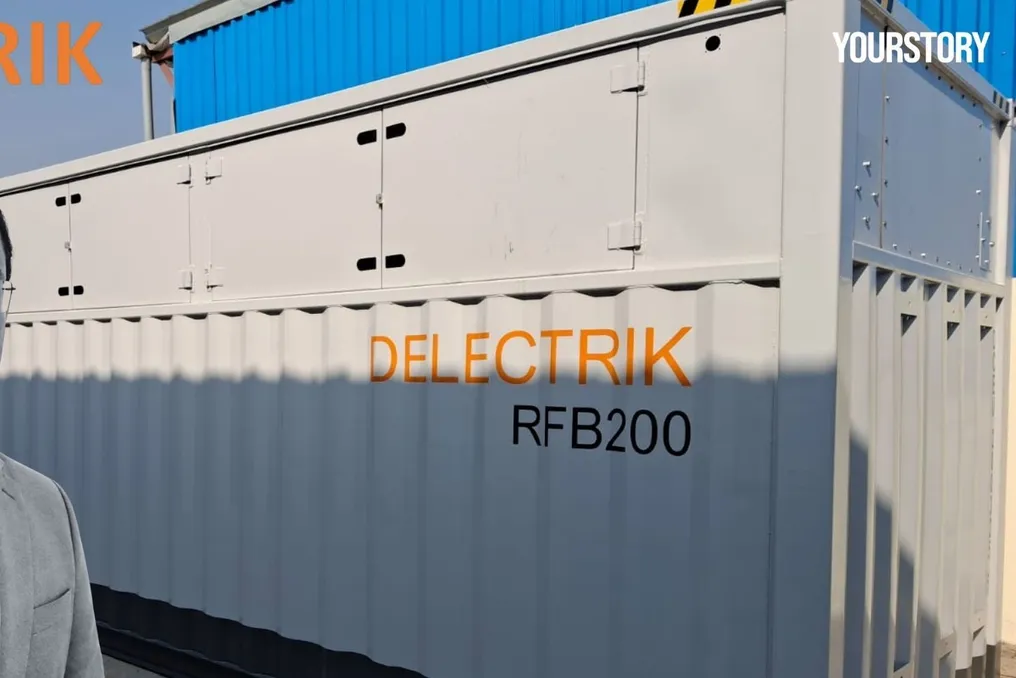
Delectrik develops flow batteries that provide significantly longer energy storage from renewable sources compared to traditional counterparts. Unlike lithium-ion batteries, which store energy in solid electrodes and degrade with each charge cycle, the flow battery functions differently.
In this system, energy is contained in two reservoirs of liquid electrolyte, which is pumped past a membrane where a chemical reaction occurs. Since the liquid is not consumed, the system can operate for decades with minimal degradation.
A drawback of flow batteries is their lower energy density compared to lithium-ion, which precludes their use in mobile devices or automobiles. However, for power grids, where equipment replacement costs exceed the cost of occupied space, this disadvantage is negated: a system lasting twenty years and posing no fire hazard justifies the larger size.
The systems are developed by Delectrik, based in Gurugram, and led by its founder and CEO, Vishal Mittal. The company designs and manufactures vanadium redox flow batteries for commercial, industrial, and utility use. This development coincides with India increasing solar generation faster than energy storage capabilities, creating a mismatch between energy production and consumption.
Delectrik's systems utilize a so-called non-containerized architecture. Most large battery installations are supplied in containerized form filled with cells, whereas a flow battery includes tanks, pumps, and stacks that can be integrated directly on-site rather than just placed there, making it suitable for installations rated in tens of megawatt-hours.
From a safety perspective, the vanadium electrolyte is aqueous and non-flammable, eliminating the risk of thermal runaway that dictates fire safety regulations for large lithium installations. Furthermore, such a system can undergo full discharge and remain in that state, which a lithium system cannot.
The company builds its business around the material itself, not just the product. To achieve this, it established two subsidiaries: Delectrik Resources, which operates at earlier stages of the supply chain by producing vanadium oxide and ultimately vanadium assets, and Delectrik Esaas, which plans to offer energy storage services for commercial, industrial, and data centers.
Vanadium is a limiting factor for this technology globally. Although the metal itself is not scarce, its supply is concentrated, and the electrolyte constitutes a significant portion of the flow battery's cost. Consequently, a company capable of securing raw materials and recycling them independently has a structural advantage over those forced to purchase them.
In July 2026, the company announced its win in a tender to deploy a 100 MWh vanadium flow battery at the Khawda renewable energy park in Gujarat. This contract was secured from NTPC Renewable Energy Limited, a subsidiary of India's largest energy corporation, with Bondada Engineering serving as the contractor responsible for construction and the ten-year period of operation and maintenance. Delectrik acts as the technology partner, and the launch is scheduled for 2027.
The Khawda park is being built to achieve 30 gigawatts of generation by 2029, making it one of the world's largest renewable energy facilities. Energy storage is critical for this generation to be useful, as solar energy is produced during the day, while peak demand occurs in the evening.
The company characterizes this project as the first utility-scale flow battery installation in India and the first utility-scale storage project without lithium. Previously, it installed a 3 MWh system at the NTPC facility in Greater Noida in 2025, which served as the basis for securing the larger contract.
The company's stated goal is to secure an order book of at least one gigawatt-hour within twelve months across the markets of India, Australia, Southeast Asia, and Africa. No data regarding funding rounds, revenue, or company valuation is available in public sources.