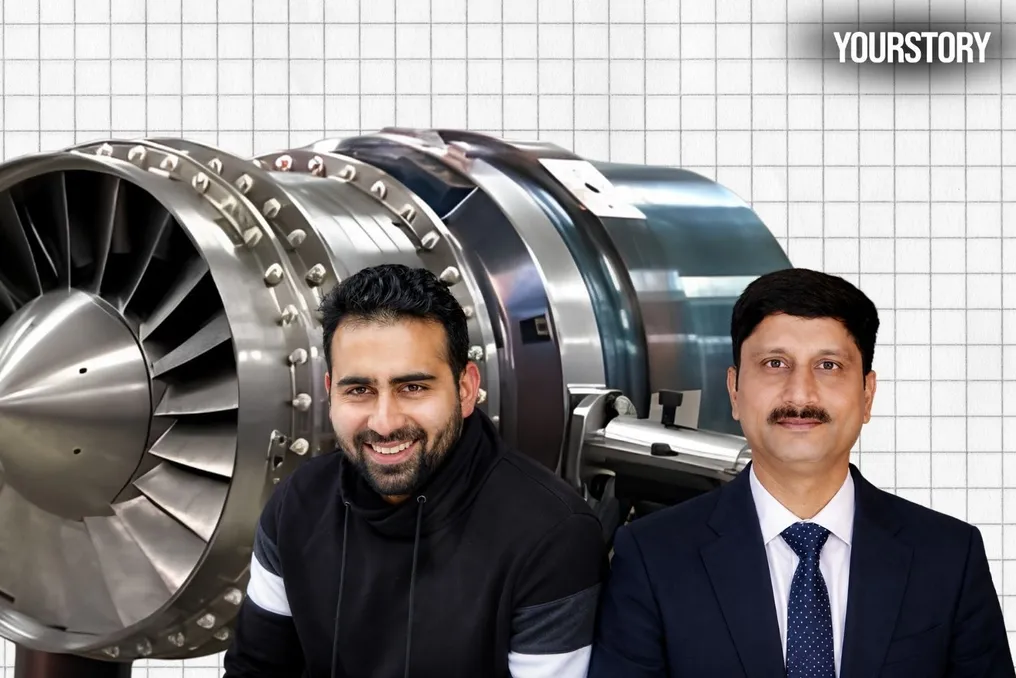
A jet engine is one of the few machines that are difficult to reverse engineer because the design itself is well-known. The complexity lies in metallurgy, tolerances, and manufacturing, which requires decades of accumulated experience. A high-speed unmanned aerial vehicle requires a compact turbojet engine, but Indian drone manufacturers were forced to purchase them abroad, leading to the need for export licenses, long waiting times, and dependence on suppliers.
DG Propulsion was founded in 2019 with the goal of producing such engines within India. Prituk Dhawan began working on microgas turbines during a student project, and later tested his first aircraft engine in 2018 while working at John Deere. He met Chirag Gupta, a former officer of the Indian Navy, who joined the company as a co-founder.
The engines are named after their thrust: DG J20, J40, and J60 produce thrust of 20, 40, and 60 kilograms-force, respectively. All of them have been designed and tested in-house and are intended for use in unmanned aerial vehicles and the defense sector.
Durability proved to be a serious test. The J40 model successfully passed continuous testing for one hour, which is a critical test for a microturbojet, distinguishing a working prototype from a mission-capable aircraft. At the end of 2024, the company conducted tests on a larger engine with a thrust of about 100 kilograms, or one kilonewton.
A more complex task is determining the proportion of engine components manufactured directly in India. Gupta stated that the current content of Indian components in the J40 is between 30% and 35%, and the company aims to increase this figure to over 90% with support from a Ministry of Defence grant. This demonstrates existing gaps in India's jet engine supply chain. The company has also developed an engine control system called DG AEMS and announced plans to transition from turbojets to turbofans, which are more efficient at transport flight speeds and on larger platforms. Plans were announced in June 2026 to create a 10 kilonewton engine, which is an order of magnitude greater than all previously tested models.
The most convincing confirmation of achievements was a recent flight. On August 11, 2026, Kawa UAV, based in Lucknow and operating under the brand name HoverIt, first launched its Divyastra Mk3 strike drone powered by a DG Propulsion turbojet engine. Both companies noted that this was the first Indian strike drone powered by an Indian engine.
Flying on another aircraft is more significant than static testing. Furthermore, it is the first public instance of integrating a DG Propulsion engine into a customer platform and subsequent takeoff. The company participated in the Aero India 2025 exhibition, where it signed an agreement with a state defense agency whose name was not disclosed. It also received support through the Ministry of Defence's innovation program iDEX, as well as grant funding for industrialization.
The company's ambitions extend beyond drones. It is developing jetpacks, jet speed vehicles, and air taxis in parallel with its engine work. This is a broad area of business for a company that has not disclosed information about external investors. Currently, data on funding rounds, revenue, order value, or production volume is not publicly available, nor has the existence of an external investor ever been announced.