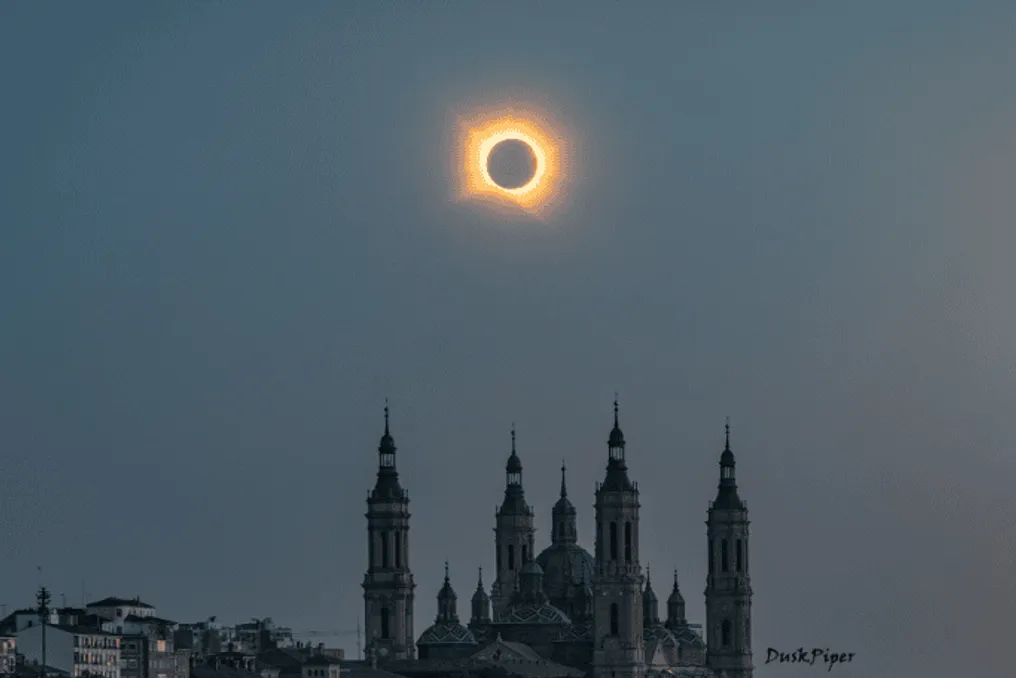
Few natural events generate such a profound sense of connection with the Universe as a total solar eclipse. Last Wednesday, the 12th, millions of individuals in Europe witnessed this phenomenon, as the Moon completely obscured the Sun in a path that crossed Iceland and Spain.
For brief moments, the appearance of the sky changed, allowing brighter stars to appear and revealing the delicate solar corona around the Moon. Although it is a spectacle of unusual beauty, eclipses also serve as a reminder of the importance of these events for advancing our knowledge of the Cosmos.
Eclipses have provided us with learning that goes beyond terrestrial and lunar movements; they have aided in measuring intercontinental distances, determining solar composition, and confirming Einstein's Theory of General Relativity, remaining a crucial tool for research on the solar corona even today. Furthermore, they have the potential to help us narrate our own history, enabling the reconstitution of events that occurred millennia ago.
For a historian, establishing the exact date of an ancient event can be considerably complex. For much of history, various global civilizations employed varied and creative methods to measure time. While some focused on lunar cycles, others monitored the annual movement of the Sun, and not all their units of time had the same duration.
Additionally, it was common practice to restart the count of years at the beginning of a new term of government. This resulted in records such as 'in the fourth year of Solomon's reign,' indicating a notion of time but without a specific date for a calendar. In some cultures, years were not even counted, receiving only a new name every New Year.
Given this disorganization, dating historical events would be almost unfeasible without the assistance of celestial bodies: eclipses.
An ancient Assyrian record, found on a clay tablet and deciphered only in the 19th century, mentioned: 'Bur-Sagale of Guzana. Revolt in the city of Assur. In the month of Simanu, a solar eclipse occurred.' In Assyrian tradition, each year was named in honor of a ruler or official appointed by the king. These events took place in the year of Bur-Sagale, in the region of Guzana. Simanu designated the third month of the Assyrian calendar, corresponding to the period between May and June currently. However, the key to precisely determining when the revolt in Assur occurred lay in the account of the eclipse.
With the progress of astronomy, notably after the formulation of Newton's laws of gravitation, it has become possible to mathematically understand the movements of the Earth and the Moon. Consequently, we have gained the ability to predict the occurrence of eclipses centuries in advance. Conversely, with increasingly refined models, it has become feasible to determine when and where ancient eclipses happened. Thus, in 1867, Henry Rawlinson identified the eclipse of June 15, 763 BC, as the most probable candidate for the phenomenon described in the ancient Assyrian writing.
In this way, the year of Bur-Sagale obtained an equivalent in our calendar and can function as a 'temporal anchor,' allowing the organization of the chronology of events recorded by the Assyrians of that time.
Another notable case is found in the work of the Greek historian Herodotus. He narrates that, during an intense battle, in the sixth year of the war between the Medes and Lydians, the day abruptly turned into night. This event is said to have caused both sides to stop fighting to seek peace. Herodotus also points out that the philosopher Thales of Miletus had anticipated the occurrence of this eclipse. Currently, it is known that this event can be related to the solar eclipse of May 28, 585 BC, providing a precise date to a historical account thanks to the accuracy of cosmic movements and science.
If simple accounts already demonstrate such scientific relevance, one must imagine the value of centuries of systematic and detailed observations of eclipses.
Chinese astronomers performed this exemplarily. Over hundreds of years, they documented eclipses, recording their dates, times, and places of observation. Although not all these records are entirely reliable, the collection is so vast that researchers have been able to compare it with contemporary astronomical calculations to investigate not only the history of China but also the history of our planet's rotation.
This occurs because the Earth does not have a perfectly uniform rotation. Its rotational speed varies subtly over time. By comparing the location and time when an eclipse should have been seen, according to our models, with what ancient observers noted, it is possible to estimate these variations. In other words, documents written centuries or millennia ago contain data on how our planet rotated during that period. Therefore, recent studies continue to use Chinese records to refine this reconstruction.
All this is possible thanks to the fascination that eclipses arouse in us. If today we seek to photograph and flood social networks with magnificent images of such a magical moment, thousands of years ago, our ancestors recorded their findings on papyrus and clay tablets, unaware that they were providing future generations with a reference capable of helping reconstruct their own time.
It is important to note that astronomy has not solved all historians' dilemmas. Many records have been lost, ancient accounts are ambiguous, and, in some cases, historical facts may be mixed with myths, fantastic interpretations, or legends. Not every eclipse cited in an ancient text can be identified with certainty.
However, it is precisely this characteristic that gives these records great value. When a past account can be confronted with the laws of physics, it transforms into a chronological reference of extreme precision for human history.
For these reasons, solar eclipses captivate and fascinate millions of people globally. They are extremely rare phenomena, of unparalleled beauty, lasting only a few minutes, but sufficient to teach us more about the Universe and aid in narrating our own trajectory.