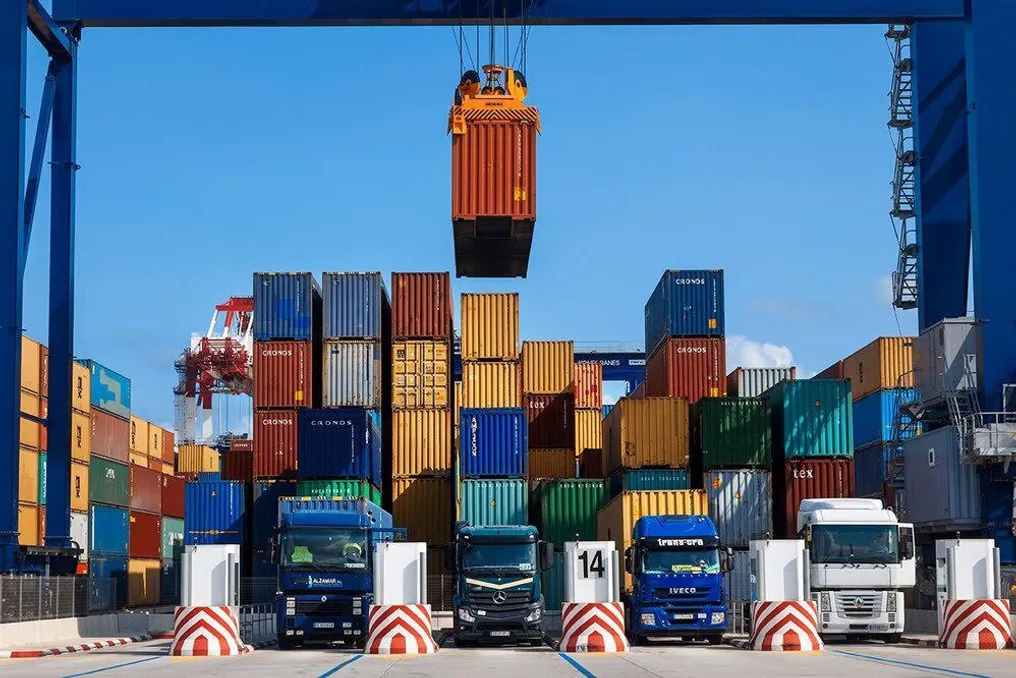
The head of the Iranian Customs Administration reported that the volume of non-raw material exports from the beginning of the current Iranian year (March 21) to August 16 reached nearly $15 billion. Meanwhile, imports amounted to $17 billion, but compared to the same period last year, there is an average decrease of 24 percent.
According to IRNA, Fouroud Asgari presented up-to-date information on the country's foreign trade at a meeting of the Tehran Chamber of Commerce Representatives Council last Tuesday. He noted that policies prioritizing goods paid for in foreign currency have been implemented in the import sector, leading to a reduction in the import of some secondary or non-essential items.
Asgari commented on the decline in mobile phone imports: if about 3,160,000 mobile phones were imported in the first five months of last year, this figure was 1 million devices this year, which represents a cost drop of approximately 70 percent.
The head of the Customs Administration emphasized that the Ministry of Industry, Mining, and Trade is currently focused on supplying raw materials to production enterprises, so the import policy is directed towards goods that directly participate in the production cycle.
Regarding car import statistics, he reported that 25,000 cars have been cleared so far, demonstrating a 67 percent increase compared to the same period last year.
Concerning the situation with essential goods in the country's ports, the head of the Customs Administration clarified that out of the total import volume of 39 million tons, about 9.5 million tons are essential goods, of which 4.5 million tons are currently in 13 ports. Of this amount, about 3 million tons of essential goods are stored in Imam Khomeini Port, and another about 1 million tons are in 12 other ports.
Asgari added that 145,000 tons of cargo are currently being unloaded, and about 500,000 tons are awaiting unloading at anchor. He stressed the need to accelerate port and customs operations to meet the country's needs in a timely manner, noting that Iranian Customs strives to ensure a smooth process for clearing essential and priority goods.
The head of the Customs Administration of the Islamic Republic of Iran, explaining the measures taken to facilitate foreign trade and reduce customs clearance barriers, announced the development and implementation of new packages in the customs sector, the extension of emergency permits until the end of September, and reforms aimed at speeding up the delivery of goods to production facilities.
Expressing gratitude to traders and sector participants working under difficult conditions, he stated that all emergency permits valid until June 14 were extended until the end of September with government approval.
Asgari explained that this includes various permits approved or issued in the form of customs packages from 65, 12, and 11 points, and economic operators can use these opportunities until the end of September. In recent months, efforts have been made to eliminate obstacles in foreign trade and goods clearance by utilizing legal possibilities and obtaining permits from competent authorities so that goods can enter the production and consumer cycles faster.
He continued that good understanding and cooperation have been observed in this process between the bodies responsible for issuing permits, including the National Standards Organization, the Ministry of Health, the quarantine sector, environmental protection agencies, and other structures, and such coordination has helped resolve some administrative bottlenecks in the goods clearance process.
The head of the Iranian Customs Administration, mentioning difficulties arising from procedures, legal requirements, and systems, stated that when existing formalities led to delays in the trade process, they tried to propose operational solutions to overcome these obstacles, obtaining permissions from higher authorities, including regarding tracking codes, goods valuation, tariffs, order registration, and other issues faced by economic operators in the systems.
Asgari stated that as part of this work, 6,300 cars were released from customs without tracking codes after receiving the necessary permits from the Supreme National Security Council and the Central Bank, allowing these vehicles to be cleared.
Furthermore, in some cases, due to special circumstances, the necessary permits were obtained to release goods from various regions and entry points, and these measures have generally contributed to optimizing certain commercial processes.
Formulating the proposed customs package before the crisis
The head of the Iranian Customs Administration noted that customs authorities anticipated the possibility of crisis conditions and their impact on trade. Accordingly, a set of proposals and solutions was prepared in the form of an expert package to identify potential obstacles in foreign trade and goods clearance and to take measures to eliminate them.
He added that this package was compiled and submitted to the relevant officials for review and decision-making. Its text was also sent to several private sector representatives and activists, including officials from the Chamber of Commerce, to keep them informed about the customs direction to support trade.
According to him, these proposals include about 30 provisions, most of which concern the government and are scheduled for consideration at the Economic Commission meeting. The goal is for goods to reach factories, production sites, or consumption points as quickly as possible, preventing unnecessary stoppages, increased costs, and accumulation at entry points.
The head of the Customs Administration emphasized that one of the key areas of this package is the principle of continuous movement of goods at borders, stating that only primary checks, such as quarantine, medical, and environmental inspections, are conducted at the border, while other permits and additional procedures can be carried out later, without undue delay to the goods.
He noted that numerous meetings have taken place with officials from relevant departments, including standards and health, and the necessary approvals have been arranged. In Asgari's opinion, if this bill is approved and goes through the legal procedure, there will be a significant transformation in the goods clearance process.
Asgari pointed out one of the important problems at the country's entry points: one reason for stopping goods is the multiple sampling by various agencies. Therefore, it was proposed to establish a specific timeframe for sampling, and samples taken at the border should be tested during the transit period or at the destination.
He explained that if goods enter the country and are destined for transit, for example, in Isfahan, tests related to the taken sample must be conducted during transportation. If the relevant authority does not conduct the test or report the result within the specified time, the goods should not remain at the border for long. In some cases, it was also proposed to transfer goods to the owner's warehouse with the obligation not to consume them, in order to reduce storage and waiting costs, and to maintain oversight by responsible authorities.
The Deputy Minister of Economy also suggested that for goods such as wheat and similar items requiring the involvement of several agencies, instead of each agency taking separate samples, a single sampling should be conducted at the moment the ship or truck arrives at the border, and the result should be available to all relevant agencies.
Regarding goods subject to sanitary and special storage conditions, he noted that some goods left in public warehouses or unsuitable environments may deteriorate in quality or spoil. Therefore, it was proposed to store such goods in refrigerated chambers or in the owner's warehouse under the supervision of the authorized body until formalities are completed. This measure helps preserve the quality of the goods and prevents additional costs from being imposed on the economic operator.
Asgari raised another important issue for economic operators: one of the problems that has always caused difficulty for traders is the priority of order registration over goods arrival. Although the speed of importing goods into the country and logistics processes often outpace administrative bureaucracy, it is possible that goods have entered the free zone, port, or border, but the order registration process is not yet complete.
He added that their proposal is that if goods have entered the country, and the order registration was done after entry, the clearance should be possible provided the necessary rules and controls are met. The Head of Customs noted that this issue is particularly important for goods requiring further verification of value, year of manufacture, or specific characteristics, and it could solve some administrative problems.
The head of the Iranian Customs Administration also announced a proposal of three important directions in the Economic Commission: one is import without foreign currency conversion, the second is supplies using one's own foreign currency, and the third is import in exchange for export.
He noted that in some cases, the requirement to obtain a source code or bank tracking codes delays the trade process. Therefore, proposals beyond existing procedures have been put forward, and decisions on them should be made with the participation of relevant bodies, including the Central Bank. In the import sector without foreign currency conversion and some similar methods, the Ministry of Industry, Mining, and Trade has also provided assistance, and this issue is being reviewed with proposals from relevant officials to ultimately make a feasible and reliable decision for economic operators.