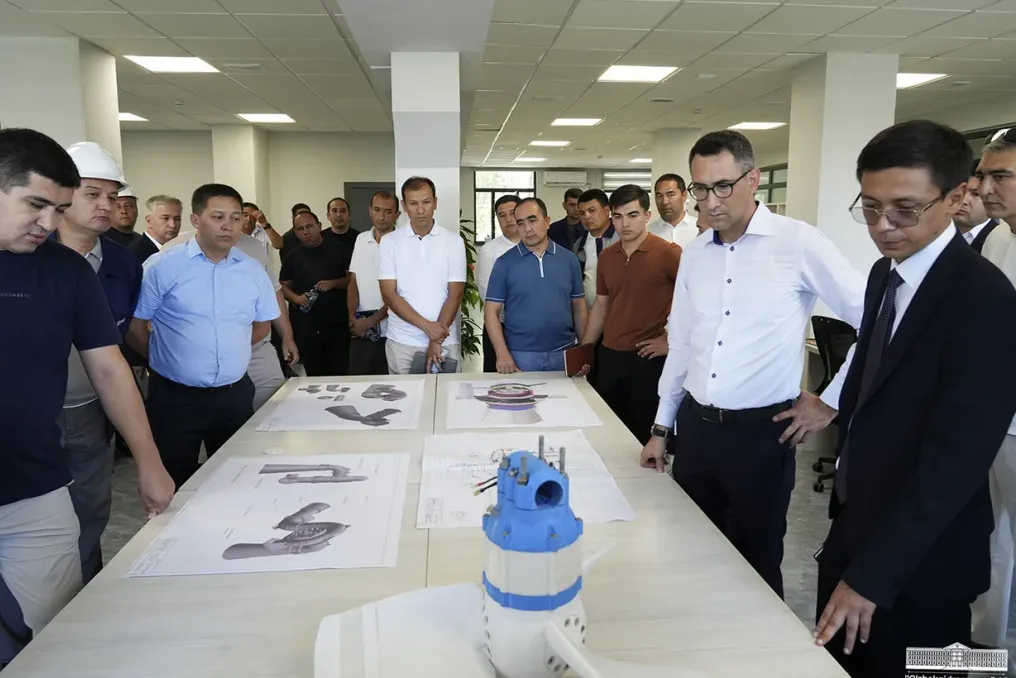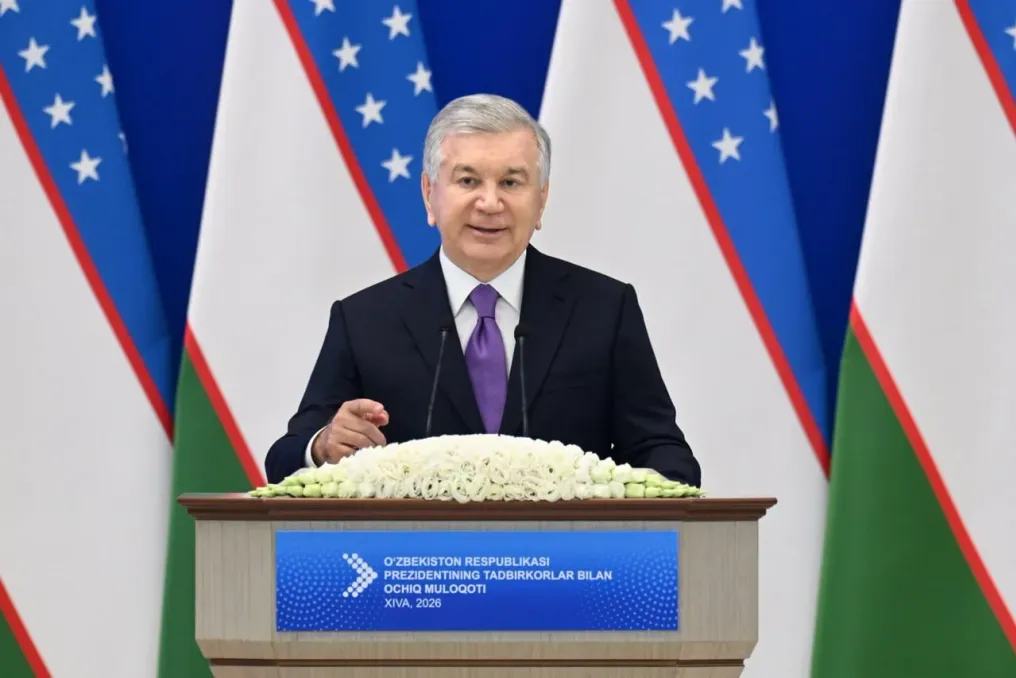
President Shavkat Mirziyoyev organized an open dialogue with businessmen in the Khorezm region. This event gathered about 25,000 business owners for the first time, who participated via studios at the district level. The President congratulated the country's business community, which now numbers 1.2 million entrepreneurs, on Entrepreneur Day, marking the fifth anniversary of the open dialogue tradition, during which 84 laws, as well as 861 decrees and resolutions, were adopted to remove obstacles to business development.
Mirziyoyev emphasized the goal of these measures: 'To create conditions for our entrepreneurs, increase the number of new jobs, and give our people the opportunity to earn income without having to travel far from home, right in their mahalla.' Over the past five years, the credit portfolio allocated to businesses has almost tripled, reaching 450 trillion soums, and entrepreneurs have received tax and customs benefits totaling 650 trillion soums. Business representatives independently attracted $1 billion from foreign banks to finance their projects, which the president called another milestone for Uzbek entrepreneurs. He noted that today entrepreneurs are transitioning from the 'start-up phase' to the 'capital accumulation phase.'
Investment by enterprises in fixed assets has tripled over five years, amounting to 363 trillion soums. The number of districts where industrial output exceeds $100 million has increased from 66 to 116, and the number of districts where services exceed 1 trillion soums has grown from 41 to 152. This growth is due to the rapid development of the information technology, fintech, and other service sectors; now 3,500 enterprises work with leading international trading platforms. More than 550 entrepreneurs who started businesses in their mahallas have opened dozens of branches across the country, and more than 300 entrepreneurs have created their own national brands.
In recent years, the supply of copper, gold, profiled metal, polyethylene, PVC, kaolin, and other raw materials has increased, triggering a significant leap in industries such as electrical engineering, building materials, pharmaceuticals, textile production, and furniture manufacturing. New sectors have emerged, including electric vehicle production, polymers and household chemicals, green energy, and jewelry, with modern car manufacturers like BYD, ADM Jizzakh, and Sirdaryo Asaka Motors bringing new experience and technologies to the industry.
Mirziyoyev also noted that completely new opportunities for entrepreneurship have appeared in Khorezm recently. The region has attracted $4 billion in foreign investment and launched 10,000 new production facilities in a short time. The Khazarasp Special Economic Zone and 31 industrial zone have been established, and power plants with a total capacity of 275 megawatts have been built in Toprokkala and Yangiarik to ensure stable energy supply to enterprises. Small businesses now account for 72% of Khorezm's economy, and their share of exports has reached 81%, placing the region first in the country. The number of weekly flights has increased from 16 to 102, and weekly rail transport from 8 to 41.
The Tashkent–Khiva high-speed train has been launched, and a new 35-kilometer Urgench–Khiva highway is being commissioned. A 25-hectare tourist complex, 'Arda Khiva,' has been built, and entrepreneurs have organized 331 hotels and guesthouses with a total capacity of 7,000 places; it is expected that 3 million foreign tourists will visit Khorezm this year. The 'Desert Star' tourist complex, including a hotel, retail, and entertainment facilities, will also be built in Khiva. The President concluded: 'In short, Khorezm is becoming a center of new opportunities for entrepreneurs today.'
Despite the difficult global situation, Uzbekistan's economy grew by 8.5% in the first half of the year, and international rating agencies Fitch and Moody's upgraded the country's sovereign credit rating by one step. Uzbekistan ranked 31st in the World Bank's report on investment and business climate, results the president attributed mainly to reforms conducted jointly with entrepreneurs.
This year, institutional reforms were carried out in public administration, procurement, standardization, food security, and urbanization. Under the 'National Industrial Chain' project, private enterprises received orders worth 4 trillion soums from large state companies. Strategic enterprises published a list of over 650 new products for localized production, creating an additional market worth $1 billion for entrepreneurs. The threshold for VAT payment was raised from 1 billion to 5 billion soums. Cafes and restaurants received 100 billion soums in VAT refunds, while farmers saved 400 billion soums through the introduction of a zero VAT rate on agricultural products. Kazakhstan lifted restrictions on the import of 11 types of construction materials, a regime of mutual duty-free trade with Turkmenistan was launched, and preferential trade agreements covering hundreds of products were signed with Jordan, Pakistan, Iran, and Afghanistan.
Large projects aimed at significantly stimulating economic growth are also being implemented, including a nuclear power plant in the Jizzakh region, the fourth copper processing shop in Almalyk, and modern highways connecting Tashkent with Samarkand and Tashkent with Andijan. Khorezm is building a complex for producing environmentally friendly aviation fuel, a modern greenhouse complex of 940 hectares is being built in Surkhandarya region, and the 'New Tashkent' airport is under construction in the Yukorichirk district. This year, 105 new industrial and infrastructure projects totaling $27 billion are planned. New residential areas designed to accommodate 3 million people are being built across the country, and local entrepreneurs wishing to participate in such projects with their goods and services will receive equal conditions to foreign investors.
In transport logistics, customs duties and processing fees on imported trucks have been abolished, and the VAT rate for providing wagons for international transport will be reduced to zero. Next year, a logistics center with a capacity of 500,000 tons will open in the Port of Poti (Georgia), and practical work will begin on the Anaklia port project; major transport and logistics centers will be created in Alata, Termez, Yangiyul, Akhangaran, and Khanabad. Next year, the Tashkent International Financial Center and the 'Enterprise Uzbekistan' international digital technology center are also expected to launch, which are expected to open opportunities to attract $20–25 billion in capital along with new knowledge and technologies.
The President announced a number of new initiatives developed in response to problems raised by entrepreneurs, grouped around five priority areas. The first area is ensuring a sustainable trajectory for entrepreneurship growth. The share of small businesses in bank credit portfolios has increased from 45% to 63%, and only in the first half of this year, 76.5 trillion soums in resources were allocated to small and medium-sized enterprises. Recently, the 'unified portal of digital credit services' was launched, through which an entrepreneur submits one application, and banks compete for the client; start-up entrepreneurs will be able to receive online loans of up to 5 billion soums. A comprehensive ecosystem will be built to support every stage of business development: the 'Business Start' program for beginners, 'Business Lift' for those who have launched production, and 'Business Ascent' for entrepreneurs moving to a new stage of growth. Within 'Business Start', entrepreneurs will be able to use artificial intelligence to study project development, prepare credit documentation, and reporting; 100 billion soums will be allocated for these purposes, and entrepreneurs will be provided with ready-made business plans and unsecured loans of up to 200 million soums. Mirziyoyev stated: 'We will create not a system that simply issues a loan to an entrepreneur, but a comprehensive system that will accompany them from the first step to becoming a large business.'
To solve the issue of collateral, one of the most acute problems for small businesses, a 'counter-guarantee' system will be introduced, allowing loans to be issued based on the assessment of the real value of the business. For loans up to 10 billion soums, the state will take on 30% of the collateral, the Entrepreneurship Guarantee Company will take another 30%, and banks will take 15%, leaving the entrepreneur to provide the remaining 25%. The AI portal 'Virtual Tax Consultant' has been launched, which helps entrepreneurs reduce costs and minimize errors, and similar AI assistants will be introduced next year in the fields of construction, labor relations, foreign trade, and public services.
The second area is expanding 'business opportunities' in the regions. The President emphasized that thousands of hectares of free land and underutilized state assets only bring real value when they are transformed into projects that generate jobs and stimulate exports. When purchasing state assets, the down payment will be reduced from 30% to 15%, with a 25% discount for those who pay in full within six months; an entrepreneur who pays half the cost can repay the remainder in interest-free installments over seven years. If state property is not sold within three months, its starting price will be gradually reduced to 10%, and the auction process period will be halved. Buyers of land at auction will no longer have to spend half a year to a year collecting documents before starting construction, as local authorities (hokimiyats) now put land plots up for auction as a 'ready package,' including a construction permit, architectural and planning assignment, and a project; the buyer can start construction immediately. The advance payment for infrastructure fees has been reduced from 20% to 5%. The sale of 2,500 real estate objects with a total book value of 9 trillion soums held on banks' balance sheets will be permitted at preferential prices, without a down payment, and with interest-free installments, and buyers of such objects will be exempt from land and property tax for one year.
A list of 50 priority goods for localization of production has been compiled, and 'border industrial zones' will be created in the special economic zones of Navoi, Jizzakh, Namangan, Urgut, and Khazarasp for their development. The import of raw materials and components into these zones will be exempt from all taxes and customs duties, and preferential conditions will also apply once the localization levels for goods sold domestically exceed 30–40%. Unified chains of modern research centers, laboratories, and engineering and technological services will operate in the border industrial zones, and $50 million will be allocated for providing entrepreneurs with ready-made buildings equipped with the necessary infrastructure. In response to complaints that a 100% advance payment for electricity and gas strains working capital, enterprises connected to the ASKUE and ASKUG metering systems and without records of payment violations will now face an advance payment of only 15%. Mirziyoyev stated: 'Overall, we are fundamentally changing the energy management system. A new system focused on the current needs and future plans of entrepreneurs will be introduced in all districts.'
Starting next year, a new approach will be introduced in construction to encourage contractors and designers: regardless of the construction site, an amount equal to 5% of the minimum wage will be allocated for every worked man-hour. State construction estimates will guarantee contracting organizations a 7% profit margin, and 4% to 7% of the object's cost will be allocated for design, depending on the complexity of the construction.