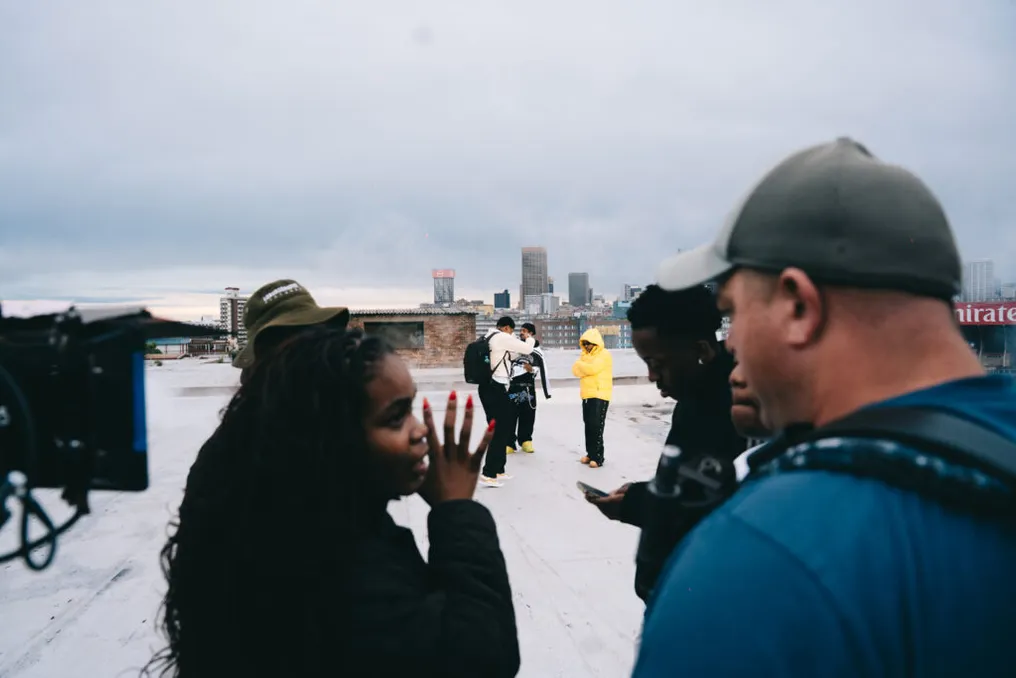
Renae Mangen shared her thoughts on her latest film, 'Colour Me Blue,' touching upon themes of vulnerability, mental health, friendship, and the significance of audience trust in unfinished narratives. She emphasized that 'every story and every person deserves to be seen.'
Throughout her career, Mangen has focused on the questions of who has the right to tell the stories of the Black community and how that should be done. As a graduate of a film and television school, she became a filmmaker, producer, and creative strategist. She is the founder of iQHAWE Magazine and currently serves as the Managing Director of iQHAWE Media, a creative agency working in campaigns and publishing.
Her documentary, Sonder, won the 'Best South African Short Documentary' award at the Encounters South African International Documentary Film Festival in 2026, and her short film Potlako has been screened at festivals across Africa and beyond.
Her newest project, the narrative series 'Colour Me Blue,' is in development with support from Yellow Rose Productions and written by Karabo Mokoena. The plot revolves around a group of friends reuniting after a tragedy, using this meeting to explore a topic insufficiently discussed in South Africa: the silent burden of mental health and emotional isolation among youth. The conceptual proofing is complete and is currently being shown to focus groups as part of the development process, which is a small but deliberate first step toward a full series.
After one of the screenings, we spoke with Mangen about restraint as a narrative tool, the discomfort of showing unfinished work, and what she hopes viewers will take away after the credits roll. When your films prompt viewers to look beyond the obvious, how do you decide what to reveal and what to intentionally leave unsaid?
Mangen explained that she has always been drawn to films that trust their audience. She dislikes work that tries to over-explain every emotion or detail every element on screen. As a director, it was important for her to approach 'Colour Me Blue' with this same philosophy. She wanted to create a space where people could bring their own experiences, emotions, and interpretations into the story. Sometimes what remains unsaid can be as powerful as what is spoken. By leaving certain moments open, she allows the audience to actively participate in shaping the story, imagining, questioning, and continuing to think about the characters long after the final credits. For her, this is where the most significant conversations begin.
Many of her stories tackle emotionally complex themes without trying to fully resolve them. What attracts you to this type of storytelling as a filmmaker? Frankly, she believes she doesn't consciously seek out such stories; rather, they find her. She is interested in people, and people are rarely simple. Life does not always offer perfect endings or clear answers, so she feels no need to impose that in her work. She is more interested in exploring the tangled, uncomfortable, and deeply human spheres that we often avoid discussing. She believes that allowing characters to exist in this uncertainty is incredibly honest, as that is often where we find ourselves in real life. She noted that Karabo's involvement in this process was phenomenal, as it created a space where they could support each other and bring it to life.
'Colour Me Blue' is described as an invitation to become part of the story before the world sees it. What prompted you to embrace the vulnerability of showing a concept instead of waiting for a finished series? Admitting that vulnerability has never been natural for her, she shared that presenting the concept before completion felt extremely exposed, as it meant inviting people into something developing. The role of a director forced her to confront parts of herself she wasn't always ready to share, which was difficult. There were moments of doubt about her own sufficiency or readiness to present the work. However, in the process, she realized that vulnerability isn't about having everything figured out, but about allowing yourself to be seen despite the uncertainty. Looking back, it was a deeply reflective experience that reminded her why she initially wanted to tell this story. But, she said, without Karabo Mokoena, the creative producer who trusted her with this work, she doubted she could have trusted herself.
The series explores mental health issues but also touches on community, relationships, and the burdens people carry in private life. What conversations did you hope to spark beyond the theme of mental health? Primarily, she hopes 'Colour Me Blue' will create a space for honest and compassionate conversations. Mangen believes that mental health is not a universal experience, and sometimes people fall into the trap of trying to apply one solution or one narrative to everyone. The series acknowledges that every person's path is unique, shaped by their relationships, communities, life experiences, and what they quietly carry every day. She hopes viewers will leave with greater empathy, not only for themselves but for others, and with a deeper understanding that healing can look different for everyone.
As both a director and a producer, how do these two roles clash? Are there times when the producer in you has to negotiate with the director? She jokes that her dual nature makes switching between roles easier. The producer constantly thinks about budgets, deadlines, logistics, and feasibility, while the director dreams without limits. These two parts truly communicate, sometimes even argue, but she finds it beneficial. The producer helps ground her creative ideas in reality, while the director reminds her not to lose sight of the vision. Finding this balance has been one of the most rewarding parts of the process.
By founding iQHAWE Media, she continued to direct her own creations. What gaps in the industry did she hope to fill by creating her own platform? She wanted to create the platform she lacked at the beginning of her journey. Access to funding, mentorship, industry networks, and opportunities often determines who gets to tell their story, and too many talented young creators remain outside these discussions. Through iQHAWE Media, she aims to open more pathways for emerging filmmakers and storytellers, reminding them that their voices matter. She wants people to feel that their stories are worth telling, regardless of their background or how unusual those stories might seem.