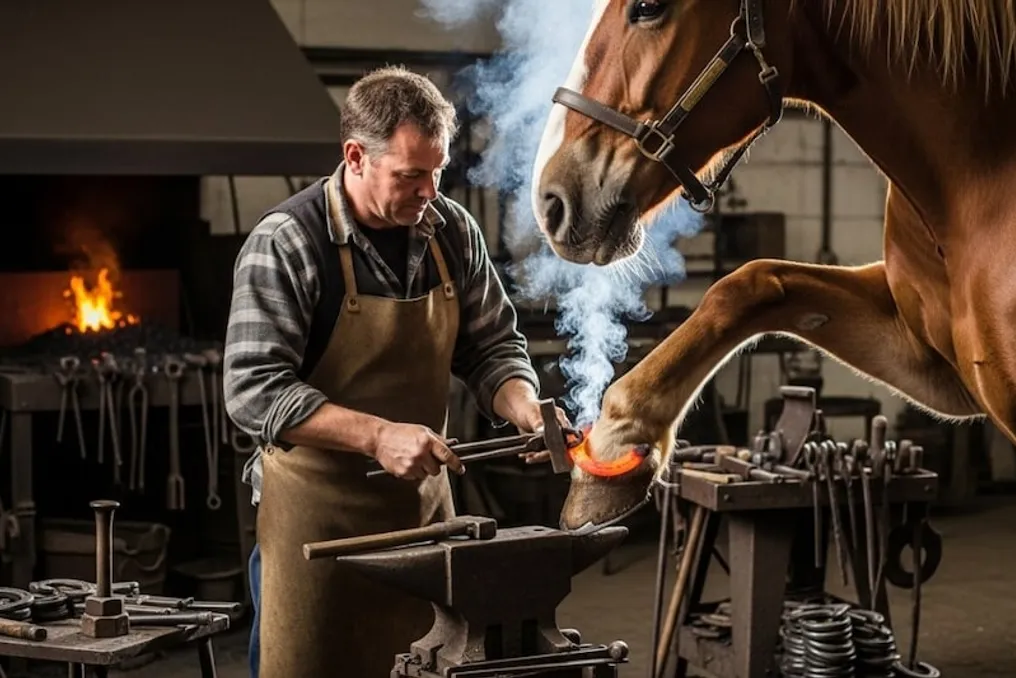
The use of horseshoes on horses is a practice that has existed for millennia. The tradition of putting horseshoes on horses began in Western Europe around 1000 AD, which was likely related to the local climate and the impact on animal hooves.
There are several ways to put horseshoes on a horse. The decision of whether or not to use horseshoes or keep the horse barefoot can be complex, as both options have their own advantages and disadvantages. The need for horseshoes depends on hoof health, workload, riding discipline, and even the horse's habitat.
Applying horseshoes serves as a therapeutic measure for the hooves and the overall health of the horse. Shoes protect the hooves from injuries such as abrasion, cracks, or stones getting in. This helps maintain the animal's health and reduces hoof pain compared to barefoot horses.
Furthermore, horseshoes provide better grip on various surfaces compared to bare hooves. This helps horses move better over rough terrain, snow, or mud.
A person who installs horseshoes on horses is called a farrier. A farrier performs hoof care and horseshoe installation in a very organized and scientific manner, similar to a blacksmith.
The process of shoeing differs. One method is hot shoeing. Before installing the shoe, the hoof is heated with a hot iron. Then the shoe is placed on it. The process is called 'hot fitting,' where the heated iron is lightly applied to the horse's hoof to avoid pain, as the outer part of the hoof is sensitive, similar to human nails.
A hot shoe leaves a light mark on the hoof, allowing the blacksmith to determine if the shoe size matches the hoof size. After this, the shoe is heated in an oven until red-hot, and then shaped precisely to fit the horse's hoof using a hammer. This ensures a complete and strong fit of the shoe to the hoof, preventing moisture and microbes from entering, sealing the outer part of the hoof.
The second method is cold shoeing. In this case, a ready-made shoe is installed with minimal changes without prior heating. In this instance, the shoe is fastened to the hoof using nails.