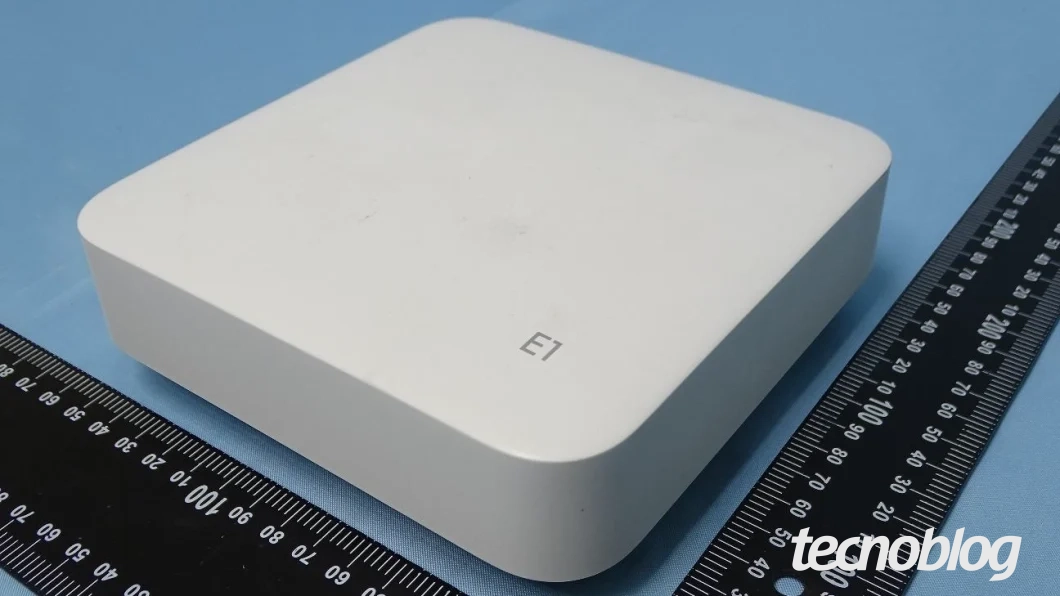
The Amazon Leo satellite internet service is nearing its commercial launch in Brazil: the router to be used by customers received certification from Anatel on Friday (08/14).
This certification was obtained in time, as the commercial start is scheduled to take place in Brazil before the 29th of this month, unless the company requests a new extension from Anatel. Previously, the service underwent testing in two Brazilian cities last year.
The device has model L1LA10 and supports Zigbee, Bluetooth LE (likely for app communication), and dual-band Wi-Fi 6. Three ports are located on the back panel: one RJ45 for connecting to the satellite antenna, a second RJ45 for wired internet access, and a C6 input for power connection.
According to FCC (Federal Communications Commission of the USA) certification photos, the L1LA10 measures about 17 centimeters in width and depth, making it quite large for a router. It is also quite heavy, as almost half of the internal volume is occupied by a 140W power supply unit, and the internal structure is made of metal.
The equipment uses various chips from Qualcomm: QCA8081 for Ethernet ports, QCN6112 as the 5 GHz radio, and the IPQ5018 SoC, which is the product's 'brain' and contains two ARM Cortex-A53 cores.
Certification of the antenna, which Amazon calls ODU in its documentation, has not yet been completed, and the company does not disclose the meaning of this abbreviation.
Amazon Leo is entering a market that is set to become more competitive. Currently, Starlink virtually dominates the low Earth orbit (LEO) satellite internet segment, especially for private individuals, although Eutelsat OneWeb also provides its services in Brazil, but only for corporate clients. The Chinese company SpaceSail has also received permission to operate in the country, which is expected before 2028.
Starlink holds a leading position in the Brazilian satellite internet market, possessing the largest customer base in this segment and being the 12th fixed broadband provider in the country. Soon, the company also plans to offer direct services for smartphones in remote areas in partnership with Vivo.
This is another market segment where Amazon intends to compete. To achieve this, the company acquired Globalstar for US$11.5 billion (about 57 billion Brazilian reais), gaining access to an existing constellation of satellites, as well as existing spectrum and usage rights.
Fixed satellite broadband services in Brazil will be sold through Sky, as both companies signed a corresponding agreement back in 2024.