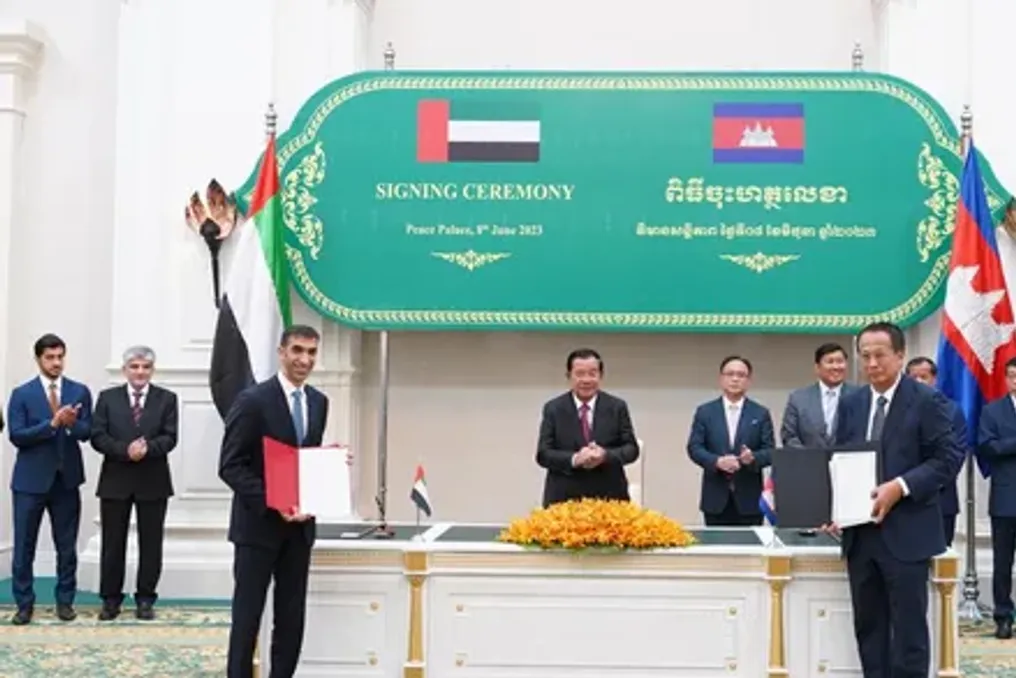
Five years ago, the United Arab Emirates decided not to wait for the results of the multilateral trading system but to create its own. The first step was the launch of the Comprehensive Economic Partnership Agreement (CEPA) program in September 2021. Subsequent actions marked one of the most active campaigns in trade diplomacy over the last decade.
By mid-2026, the UAE had concluded 37 CEPA agreements, a number later updated to 38; 18 of these have already entered into force, with several others scheduled for activation in the coming months. The geography of these agreements demonstrates wide coverage: they stretch from India to Indonesia, from Kenya to Chile, and also from Ukraine to Malaysia, forming a trade network that covers almost all major regions of the global economy.
The figures resulting from this program are impressive. In the first half of 2026, the volume of non-resource foreign trade turnover in the UAE reached approximately $527.4 billion, and non-resource exports amounted to about $123.2 billion. Notably, non-resource exports increased by more than 45% in 2025 alone, highlighting the UAE's commitment to linking its trade agreements with the expansion of production capacities in the industrial sector. These indicators reflect a targeted policy of using market access as a lever to enhance the internal value chain.
The CEPA agreements are part of a broader strategy aimed at strengthening the UAE's position in global trade and supply chains. The Emirates leverage their developed logistics infrastructure, ports, free zones, and the ability to connect Asian, African, and European markets. Dubai and Abu Dhabi position themselves as an indispensable hub between hemispheres, through which goods, capital, and services move between the Global South and the industrialized world.
The partnership with India serves as the most obvious confirmation of this concept. The CEPA agreement between the UAE and India has significantly promoted trade development: bilateral exchange grew from $73 billion to $84 billion annually, representing a 16% increase. In the first half of 2026 alone, non-resource trade between the two countries reached approximately $29.3 billion. What started as a bold experiment has turned into a model to be emulated, and now the question is the speed at which the UAE can replicate this model.
The most significant example of replicating this model is Africa. In 2026, the UAE's CEPA program in Africa ceased to be merely a headline of trade policy; it is becoming a practical tool for changing economic relations, deepening supply chains, and establishing long-term investment pathways in strategic sectors, including logistics, agriculture, aviation, clean energy, and services.
Kenya, whose parliament ratified the CEPA agreement, is viewed as a serious economic instrument, not just a symbolic handshake. Kenya's strategic value lies in its role as a regional logistics and aviation hub, a major service economy in East Africa, and a gateway to wider regional markets. The Gulfood360 Africa platform, based on the CEPA agreement between Kenya and the UAE, aims to directly connect Kenyan and African food producers with global buyers, indicating that the agreement is already creating a commercial architecture, not just a political arrangement.
This approach reflects a conscious effort to avoid excessive dependence on a small number of trading partners by concluding agreements with large consumer markets, production centers, agricultural exporters, and developing economies. In July 2026, the UAE and Canada concluded negotiations in record time under the program, with bilateral trade between the two countries reaching approximately $4.2 billion in 2025, representing a 21% increase compared to 2024.
Not everyone welcomes this trend without reservations. Analysts note that African governments must approach these agreements with clear industrial strategies. As one industry leader quoted in a recent assessment of investment dynamics in the Persian Gulf and Africa region stated, there is a risk that these agreements will turn into import-export platforms rather than genuine catalysts for industrialization, with African raw materials continuing to be processed elsewhere.
This tension is the central issue hidden beneath the impressive figures. The UAE built this machine. A more important question for Africa, Asia, and the small economies joining the network is whether preferential access will lead to productive potential or simply change the direction of dependency. The answer will be written not in the text of the agreements, but on the factories, logistics corridors, and value chains that arise from them or fail to arise.