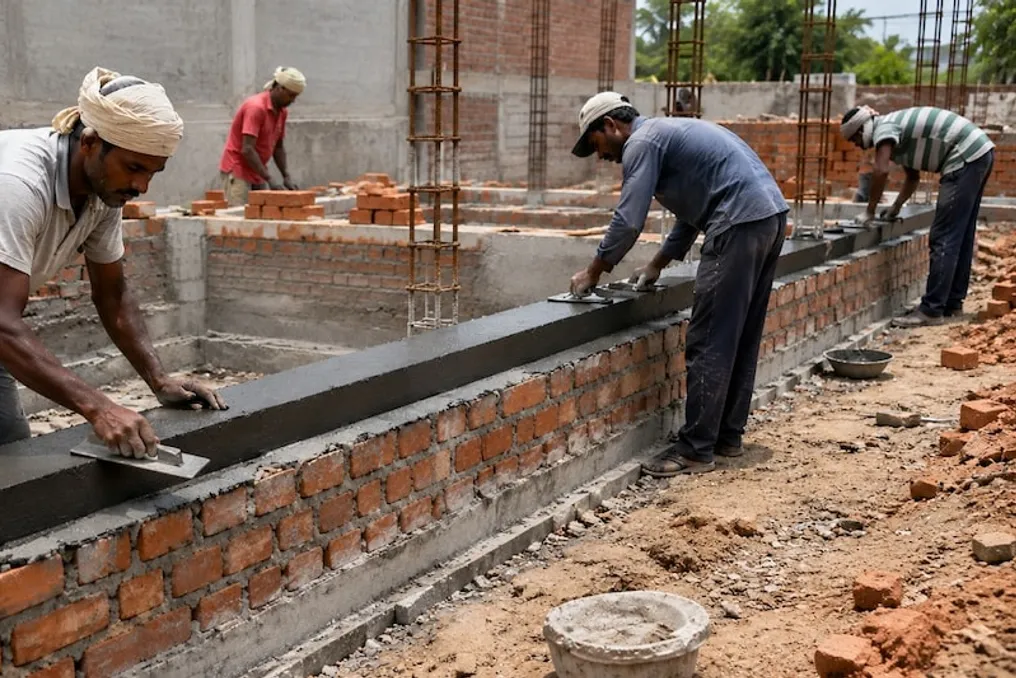
What is DPC and how does it help prevent dampness in a house
Read more
Aaj Tak
www.aajtak.in

What is DPC and how does it help prevent dampness in a house

The construction of a house involves many stages, and each level has its advantages. Skipping any of these stages can lead to serious consequences. One such critically important element is the DPC.

Everyone knows about reinforced concrete structures (RCC), but many do not know what DPC is or what benefits it brings. This article examines exactly these aspects.

Building a home is a long process that requires careful preparation, including choosing a design, construction methods, and building materials. At the same time, it is necessary to observe a number of precautions so that the budget does not get out of control, while avoiding the use of overly expensive solutions.

Nevertheless, there are basic methods for protecting house walls from moisture that must be applied. One such measure in construction is the DPC. DPC stands for Damp-Proof Course.

This layer must be installed after erecting the wall at a certain height above the surface where the foundation is laid. The DPC is applied at the level of the plinth. The plinth is the floor height relative to the ground.

A thin layer of concrete is applied to the bricks at the plinth level. This concrete is made from fine gravel or bitumen, as well as waterproof chemical additives and cement. After applying the DPC at the plinth level, the wall is erected.

DPC means moisture-resistant concrete and is similar to PCC. It is usually placed below the plinth level of the building or structure. The thickness of this layer is about 50 mm, and it is located at a distance of approximately one foot from the ground or according to the structure's design.

As the name suggests, its main task is to protect walls and floors from moisture penetration. DPC has several advantages: it prevents moisture from the ground from entering the walls, and it also prevents its appearance in the floor. Thanks to this, dampness does not appear in houses with an installed DPC. After its installation, problems such as mold, wall peeling, and fungus can be eliminated.

Similar stories

Opposition Disagreements on FCRA Bill: Congress Demands Repeal, TMC and DMK Insist on JPC
Read more
www.aajtak.in

Opposition Disagreements on FCRA Bill: Congress Demands Repeal, TMC and DMK Insist on JPC

There is no unified position among opposition parties regarding amendments to the FCRA law. While Congress advocates for the complete repeal of the bill, the TMC, DMK, and BJD parties demand that it be sent to the Joint Parliamentary Committee (JPC). The government is also considering the option of referring the bill to the JPC.

Congress's stance on the FCRA law is the most stringent, as the party insists on its withdrawal. During discussions among opposition forces, many different opinions were expressed regarding this bill. Meanwhile, the government is attempting to negotiate with opposition parties to reach an agreement on proceeding through the JPC.

The TMC party had previously stated its intention to send the bill to the JPC within the Rajya Sabha Business Advisory Committee, although later a demand for the law's withdrawal was also received from this party. The DMK asserts that the law must either be withdrawn or referred to the JPC for detailed investigation. The BJD party has also put forward a demand to include the bill in the JPC.

Supriya Sule, Executive Chairman of NCP (SP), also appealed to the center to withdraw the law or refer it to the JPC. She emphasized that foreign funding cannot always be viewed through the lens of suspicion.

The amendment to the FCRA law was presented in Lok Sabha on March 25, 2026. Its progress was subsequently suspended due to objections from various parties. The bill proposes a new system for managing and supervising the assets of organizations whose FCRA registration has expired and which receive foreign contributions.

At the BAC meeting on Monday, the FCRA law and the proposed redistribution bill were not included in the agenda. Consequently, the government now has the opportunity to use the JPC option to achieve consensus with the opposition and further advance the bill. However, due to disagreements among opposition parties regarding this law, the future situation remains undetermined.

Popular