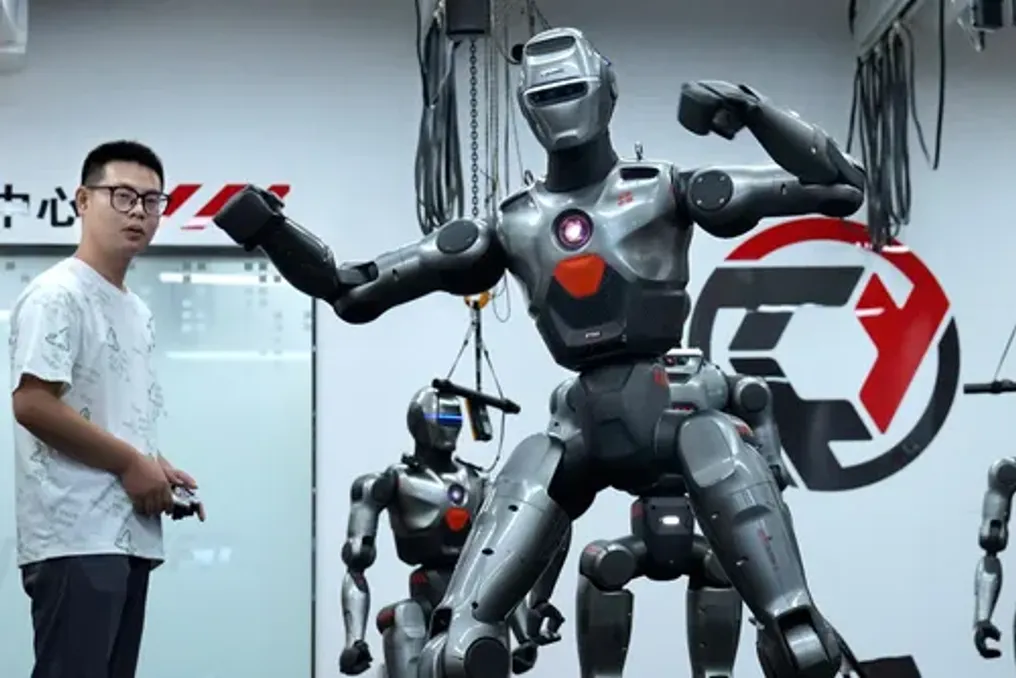
The rapid development of robotics in China is transforming not only its own industry but also opening critically important opportunities for African countries, especially in sectors such as agriculture, healthcare, and mining.
China's rise as a technological power in robotics goes beyond laboratory demonstrations and has become a key element of national industrial strategy with far-reaching consequences. A recent seminar on 'Digital Transformation of Manufacturing,' organized by the Zhejiang Provincial Chamber of Commerce through the BRICS Special Economic Zones Secretariat, demonstrated how robotics, artificial intelligence, and industrial digitalization are integrated into overall state policy to enhance industrial competitiveness.
For Africa, particularly South Africa, Chinese achievements in robotics can help solve chronic problems in manufacturing, medicine, agriculture, mineral extraction, and skills development. However, this opportunity will be missed if African states become passive consumers of imported equipment instead of actively participating in the industries, knowledge systems, and regulatory frameworks that robotics creates.
The scale of China's progress is significant. According to the International Federation of Robotics, approximately 295,000 industrial robots were installed in China in 2024, accounting for 54% of global installations. The total fleet of machines exceeded two million units, making the country the world's largest market for industrial robotics. In 2024, Chinese manufacturers accounted for 57% of the domestic industrial robotics market, indicating the growing ability of local companies to develop and produce systems required by modern factories.
This success reflects China's unique model of technological development, which combines long-term state planning, high industrial demand, significant research funding, extensive manufacturing capacity, and a unusually large domestic market. Robotics companies can test their products in automotive plants, electronics factories, warehouses, and logistics networks before exporting, leading to a rapid cycle of experimentation, cost reduction, and commercial implementation.
China is currently actively developing systemic solutions based on humanoid robots and 'embodied intelligence'—machines capable of perceiving their environment, learning from data, and performing various physical tasks. Reports indicate that Beijing has invested over $20 billion in this sector over the past year and is establishing a one trillion yuan fund to support artificial intelligence, robotics, and related technologies. Nevertheless, caution should be exercised regarding this hype, as many humanoid robots remain expensive prototypes or function only in controlled environments; the industrial robot remains a more mature and immediately useful technology for most developing economies.
This distinction is crucial for Africa, as the continent does not primarily need spectacular machines capable of dancing, talking, or performing carefully staged demonstrations. It needs reliable, affordable, and repairable technologies that can boost productivity in sectors where safety, quality, and process continuity are constant challenges. Robots sorting recyclables, inspecting railway tracks, harvesting crops, handling hazardous chemicals, supporting warehouse operations, or assisting in medical diagnostics can bring greater social benefit than widely advertised humanoid devices.
Agriculture is one area where Chinese robotics can have a practical impact, especially given the labor shortage, water scarcity, poor logistics, and unpredictable weather faced by African farmers. AI-driven systems can support precision planting, targeted irrigation, crop monitoring, and early disease detection. Small agricultural drones and automated equipment will allow farmers to use fertilizers, pesticides, and water more efficiently. However, the greatest benefit will be achieved by adapting these systems to local crops, farm sizes, languages, climatic conditions, and land ownership models.
Healthcare represents another vital opportunity, as many African countries suffer from shortages of doctors, nurses, technicians, and specialized medical services. Robotics will not replace the human element at the core of healthcare, but it can extend the reach of limited professional resources. Remote diagnostic tools, automated laboratory equipment, rehabilitation devices, and robotic hospital logistics systems can reduce strain and improve access to care. In rural areas, robotics integrated with telemedicine can help healthcare workers collect and transmit information to specialists in urban centers.
South Africa is particularly well-positioned to benefit from this transformation due to its relatively developed industrial base, existing universities, experience in the mining sector, and significant automotive sector. Robotics can support the country's efforts to modernize production, strengthen local component manufacturing, and increase the competitiveness of its vehicle manufacturing, mineral processing, and renewable energy industries. Chinese technological partnerships can also assist South Africa in developing 'smart' factories, machine vision systems, and automated maintenance capabilities.
Signs of cooperation in this direction already exist. The Department of Science, Technology and Innovation of South Africa has initiated partnerships with Chinese technology companies in artificial intelligence, cloud computing, next-generation networks, and skills development. A recent pilot project using an AI-based car painting robot in South Africa demonstrates how Chinese systems can be implemented in specific industrial applications rather than being viewed as abstract technological imports.
Mining is another area where robotics can save lives, as South Africa's deep mines are among the most demanding industrial environments globally. Autonomous vehicles, remotely operated drilling rigs, robotic inspection equipment, and underground sensor technologies can reduce worker exposure to collapses, heat, dust, and explosive conditions. In this context, automation must also be viewed as a potential tool for occupational health and safety.
The economic benefits may go beyond mere productivity gains. If Chinese companies establish assembly plants, maintenance centers, and training centers in African countries, robotics can foster new industrial opportunities. Local firms can supply sensors, software, batteries, protective gear, and mechanical components. Technical colleges can train technicians in programming, maintenance, and system integration, while universities can develop research programs focused on African needs. Recent partnerships between Namibia and China and South Africa aimed at developing AI and robotics curricula, applied research, technology transfer, and 'smart' skills centers offer one possible model.
Despite the significant opportunities associated with these technological advancements, serious risks also exist. The main risk is mass job displacement in a region with rapidly growing youth demographics and economies already struggling with sufficient formal employment. Robotics can increase productivity but decrease the demand for manual labor in factories, warehouses, call centers, and some service industries. A development strategy that welcomes automation while ignoring displaced workers will be socially and politically unsustainable.
The second danger is technological dependence. If Africa imports ready-made robots, proprietary software, and closed maintenance systems, it risks remaining at the bottom of the value chain. Chinese companies gain market access while African economies provide minerals, data, and consumers but retain little control over design, standards, or intellectual property. Therefore, technology transfer must be enshrined in contracts, supported by local procurement, and accompanied by measurable goals for training, assembly, and domestic ownership.
There are also issues concerning data security, surveillance, cybersecurity, and accountability. Robots increasingly rely on cloud systems, cameras, and artificial intelligence. In hospitals, mines, and public spaces, they can collect sensitive information about people and communities. African governments must not assume that cheaper technology is automatically suitable. Procurement must include transparent data handling rules, independent audits, cybersecurity standards, and a clear definition of liability in case of harm caused by an automated system.
South Africa must adopt a thoughtful national robotics strategy, not a series of isolated memorandums. Government, industry, trade unions, and universities must define sectors where automation can enhance safety and productivity without increasing unemployment. State funding should support applied research and local system integrators. Vocational education and training must be revised to include mechatronics, software, electronics, and robot maintenance. Workers affected by automation must receive credible opportunities for retraining, not vague promises about the future digital economy.
China's progress in robotics presents Africa with a strategic choice: the continent can become a market for machines designed elsewhere, or it can use these machines as tools for industrial learning and economic transformation. The difference will depend on bargaining power, government policy, and institutional trust. While the goal should not be mechanical imitation of China, it should be to learn from China's patient investments in manufacturing and innovation, ensuring that automation serves Africa's development priorities.