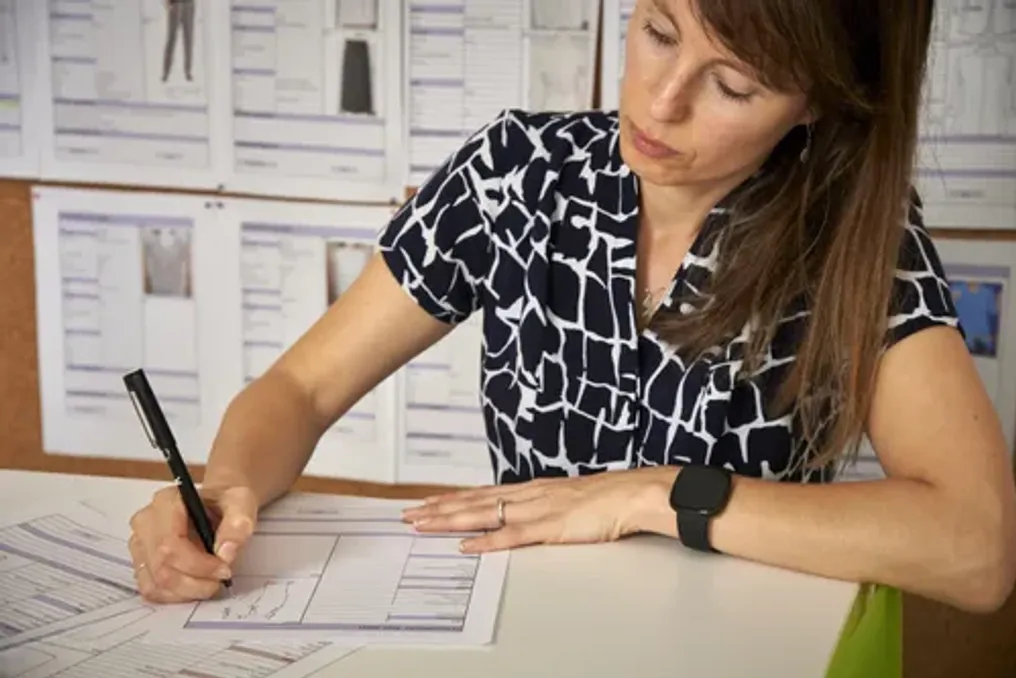
Nicole Hepburn-Strickland, an apparel technologist at Imagemakers, has spent the last thirteen years working to transform creative concepts into practical, durable, and high-quality garments.
In an industry often associated with designers and models, her role highlights the technical competence required to translate an idea sketched on paper into comfortable wearable clothing.
Describing herself as dedicated and adventurous, valuing quality, she stated: 'I am Nicole, and I was born and raised in Cape Town.'
Her career at Imagemakers began after working in a small fashion boutique, where, she said, she flourished before deciding to step outside her comfort zone.
Today, she refers to apparel technologists as 'engineers of the fashion world.'
'We transform a designer's creative sketch into a high-quality garment that can be efficiently produced within budget,' she explains.
Although a designer's sketch may look simple, its realization requires a complex technical process. According to Hepburn-Strickland, producing a single item of clothing from start to finish can involve at least 50 people, encompassing all stages: from pattern making and fabric selection to technical drawings and precise measurements.
How to Make Corporate Wear Fashionable
One of the main concerns for Hepburn-Strickland is the perception that business attire must be dull. Corporate wear is often linked to conservative and outdated outfits, yet she notes that the industry has evolved significantly.
'At Imagemakers, we genuinely strive to offer stylish and fashionable options suitable for all types of people, professions, and body shapes, including maternity wear,' she stated.
Her own approach to fashion also focuses on fit and quality. If she had to choose one wardrobe item to wear throughout her career, it would be the Armani blazer she wore during the interview.
'It is absolutely well-made. It just fits me in the right places,' she shared.
For Hepburn-Strickland, looking neat also has a practical benefit: she prepares her outfit the night before, eliminating one decision from her morning routine.
'It really helps mental health to look put-together when you leave the house. You know, just starting your day on the right note.'
Why Cheap Corporate Wear Can Cost More
In a market where companies are often pressured to achieve the lowest bid, Hepburn-Strickland believes businesses should look beyond the initial price. She warns that cheaper items can ultimately cost more because low-quality fabrics shrink, fade, or tear after multiple washes.
This results in a cycle of premature replacement and repeat orders.
'Investing in premium, durable corporate wear actually lowers the cost per wear,' she said, describing cheaper alternatives as a potential false economy.
It is also crucial to understand how the items will be used when selecting fabrics. 'We can't dry clean everything, so we need fabrics that can be washed,' she clarified.
Polyester is useful due to its wrinkle resistance and washability, although it can cause discomfort in hot weather. Cotton offers a cooler alternative but usually requires more attention when ironing.
Her personal favorite is Tencel, which she likes for its mobility, while denim earns her approval for its durability.
Creating a More Sustainable Wardrobe
The impact of fashion on the environment is another issue close to Hepburn-Strickland's heart. She finds it difficult to see mountains of discarded clothing, especially given that the fast fashion industry continues to contribute to waste generation.
She believes that for a company dealing in corporate wear, durability must become part of the sustainable development discussion.
'At Imagemakers, we work towards a 'one hundred twenty washes' metric—it should last that long,' she stated.
She is also fascinated by advancements in textile technology, including converting recycled plastic bottles into fabric.
She argues that focusing on durability is not just about creating longer-lasting items; it is also about reducing the need for constant replacement and prompting companies to think about the entire lifecycle of the goods they purchase.
Technologies Changing How Clothes Are Made
Technology is also opening up new possibilities in clothing production. Imagemakers already utilizes digital modeling systems, and 3D computer design allows technologists to visualize clothing on avatars before the fabric is cut.
For Hepburn-Strickland, technology has the potential to make the development process more efficient while reducing the number of physical samples.
What if money were no object? 'I would like to invent a scanning machine that creates 2D patterns directly from a 3D item!'
This idea reflects the intersection of creativity and technical thinking that defines her profession.
A Career for Problem Solvers
For women considering a career in the technical field of fashion, Hepburn-Strickland says success requires more than just an interest in clothing. A future apparel technologist must be driven, diligent, numerically savvy, and ready to work. Strong interpersonal skills are also necessary, as the job involves interacting with many people throughout the entire production process.
Most importantly, in her opinion, is persistence. 'You have to be someone pleasant to talk to because you work with many people every day,' she said. 'You need that persistence to be able to say, 'No, that won't work.''
For Hepburn-Strickland, the willingness to challenge ideas, solve problems, and precisely understand garment construction sustained her passion for the job for over a decade.
Perhaps her Leo dedication also played a role. During an interview, she mentioned her zodiac sign only to discover that the wife of the company founder, Mr. Spoun, was an astrologer. 'He said, 'Well, then it must be!'', she recalls with a laugh.
This might have been a lighthearted moment, but after 13 years, Hepburn-Strickland's career proves that the right combination of technical skills, curiosity, persistence, and passion can turn fashion into something more than just making clothes.