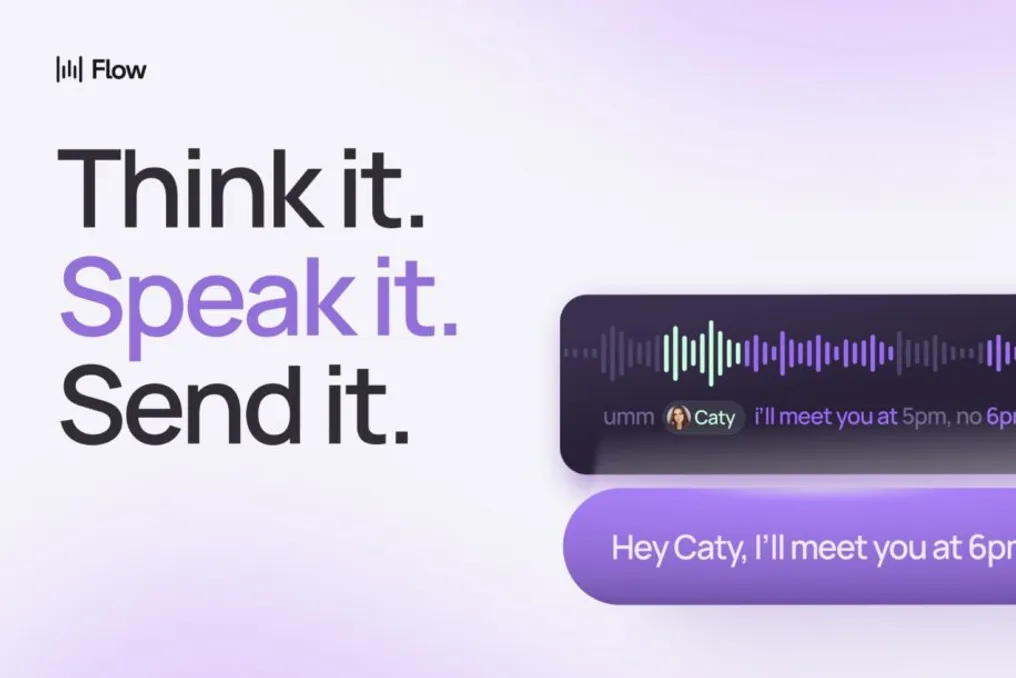
Significant capital is required to build next-generation artificial intelligence infrastructure due to rising costs for computing power and hardware. To address this issue and move beyond traditional dictation, startup Wispr has raised $280 million in a Series B funding round at a $2 billion valuation.
This large influx of capital will allow the company to train its own voice models that easily process complex real-world audio material. By proactively solving expensive computational needs, Wispr aims to create a universal voice interface that will replace text input on everyday devices and digital platforms.
Most people view voice control as a simple tool for setting timers or writing short messages. However, Wispr envisions a future where natural human speech becomes the primary method of data entry across all daily-use software applications.
Wispr's flagship application, Flow, allows users to speak seamlessly into any text field on both desktop and mobile operating systems. Flow processes human speech in real time, eliminating the need for clumsy raw transcriptions. It removes filler words like 'um' and 'uh', corrects grammatical errors, and subtly fixes stumbles on the fly. Thus, it transforms the user's hasty, vague ideas into clear, professional text without tedious manual editing and typing.
The new capital directly accelerates the development and deployment of Canto—Wispr's proprietary voice model designed specifically for noisy real-world environments. Standard speech-to-text engines work acceptably in quiet rooms but fail completely in typical conditions. Background conversations, barking animals, heavy traffic, and coffee shop noise usually lead to significant transcription errors. Canto overcomes this major hurdle by training directly on unfiltered, chaotic audio data.
Thanks to this, Canto reduces the frequency of speech recognition errors in noisy environments from 30% to less than 10%. Users can easily dictate long emails or complex documents while traveling or in open-plan offices. Consequently, Canto lowers the percentage of speech recognition errors in loud places from 30% to less than 10%, allowing users to comfortably dictate detailed letters or complex strategic documents while commuting, walking through busy city streets, or being in noisy offices.
Major venture capital funds clearly see enormous long-term value in Wispr's technical approach and ambitious product vision. The Series B funding round was led by Menlo Ventures alongside Notable Capital, NEA, Neo Ventures, 8VC, and MVP Ventures. With this strategic injection of funds, Wispr has raised a total of $361 million. The technology is already gaining significant popularity among corporate teams, creative professionals, and even notable users. To date, users have generated over 60 billion words on the Flow platform.
Employees from almost all Fortune 500 companies and over 10,000 enterprises use Flow daily. Multilingual specialists and professional athletes highly value Flow for its ability to smoothly switch between languages without losing words. In the future, with the advancement of artificial intelligence, traditional physical keyboards and touchscreens may become obsolete. With a substantial reserve of funds, Wispr is using this money to create a persistent voice layer situated directly beneath every desktop and mobile application. Instead of switching between different apps or manually typing long messages, users will simply be able to speak naturally to their screens. Combined with the optimization of specialized voice models, voice input becomes significantly faster and more accurate than manual typing.