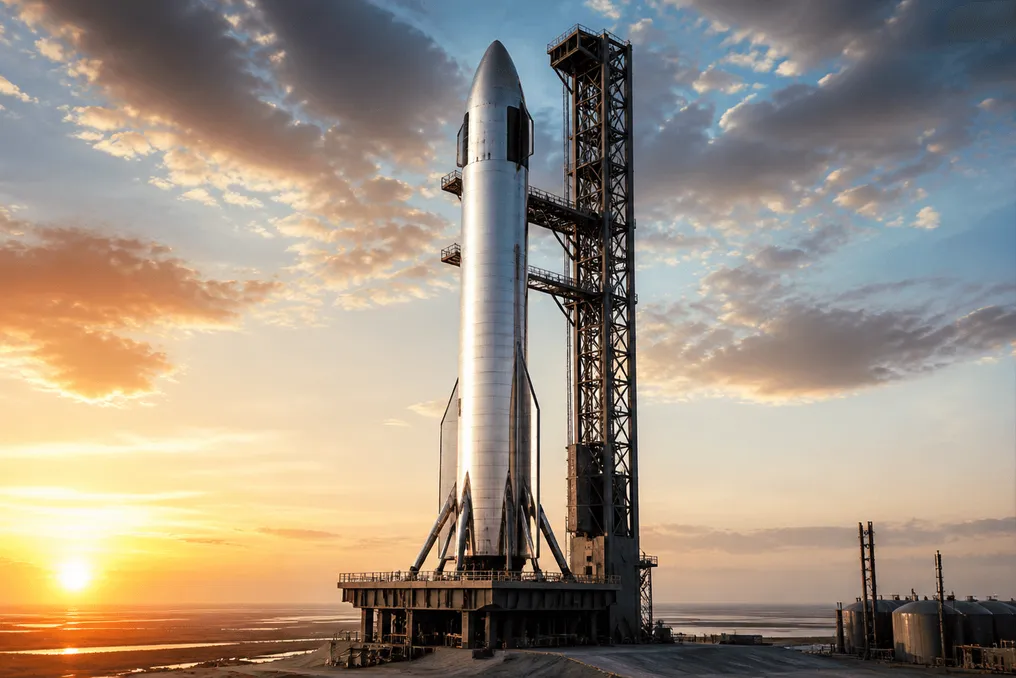
LandSpace has confirmed the launch window for the Zhuque-3 Y-2 rocket: from 7:27 to 8:04 AM on August 19 in Jiuquan. The primary objective of this launch is to achieve vertical landing of the first stage. Success in this mission would make China the first commercial liquid-fueled rocket to achieve vertical landing of an orbital-class first stage. Analysts at Huayuan Securities noted that the industry's valuation logic may shift from concept to verification of industrial production of reusable rockets.
The satellite technology market reacted accordingly: the CIMC Satellite ETF index (159218) showed growth of over 18% since August.
There are two main approaches to reducing launch costs. On July 10, the Long March 10B rocket successfully completed its first flight using sea recovery technology, which was the first such instance globally. Xiangcai Securities believes this method reduces requirements for stage mass and landing accuracy, allowing the saved structural weight to be converted into payload. The Zhuque-3 Y-2 uses an alternative path—vertical landing relying on landing gear for a soft touchdown, aligning with SpaceX's approach with the Falcon 9 rocket.
These two methods complement each other: sea recovery is suitable for high-safety and high-payload missions, whereas ground landing offers a proven technology, better reusability efficiency, and deployment flexibility.
As recovery technology becomes routine, launch costs decrease significantly. Even accounting for maintenance, rockets used fewer than five times show a clear cost advantage, and with more than ten reuse cycles, the cost per launch can drop by approximately 60–80%. Thus, 2026 is expected to be a busy testing period for recoverable rockets in China, with forecasts for several types to transition to regular flights.
Advances in reusable rockets provide key capacity for deploying low Earth orbit constellations. On August 16, the Long March 12 rocket launched the twenty-fourth group of internet constellation satellites from a commercial launch site in Hainan. The Guowang constellation plans to launch 15,000 satellites in three phases: 648 satellites by the end of 2025 for regional coverage, global coverage by the end of 2027, and a full constellation by the end of 2030. The first generation of 168 Qianfan constellation satellites has already been launched and should soon become operational. Global demand for low Earth orbit applications exceeds 1.3 million, while Chinese Guowang and Qianfan constellations have only about 100 satellites in orbit each, representing only about 1% of the plan fulfillment, creating an urgent need for batch launches.
Xiangcai Securities emphasized that the biggest challenge in the industry remains converting value from satellite creation to actual utilization, as breakthroughs are still required to create a consumer commercial cycle. SpaceX's first earnings report after its IPO serves as an example: Starlink had 12 million global subscribers by the end of the second quarter, double the 6 million from the previous year. Revenue from subscriptions reached $4.291 billion, an increase of 66%, while revenue from corporate and government clients grew by 108%, and operating profit reached $1.656 billion, an increase of 79%. This confirms the cycle of decreasing launch costs, expanding constellations, growing users, and increasing revenue, providing a foreign benchmark for the commercialization of satellite internet in China.