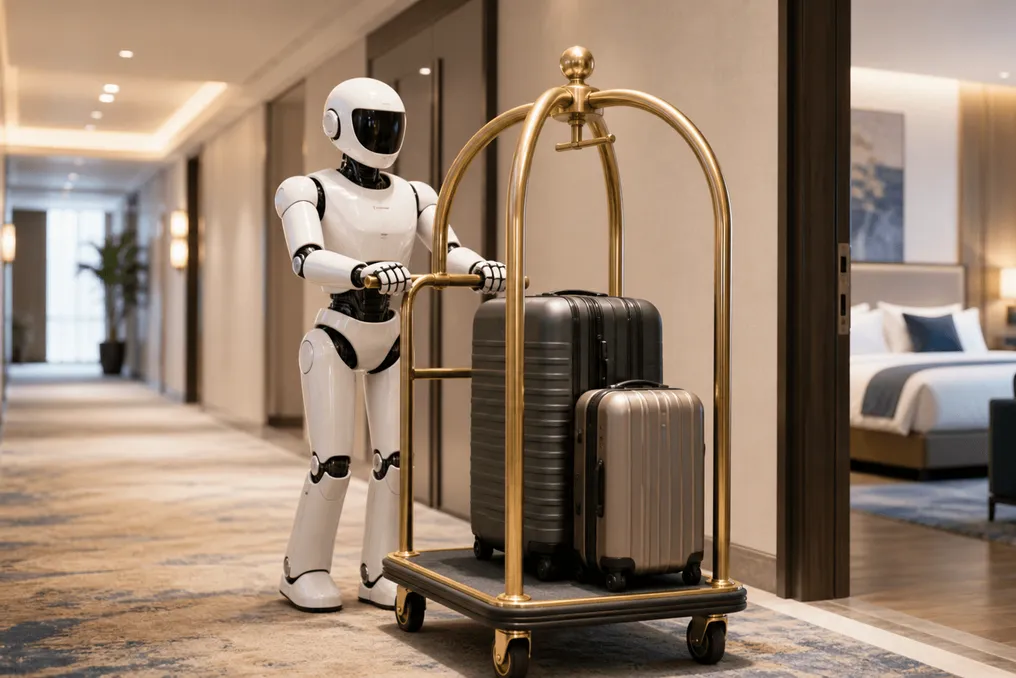
From August 16 to 17, a competition on guest services was held at the Beijing Wuzhou Hotel as part of the second World Humanoid Robot Games. The contest leader, Li Ziye, noted that each round is limited to 30 minutes, during which robots must complete tasks such as baggage handling, restocking room supplies, and room cleaning. These tests assess the robots' ability for mobile weight transfer, balancing when pushed, dexterous grasping, real-environment navigation perception, and planning complex multi-stage tasks.
The goal of this competition is to accelerate the transition from laboratory development to commercial implementation. The contest includes four main challenges: unstructured real hotel environments requiring high navigation and obstacle avoidance; soft items like bedding and towels that change shape and require flexible manipulation; pushing loaded trolleys with difficult posture balance; and a long chain of tasks under time constraints, which questions the overall stability of the machine.
Zhang Yizhou from the Renmin University of China-Beijing Humanoid Alliance-iYZhou team pointed out that the venue itself was the most difficult part: real scenes differ greatly from simulated ones, and narrow corridors test the robots' maneuverability when moving forward and backward while handling luggage.
In the baggage handling task, robots must place two suitcases and two bags on a transport trolley, drive it to the specified room, unload all the luggage, and then return the trolley. For restocking supplies, robots retrieve one towel, two pairs of slippers, and two bottles of water, hang the towel straight, place the bottles on a corner cabinet, and arrange the slippers under the bedside table. During cleaning, robots smooth the bed and place two dirty towels and one piece of trash into recycling bins.
Li Ziye emphasized that timely completion of the task does not guarantee high scores; the neatness of item placement is important. Fully autonomous mode earns 1.0 point, whereas remote control mode is only rated at 0.5.
The hospitality competition is one of the events in the Games conducted in real conditions. The Games select worker robots based on real needs across nine different scenarios: home cleaning, hotel service, industrial production, emergency rescue operations, library management, retail, office service, garden inspection, and vehicle charging, developing complex tasks that test eye-brain-hand coordination.
Li Ziye added that the hospitality competition is based on real industrial needs: after surveying sites, the team identified pain points in highly standardized repetitive work, labor shortages, rising personnel costs, and high staff turnover; such work corresponds to the current stage of humanoid robot development.
Wang Fan, director of the hospitality competition and head of the Asia-Pacific office of Beichen Group, stated that as humanoid robots improve in mechanical and process services, the efficiency of hotel operations will increase. Currently, hotels already use robots for room delivery, smart cabinets, and AI-based voice stations, and plan to introduce robots for baggage handling, guest interaction, and coffee preparation, promoting a robot-oriented hotel strategy while providing more real scenarios for robot training.