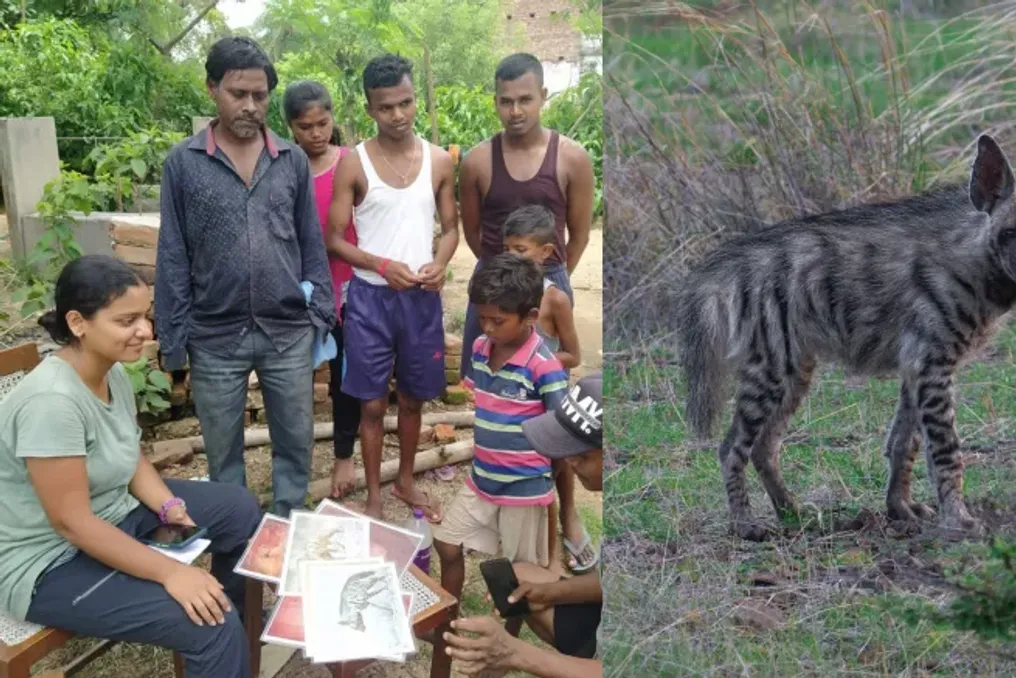
A new study casts doubt on the common belief that people living near wild animals automatically possess deep knowledge of their ecology. Researchers from Human and Environment Alliance League (HEAL), The University of Trans-Disciplinary Health Sciences and Technology, and the National Centre for Biological Sciences (NCBS) found that the level of such knowledge heavily depends on how much an animal can be seen and observed in reality.
In the case of the striped hyena, its secretive, solitary, and nocturnal lifestyle significantly limits opportunities for direct contact. Knowledge gaps may be filled by folklore, rumors, inherited beliefs, media images, or memories of rare but emotionally strong events.
Vasudha Mishra, lead author of the study and a research fellow at Human and Environment Alliance League, noted: 'Living in the same landscape does not necessarily mean knowing the species. Knowledge is formed through repeated observation. When an animal moves alone, comes out mainly after dark, and avoids people, even neighboring communities may have very little opportunity to understand how it truly lives.'
The researchers analyzed 104 semi-structured interviews collected in two areas of Purulia. Respondents were shown photographs of five predators: leopard, golden jackal, Bengal fox, Indian grey wolf, and striped hyena. They were then asked to identify the animal and describe its appearance, diet, habitat, and behavior. The study compared these comparisons with detailed discussions about the cultural significance associated with the hyena.
Predator many neighbors could not identify
Most respondents correctly identified the leopard, golden jackal, and Bengal fox, but only 39% could name the striped hyena. Knowledge of the hyena's ecological characteristics was lower than that recorded for more frequently encountered predators.
The golden jackal and Bengal fox were observed more often due to their social or more conspicuous behavior, their presence near settlements, and interaction with domestic fowl and other livestock. These regular encounters allowed people to observe their habits, form knowledge more aligned with scientific descriptions, and assess the risks they pose. The striped hyena, conversely, largely remained outside everyday human experience. This limited visibility contributed to uncertainty not only about what the striped hyena does but also about what it is.
One species, two cultural images
Of the 104 respondents, 28 could not name the animal and reported not seeing it in the local environment, while 25 identified it as another species. Among those who named it, two contrasting cultural images emerged: Gaadha and Kuia. 33 respondents called them Gaadha, and 11 called them Kuia. Descriptions of Gaadha were more consistent with the known ecology of the striped hyena, whereas the traits attributed to Kuia were significantly less aligned with scientific data.
Gaadha was typically described as a large, nocturnal, forest-dwelling animal that moved alone or in pairs and fed on carrion. It was associated with riverbanks, cemeteries, and cremation sites. Although its bold nature inspired fear, especially its supposed tendency to stand its ground rather than flee, it was generally considered relatively harmless compared to predators that regularly killed livestock or threatened humans.
Kuia belonged to an entirely different sphere of local understanding. It was depicted as a ferocious and extremely powerful pack hunter capable of attacking livestock, humans, and even animals much larger than itself. Most people discussing Kuia had never seen such an animal. Their knowledge came primarily from elders, neighbors, and circulating stories. Some attributed descriptions, including killing in anger, blood-sucking, or subduing elephants, did not match the biology of the striped hyena. The study suggests that one negative interaction between the hyena and humans in a landscape where the species was rarely encountered or understood gave rise to the recognizable animal form of the old cultural ideas about Kuia.
Tiasa Adhya, co-author and deputy secretary of Human and Environment Alliance League, stated: 'The image of Kuia demonstrates how an elusive species can gain a second life in the human imagination. When ordinary encounters are almost absent, one exceptional incident can become disproportionately influential. The animal is remembered not so much for its ecology as for fear, memory, folklore, and the retelling of the event.'
Scavenger recognized, but not always appreciated
The study also revealed cultural ambivalence towards scavengers. Many respondents clearly recognized the striped hyena as an animal that feeds on fresh or decaying carcasses. In fact, this was the ecological trait most consistently linked to the species. However, recognizing this role did not automatically lead to appreciation.
When hyenas consumed livestock carcasses discarded far from homes, some residents viewed them positively because they removed decaying matter and unpleasant odors. The same activity became unacceptable when it occurred near villages, where it was associated with dirt and contamination. Some people also believed that eating carcasses could make the animal 'mad' or aggressive, leading it to attack live livestock or humans.
The greatest concern stemmed from stories of Gaadha digging up and consuming buried human bodies. For families unable to afford cremation, burial near rivers was sometimes practiced. Respondents described the disturbance of these graves as a serious problem. They believed that this act could prevent the deceased from finding peace, imply a transgression during the person's life, and bring shame, impurity, or misfortune to the family. It is reported that some graves were covered with large stones to deter scavengers. This indicates that the species was also associated with ill fortune and spiritual anxiety in cultural perceptions.
Rethinking coexistence with elusive predators
Traditional conflict mitigation programs often focus on compensation, livestock protection, or barriers. Such measures may prove insufficient for species whose conservation issues arise from fear, misidentification, and cultural narratives, rather than frequent economic losses.
The authors caution against both completely dismissing local knowledge and unconditionally idealizing it. Arjun Srivastava from the National Centre for Biological Sciences in Bangalore notes: 'Community knowledge can be exceptionally detailed when people regularly observe the species. But for animals that are rarely encountered, cultural predispositions can overshadow knowledge gained from direct experience.'
The study recommends developing conservation programs tailored to local conditions that account for diverse community interpretations while providing accessible information about the actual ecology of the hyena. Audiovisual information campaigns could help residents distinguish the striped hyena from other predators, understand its behavior during chance encounters, and recognize scavenging as an ecological service that removes waste and reduces disease risks. Such initiatives would be particularly important after unusual encounters, before fear and misinformation become entrenched.
Sayan Banerjee, a graduate of the National Institute of Advanced Studies in Bangalore, shares his view: 'Coexistence depends not only on reducing harm. It also requires understanding how the animal is woven into stories, memories, fears, and moral worlds. For an elusive species like the striped hyena, conservation must address both the biological animal and the cultural images that have formed around it.'