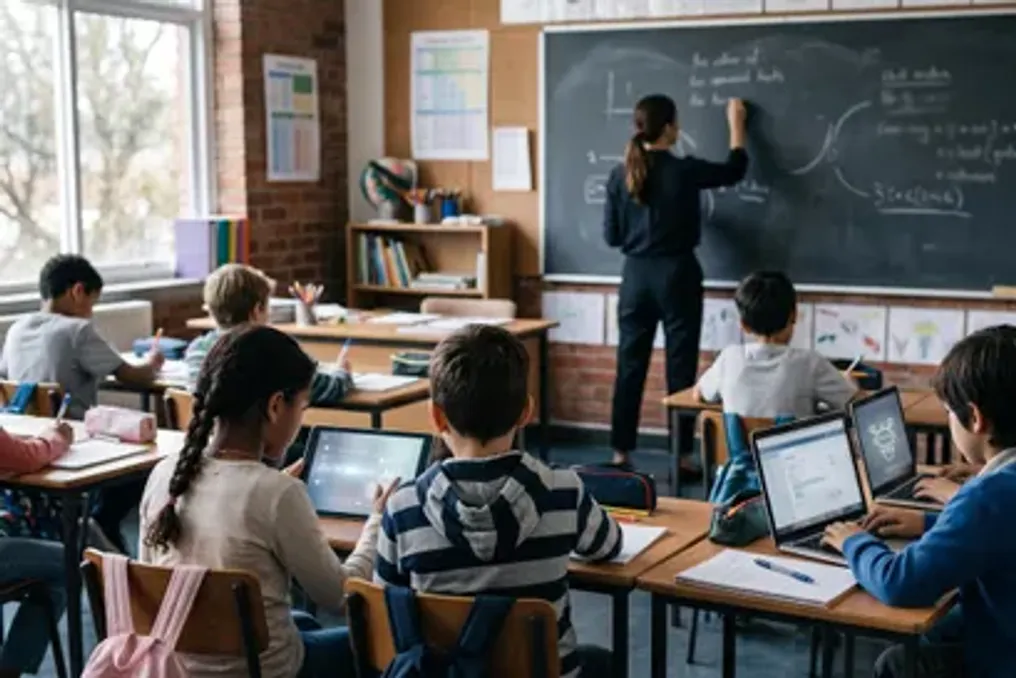
As artificial intelligence (AI) integrates into daily learning, educators face a growing challenge: how to utilize this technology without weakening students' critical thinking skills. A recent example, where a physics teacher found a student's homework containing a chatbot's question after the solution was elegantly and correctly generated by AI, drew public attention.
This case went viral because it reflects a worrying trend: modern schoolchildren are not only forgetting how to think but sometimes also forgetting how to cheat properly. The situation escalated when President Vladimir Putin instructed the State Council to prepare proposals for amending federal educational standards and incorporating AI into them, turning the discussion from a joke into a question of the future of Russian education.
The consequences of this process will extend far beyond the classroom, shaping how children read, write, argue, memorize, and think. Statistics confirm this trend: by 2025, the share of student work completed with the help of AI will increase from 17.8% to 24%, meaning nearly a quarter of essays, presentations, term papers, and dissertations will be created with AI assistance.
Among schoolchildren, the situation is even more pronounced: 29% of Russian students admit to using AI tools for homework, and 23% do so out of boredom, using AI instead of real interaction. Teachers witness this problem daily; for instance, one student who wrote excellently at home consistently failed creative assignments in class until his ability was refuted by his Unified State Exam results when he lost his 'digital co-author.'
Experts and teachers point out several serious risks. According to surveys, 36% of respondents fear that reduced mental effort will harm children's development, and 31% are concerned about the reduction of personal interaction. Another 27% predict a drop in motivation and an increase in catastrophic laziness.
The central danger is that AI can simulate effort, creating the appearance of thought and even personality. Unlike a polished essay from AI, a poorly written composition by a child remains a human document, containing errors, awkwardness, effort, fear, and ambition. IT pioneer Natalia Kaspersky warned of the risk of raising a 'generation of complete idiots.'
However, a complete ban on AI in the educational process is considered a naive approach. The serious response lies in teaching children to use AI competently, preventing them from completely outsourcing their thoughts to algorithms. AI can ease teachers' workload by helping prepare tests, analyze work, and reducing routine burdens, thereby supporting rather than replacing pedagogical judgment.
The main problem is that neither teachers nor students have received adequate training on working with this tool. Similar to the initial concerns surrounding calculators, AI should only be applied after basic skills—reading, writing, argumentation, and doubt—have been established. AI must become an additional layer of intelligence, not a replacement.
What only living people can provide is real interaction, shared thought, the discipline of disagreement, and emotions that cannot be simulated. Even the most advanced AI cannot feel, but it can imitate feelings, which might be acceptable for a lonely child.
Partial responsibility lies with teachers, but given the acute shortage of staff in Russia, neural networks are becoming the most accessible 'tutor.' To solve the problem, it is not enough to simply scold children for copying chatbot answers; it is necessary to restore the authority of the teacher, reduce bureaucracy, eliminate staff shortages, and teach all participants in the educational process to work honestly with AI, otherwise, the machine will replace thinking itself.