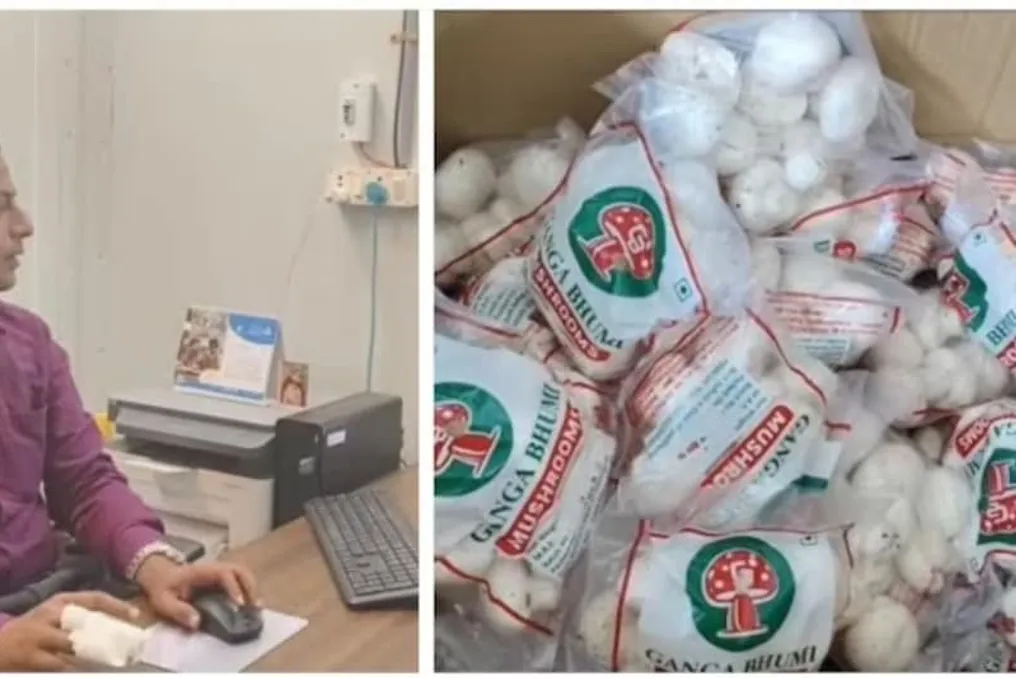
Vikramdev Mohapatra, after fourteen years working in the software development sector, worked at several technology companies, building a career that many engineering graduates consider exemplary. However, he later decided to leave the IT sector and return to his home in Nabarangpur, Odisha. Now, his activities are focused not in an office or during conference calls, but on a mushroom cultivation production site.
Today, his business for cultivating and processing mushrooms produces between 500 and 600 kilograms of mushrooms daily, which amounts to about 15–18 tons monthly. According to the report, the company's monthly income reaches 16–19 lakh rupees. Furthermore, this business has provided employment for 24 local residents.
Vikramdev received a Bachelor of Technology (B.Tech) degree in 2012 from Bijay Patnaik University in Odisha, specializing in 'Electronics and Communication.' After that, he entered the IT industry and worked at companies such as Discovery Solutions, Mindtree, Cerol Technologies, and LTI Mindtree. During his employment, he held various positions, including software engineer, module lead, technical lead, and senior implementation specialist. His responsibilities included software development, product implementation, SAP solutions, team management, and client interaction, which was drastically different from his current agricultural venture.
After 14 years in the corporate sector, Vikramdev returned to Nabarangpur and founded Ganga Bhumi Mushroom, focusing on commercial mushroom cultivation and processing.
This facility is not just a small farm. According to the report, it produces approximately 500–600 kg of mushrooms daily, equivalent to 15–18 tons per month. The produced mushrooms are supplied to the markets of Brahmapur and Bhubaneswar, allowing his business to operate year-round.
The most significant aspect of Vikramdev's career change is that after leaving the IT field, he did not just start his own business but also created employment opportunities for others. His company currently employs 24 people, including 18 women and 6 men. Thus, the former IT specialist now earns a living and provides jobs for the residents of his area. His story demonstrates not only the transition from office work to agriculture but also how skills acquired in a corporate environment can be applied to a completely new and different business.