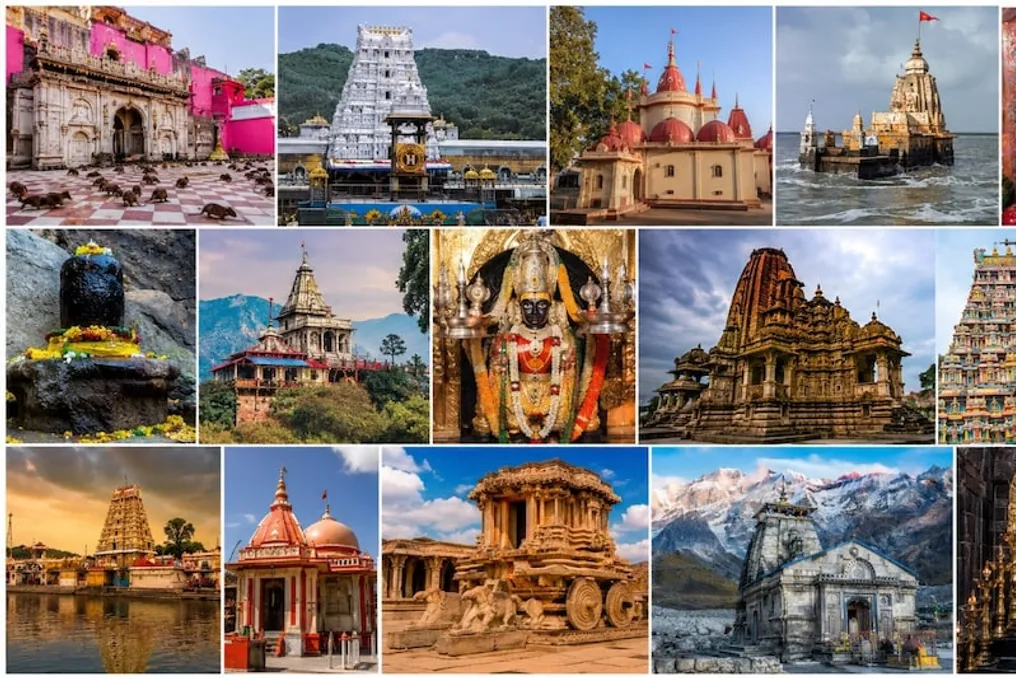
India is known for its ancient and majestic temples, which are an integral part of the national identity. There are countless such shrines in all states of the country, to which pilgrims arrive from all over the world to perform pilgrimages. Among them are temples known not only for their religious beliefs but also for mysterious traditions and unique features.
Below are some of these mysterious temples of India.
Karni Mata Mandir, Rajasthan
Karni Mata Mandir, located in Bikaner, Rajasthan, is considered one of the most mysterious temples in the country. It is dedicated to the goddess Karni Mata, who is revered as an incarnation of the goddess Durga. The main sanctuary houses a statue of the Mother, flanked by statues of her sisters on both sides.
A distinctive feature of this temple is the large number of rats that inhabit it. According to legends, there are over 25,000 rats living in the temple. Pilgrims visiting the temple feed these animals milk, sweets, and offerings. Special reverence is given to white rats, which are believed to be connected to Karni Mata and her family.
Tirupati Venkateswara Mandir, Andhra Pradesh
Tirupati Venkateswara Mandir, located in Andhra Pradesh, is one of the most famous temples in the country. There is a belief that the wishes of any devotee who sincerely worships Lord Venkateswara will be granted.
Pilgrims offer their hair according to their faith. According to one legend, the hair on the statue of Lord Venkateswara is real and never tangles. It is also said that if one presses an ear to the statue, a sound resembling ocean waves can be heard.
Kamakhya Devi Mandir, Assam
Kamakhya Devi Mandir, situated on Nilachal Hill in Guwahati, Assam, is among the principal Shakti Peethas of the country. According to mythological accounts, when Mata Sati immolated herself in the yajna of her father, Daksha, Lord Shiva began to dance Tandava while holding her body. To pacify Lord Shiva, Lord Vishnu divided Mata Sati's body with his Sudarshana Chakra. It is believed that Kamakhya Devi Mandir is located where a part of Mata Sati's yoni fell.
Stambheshwara Mahadeva Mandir, Gujarat
Stambheshwara Mahadeva Mandir, located on the Arabian Sea coast in Gujarat, is known for its unique characteristic. This temple is surrounded by the sea and the Khambhat Bay. Its peculiarity is that during high tide, the temple submerges in seawater, and after low tide, it becomes visible again. Therefore, the time of visiting the temple depends on the tides of the sea.
Mehandipur Balaji Mandir, Rajasthan
Mehandipur Balaji Mandir, located in the Dosa area of Rajasthan, is dedicated to Lord Ganesha. Pilgrims from all over the country come here to worship. There are many religious beliefs surrounding the temple, and people come here hoping to rid themselves of negative forces. Various traditional religious rituals are conducted in the temple, and pilgrims pray to Balaji Maharaj for help in overcoming their problems.
Achleshwara Mahadeva Mandir, Daulapur
Achleshwara Mahadeva Mandir, located in the Daulapur area, Rajasthan, is known for its unusual belief. This temple is situated in the Chambal region, on the border of Rajasthan and Madhya Pradesh. According to belief, the Shivling installed here changes its color three times during the day. It is said that in the morning it looks red, in the afternoon saffron, and in the evening dark brown.
Varaha Shyam Mandir, Bhinmal
Varaha Shyam Mandir, located in Bhinmal, Rajasthan, is believed to be dedicated to Lord Vishnu. This temple is considered very ancient and is associated with numerous religious beliefs. According to belief, the form of Varaha Shyam is extremely vast: there is a religious concept that his feet are in the underworld, his head is in the heavenly realm, and his hands hold the earth.
Nishkalank Mahadeva Mandir, Bhavangar
Nishkalank Mahadeva Mandir, located in Bhavangar, Gujarat, near the Coliyak coast on the Arabian Sea, is extremely unusual. Here, sea waves wash over the Shivling daily. Pilgrims reach the temple on foot when the sea level recedes. After the tide rises, most of the temple is submerged in water, and only the flag and part of the building are visible. Five Shivlings are installed on one platform, making this temple one of the unique Shiva temples in the country.
Lakshmeshwara Mandir, Chhattisgarh
Lakshmeshwara Mandir, located in Araul, Chhattisgarh, is dedicated to Lord Shiva. Araul is called Kashi of Chhattisgarh. According to belief, the Shivling located here has one lakh holes, which is why it is also called Lakshalinga or Laksheshwara. It is said that one of these holes is connected to the underworld, where water flows, and one hole is always filled with water and is called Aksha Kund.
Ranganath Swami Mandir, Tamil Nadu
Ranganath Swami Mandir, located in Srirangam, Tamil Nadu, is among the largest temple complexes in the world. This temple covers an area of about 156 acres and is dedicated to Lord Ranganatha. According to legend, the place where the statue of Lord Ranganatha was located eventually turned into a forest. Later, a king of the Chola dynasty discovered the divine statue in the forest, after which the development of the temple began.
The Hunmanta Mandir in Midhipur, Madhya Pradesh, is also mentioned.