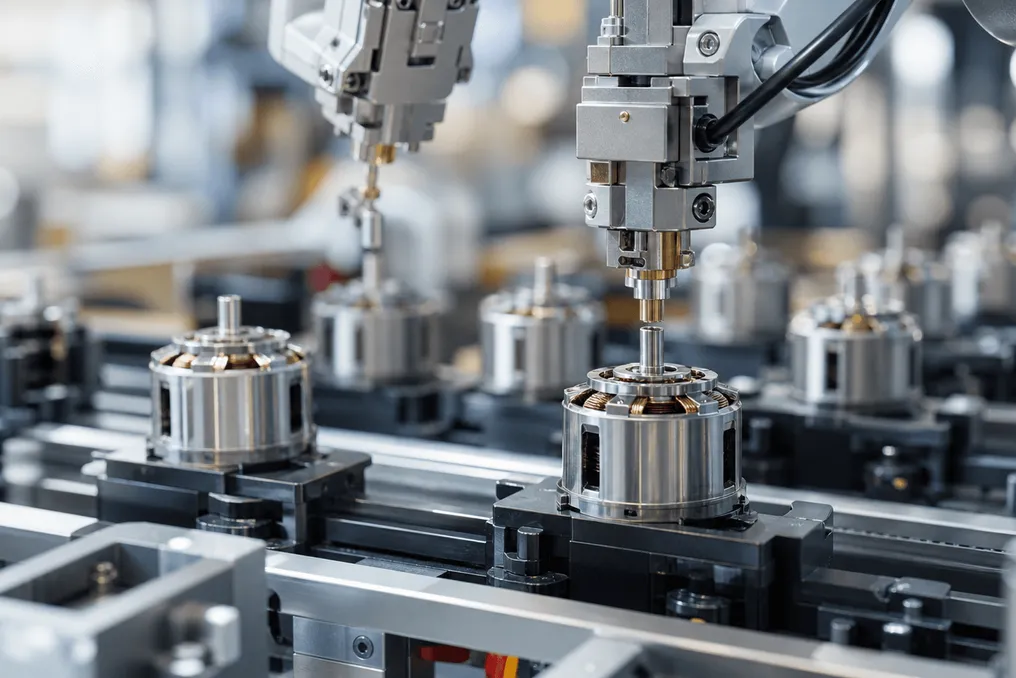
Jiangsu Leili Motor, which has accumulated 33 years of experience in developing motors for home appliances, is now utilizing its technologies to create the 'power heart' of humanoid robots. Micro-motors with a diameter of less than 10 millimeters ensure precise movements in robots, allowing them to write with a pen, pour tea, or play the piano with a high degree of smoothness.
Initially, the company gained recognition through the production of motors for household appliances, and later expanded its activities to medical equipment, new energy vehicles, industrial control, and recently, embodied intelligence, serving over 5,000 clients worldwide. Thirty-three years ago, it was a small factory in Yujin, Changzhou, with just over ten employees.
In 1993, Su Jiangguo founded the Leili electric factory against the backdrop of air conditioners with split systems entering the domestic market when all stepper motors were imported due to a technological embargo. Using a technical team from the Changzhou state enterprise, Leili developed its first air conditioner motor. As Wang Shilun, Deputy General Manager of Operations, noted, for over 30 years, the company has exclusively focused on motors, never venturing into other industries; this long-term concentration allowed it to accumulate indispensable technical and manufacturing experience.
By 2025, the company's revenue exceeded 4 billion yuan, while the share of home appliances decreased from nearly 90% to 55% after listing.
Before the company was included in the Shenzhen ChiNext list in June 2017, management noted limited growth in the core business: the home appliance motor market was a highly competitive environment with low pricing power. Meanwhile, medicine, the automotive industry, and industrial automation required significantly higher reliability and precision. Su Da recalls that a small-scale research in the medical field began in 2015 with the participation of a French R&D team, and a breakthrough occurred in 2019 after acquiring Dingzhi Technology, which provided medical qualifications and clients.
Preparation for the automotive industry began around 2010; in 2019, Leili opened its first overseas base in Vietnam and started producing motors for new energy vehicles. Su Da calls this a period of spatial trading: each new industry requires two to three years of experience accumulation before the technology takes root.
The transition between industries is not simple copying. The automotive industry requires IATF16949 certification and A-to-C sample testing over two to three years, so Leili starts with non-safety-critical products such as electronic water pumps and actuators. Through the acquisition of Dingzhi Technology and Zhongke Lingxi, the company gained teams in medicine and robotics. By 2025, the revenue structure looked like this: home appliances accounted for 55.09%, the automotive industry for 22.48%, industrial control for 12.83%, and medicine for 6.51%.
In medical devices, Leili motors, such as stepper worm gears and voice coils, are used in in vitro diagnostic (IVD) apparatus, portable point-of-care tests (POCT), analyzers, and ventilators. Voice coil motors for ventilators have achieved replacement of domestic analogs in the Mindray client base. In 2024, Leili achieved full-scale mass production of hollow rotor motors, and in the field of embodied intelligence, the company covers key components, motion control units, and intelligent control, supplying components to dexterous hand manufacturers both domestically and abroad. For example, a cable-driven dexterous hand with 22 degrees of freedom requires fifteen or sixteen hollow rotor motors. Hollow rotor motors from the subsidiary Dingzhi Technology cover a range from 6 to 42 millimeters with automatic coil winding. The company has bases in Vietnam, Mexico, Thailand, and Malaysia, with foreign sales accounting for about 50% of sales volume in 2025.