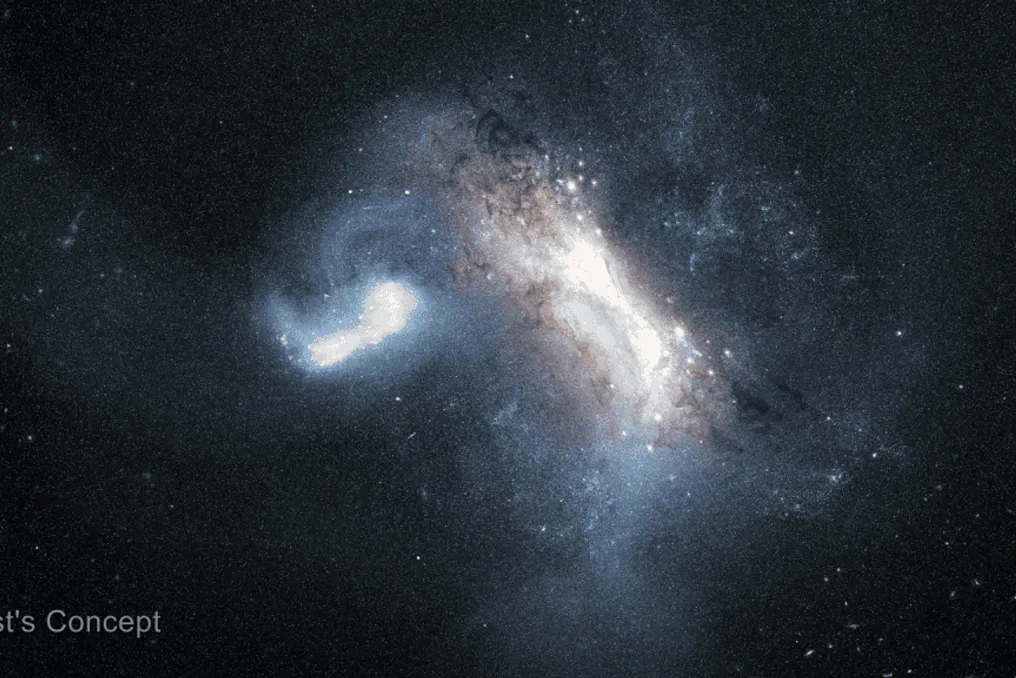
New data obtained using the Hubble Space Telescope from NASA has provided conclusive evidence that a dwarf galaxy collided with and merged into the Milky Way when our galaxy was in its early stages of evolution.
This merger occurred about 11.8 billion years ago, approximately two billion years after the Big Bang. This discovery allows for a correction of existing understandings regarding the history of major mergers that contributed to the formation of the Milky Way, pushing back this knowledge by 1.8 billion years.
Currently, the Milky Way is a massive spiral galaxy containing hundreds of billions of stars. However, it did not always possess this size; our galaxy grew both through the formation of new stars from gas clouds and through the accretion of stars, gas, and dark matter from other galaxies during merger processes.
The last large-scale merger in the Milky Way's history involved the Sagittarius dwarf galaxy. This process began more than six billion years ago and is still ongoing.
By investigating even earlier periods, researchers have already found that the Milky Way absorbed another dwarf galaxy known as Gaia-Sausage-Enceladus about ten billion years ago. This ancient merger significantly impacted the structure of our galaxy's stellar disk.
Other, smaller mergers took place between these events. Nevertheless, observations and simulations suggested that another major merger burst preceded these two, although the details of this episode have been subject to intense scientific debate. Now, Hubble has found irrefutable evidence of this earlier merger.
Large-scale astronomical surveys and high-precision data from space missions such as the European Space Agency's (ESA) Gaia have also played a crucial role in reconstructing the history of our galaxy. The further back scientists attempt to look into the past, the more difficult it becomes to precisely determine what happened. When the Milky Way was young, it was smaller and had dimensions closer to the galaxies it encountered. It is in this little-known past that Hubble was able to conduct this study.
Details of cluster analysis
The team analyzed images from Hubble of 39 globular clusters located within 20 thousand light-years of the Milky Way's center. This region is where traces of our galaxy's oldest mergers should be preserved.
Researchers expected to find in this sample both clusters formed within the younger Milky Way itself and structures accreted during the merger with Gaia-Sausage-Enceladus about ten billion years ago. Thanks to Hubble's sensitive observations, scientists were able to determine the age and metallicity of each cluster with high accuracy. In astronomy, metallicity refers to the abundance of elements heavier than helium.
By combining this information with measurements from the Gaia mission, the team managed to identify a third population of globular clusters in the inner regions of the Milky Way. As Chiara Zerbinati, a co-author of the study and researcher from the University of Bologna, stated: 'Thanks to Hubble's high resolution and image depth, we were able to measure the age and metal content of these clusters with unprecedented accuracy.'
She continued: 'In combination with Gaia measurements, this allowed us to distinguish this population of globular clusters from the others. These are the clusters that were born in LKH and tell us when this galaxy was absorbed by ours and what its mass was.'
The identified clusters were older than those absorbed in the merger with Gaia-Sausage-Enceladus but younger than the clusters formed within the Milky Way itself. Their age and chemical composition indicate that they resulted from another, even older merger, during which the Milky Way absorbed the dwarf galaxy LKH.
The discovery of such a large-scale merger at such an early stage of the Milky Way's formation is significant for understanding our galaxy's evolution. Some previous studies claimed that the earliest phases of the Milky Way's evolution were determined exclusively by stars born within the galaxy itself. Massari noted: 'Some previous studies claimed that the first phases of our galaxy's evolution were determined only by stars born within it.' He added: 'Here we show that stars born in external galaxies must also be taken into account.'
The team plans to continue studying the Milky Way's globular clusters to reconstruct its history and identify all major mergers that occurred throughout the galaxy's evolution. Fernando Aguado-Agelet, a co-author of the study and researcher from the University of Vigo and Universidad de La Laguna (Spain), stated: 'Hubble is observing globular clusters that have never been studied before, and this will help us characterize the merger events that occurred in very ancient periods of the Milky Way's history.'
The results were published in the journal Nature Astronomy this Monday (17). Information that Hubble discovered a galaxy that merged with the Milky Way 11.8 billion years ago first appeared in Olhar Digital.