A blurry image consisting of several pixels in a desert landscape has become fuel for one of the most common internet phenomena: turning insignificant images taken in space into supposed evidence of Unidentified Flying Objects (UFOs).
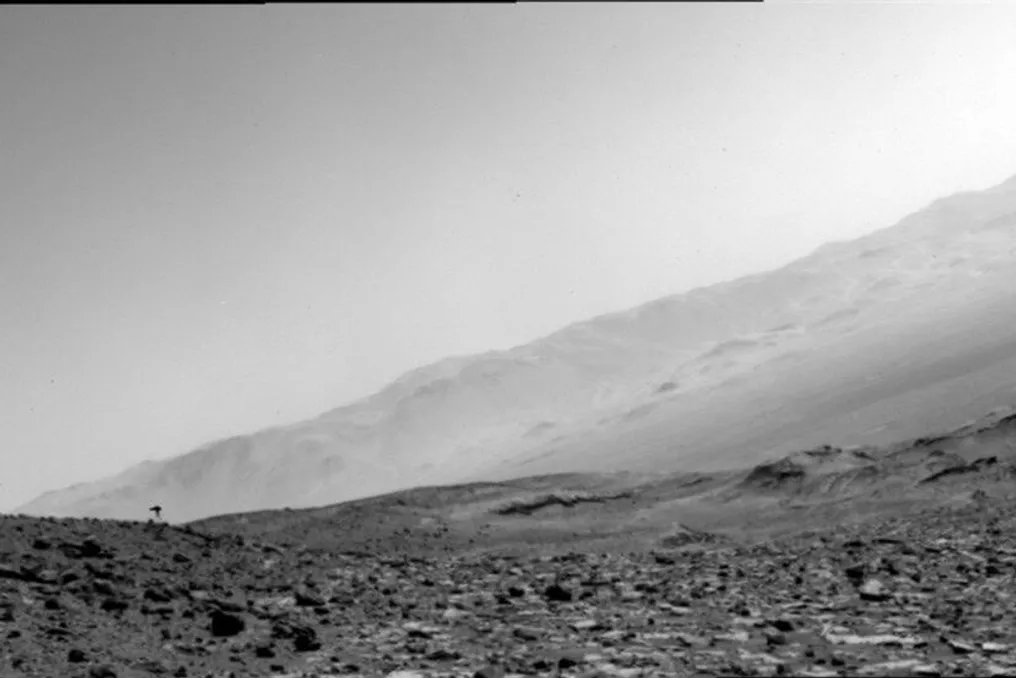
The latest case involves a photograph taken on August 20, 2023, by the navigation camera (NavCam) of NASA's Curiosity rover in Gale Crater. The image shows a small dark blurred object, whose silhouette vaguely resembles a jellyfish floating above a rocky ridge.
The image attracted attention again after the profile @KariSivertzen on X reposted it. This account is known in the community of digital 'scavengers' who study raw files from space agencies in search of anomalies.
This pattern of viral spread follows a clear formula: a raw snapshot is reproduced on social media with deliberate angles and moves to YouTube channels, where it receives the guise of thorough technical analysis to confirm theories about the presence of UFOs in space.
An example of this mechanism is presented in the channel The Angry Astronaut. In a 15-minute analysis, the content creator uses real NASA operational data to create an appearance of scientific rigor and attempt to prove the existence of the alleged UFO.
The host refers to the exact resolution of NavCam (black-and-white sensors with a resolution of 1 megapixel and 0.82 mrad/pixel), points out a time interval of exactly 13 seconds between frames, and performs trigonometric calculations to estimate the distance (150 meters) and the minimum speed the object would have needed to develop to exit the field of view (from 1.4 km/h to 35 km/h).
However, mathematics and hardware specifications serve only as a technical pretext to justify conclusions that lack methodological support. The central premise of the video ignores the simplest explanations—such as sensor malfunction, reading noise, or pareidolia (the optical illusion effect)—and immediately jumps to extraordinary scenarios.
At some point, the narrator draws artificial parallels with UFOs in the form of a 'jellyfish,' recorded by American military personnel in Iraq in 2017, and challenges known physics: to explain how the alleged craft could fly in the thin Martian atmosphere (only 1% of Earth's density) without kicking up dust from the surface or using rotors like the Ingenuity helicopter, the video begins to speculate about a 'magnetohydrodynamic drive,' 'negative mass' accumulated in the core of celestial bodies, and 'exotic physics.' Classifying the options, he rejects geology and considers the hypothesis of an extraterrestrial origin for the UFO as the most plausible explanation for the phenomenon.
This approach demonstrates how modern sensationalism disguises itself as popular science awareness: it relies on real data to gain viewer trust, and then distorts the scientific method to steer the public toward fantastical conclusions.
Scientists and planetary engineers analyze the same data through the lens of methodological skepticism, looking for answers in optical physics and the operation of space instruments to counter the sensationalism of virtual channels.
Astronomer Marcelo Zurita, president of the Paraíba Astronomy Association (APA), member of the Brazilian Astronomical Society (SAB), technical director of the Brazilian Meteor Observation Network (BRAMON), and columnist for Olhar Digital, strongly warns about the need for caution.
Recalling Carl Sagan's classic maxim, the specialist emphasizes that 'extraordinary claims require extraordinary evidence' and believes that the available material is merely a 'spot, a blur on a point image taken by Curiosity.'
Examining the original file published by NASA, Zurita identifies clear signs of a technical failure in the creation of the photograph. The strongest sign is the framing geometry: while the horizon of the Martian landscape is noticeably tilted, the dark spot remains parallel to the edges of the image. For the astronomer, this inconsistency relative to the ground is a 'very strong sign of an image artifact, i.e., a focus error, a capture error,' rather than the registration of a physical body flying over Mars.
Another critical contradiction lies in the optical physics of the lenses. NavCams, designed for mapping and close focus, naturally leave distant terrain and rocks blurred in the background. In contrast, the anomaly exhibits sharp contours. Zurita explains that this diverging sharpness limits the scenarios to a few viable interpretations within robot engineering. 'It indicates either a real object, but much closer to the camera, or an image artifact.'
Without cross-confirmation from other angles, the speculations about magnetohydrodynamic drives and exotic physics promoted by channels like The Angry Astronaut collapse. The specialist stresses that the lack of data prevents any claims about extraterrestrial artifacts. Since there is an infinitely more logical explanation based on rover mechanics, Zurita concludes that he would discard the hypothesis of an alien spacecraft 'or place it at the end of the list of possibilities for this image.'
Read More:
In February 2025, a photograph taken on Mars on January 30, 2014, reappeared on social media. This image, published by the 'UFO mania' account on X, depicts a rock formation that, depending on the angle, resembles a small door. The unusual appearance fueled theories about a possible alien portal or passage into the planet. However, the explanation is much simpler: it is a natural crack in the Martian rock.
A similar image received attention in 2022. At that time, NASA explained to BBC News Mundo that the supposed door was a small fissure registered with high magnification. The image was part of the 'Sol 3466' series taken by the Curiosity rover on May 7 of that year.
According to scientists from the Jet Propulsion Laboratory (JPL), the opening is about 30 centimeters wide and 45 centimeters long. It formed where several cracks intersected.
British researcher Neil Hodgson also determined its natural origin. According to him, erosion of ancient rock layers, formed about 4 billion years ago, created this structure.
The impression of a door is related to pareidolia—a phenomenon where the brain recognizes familiar shapes in random patterns, such as faces in shadows or animals in clouds. Astrophysicist Carl Sagan explained in his book 'Cosmos' that this evolutionary ability was vital for the survival of early humans. If an ancestor saw something resembling a predator among trees, the safest reaction would be to run, even if it later turned out to be just a play of light and shadow. Those who hesitated risked not surviving. This mechanism is active today, making us see patterns even when they are not there.