In August 1964, a group of entrepreneurs made the bold decision to violate Dutch laws on commercial radio and television broadcasting. They erected a platform in the middle of the North Sea, about 10 kilometers from the city of Nieuwwerk, outside the country's territorial waters.
The main idea was that since Dutch legislation did not permit this type of communication equipment, a channel had to be opened outside national borders but close enough for the signal to be received on the mainland. Although others attempted similar things using ships, the pirate radio and TV that appeared at the time aimed for a more permanent solution: it was REM-Eiland, which means 'Advertising Exploitation Company' in Dutch.
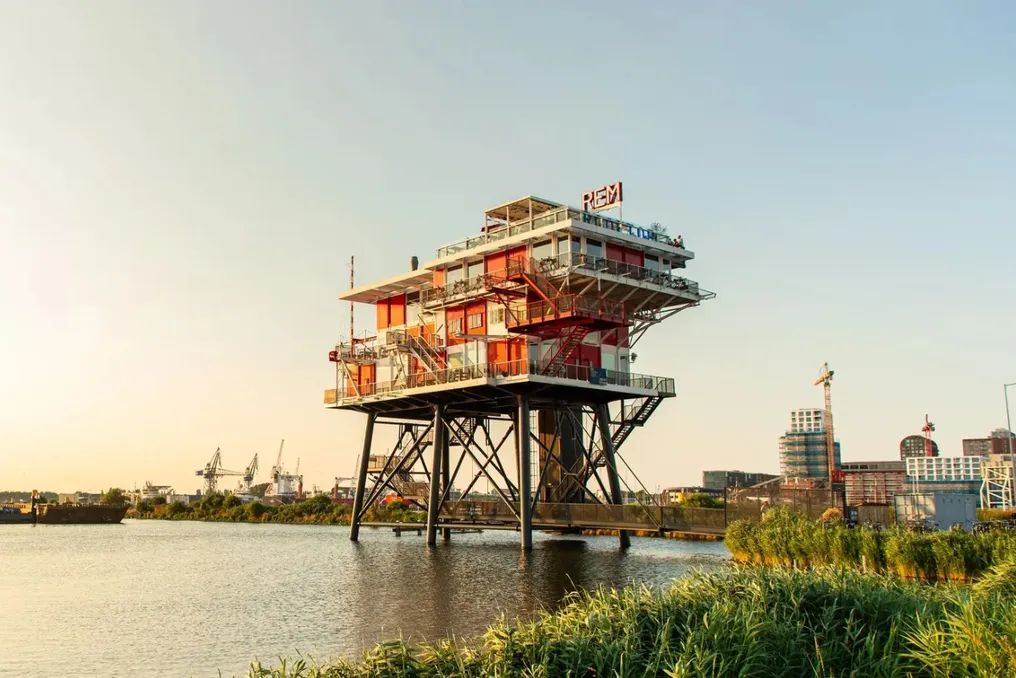
Although the initial idea was not successful (though not literally), REM remained in the memory of the Dutch. Decades after the structure was dismantled, it was recreated in the port of Amsterdam as a bar and restaurant.
The history of this platform began a year before its construction, in 1963, when REM was founded. At that time, television was just beginning to develop, and the Netherlands maintained a peculiar system based on the concept of 'pillarization'—the complete division of social, educational, and communication structures into specific ethnic and religious groups. The government showed strong resistance to allowing commercial media to operate.
However, instead of passively accepting the laws of that period (which were changed at the end of the decade after authorities realized the impossibility of stopping technological progress), many investors began to fund pirate radio and TV stations operating outside the country's borders. Ships were the preferred option, but REM-Eiland offered an innovative solution—building a platform similar to those used for deep-sea oil extraction. Built in a shipyard in Ireland, it was installed in the North Sea and began broadcasting on August 15, 1964.
Being commercial, unlike existing public and educational channels, REM adopted the name TV Nordzee and broadcast a range of imported canned goods from the United States, such as 'Zorro' and 'Tintin', and also displayed advertisements during breaks, which was also unusual for that time.
The experiment did not last long: by December, the Dutch government approved an emergency law that permitted military operations outside its territorial waters, extending to the entire continental platform off the coast of Holland, including the location of REM-Eiland. The structure was seized and dismantled by the navy just four months after the secret broadcasting began.
In the following decades, the state took control of the platform and used it primarily for monitoring weather and tides—which is extremely important for a country where a significant part of the territory is below sea level. REM-Eiland was finally dismantled in 2006, and five years later, it was rebuilt in Amsterdam.
Today, those wishing to visit this unusual place can go to the Hofthaven district in Amsterdam. The old REM-Eiland no longer broadcasts pirated signals or measures wave height, but has become an unforgettable spot for viewing the port and the IJ river, as well as for getting acquainted with a unique part of Dutch television history.
This space now combines a restaurant, a bar, a terrace, and a studio with various functions located in the former TV Nordzee transmission room. The cuisine combines Scandinavian, Japanese, and Mediterranean influences; visitors can choose dishes from the menu or a five-course tasting set. The establishment is open from Tuesday to Saturday from 5:00 PM to 1:00 AM. Additional information can be found on the official website rem.amsterdam.