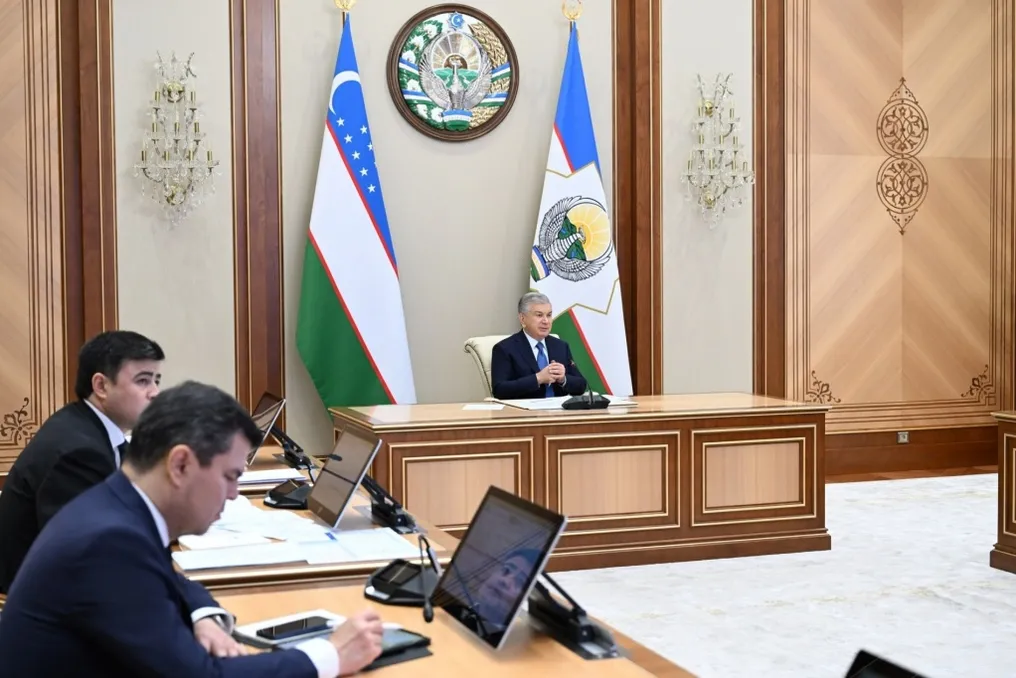
The Ministry of Justice reported that the President of Uzbekistan, Shavkat Mirziyoyev, signed a decree on August 14 concerning measures to improve the provision of installment services to the population. According to this document, the activities of installment service operators in the country will begin on January 1, 2027.
An operator in this context is defined as a legal entity that provides installment services, while banks and microfinance organizations are excluded from this definition. The right to conduct such activities will only become available after the company is included in a special register compiled by the Central Bank.
Banks and microfinance organizations will be included in this register by notifying the Central Bank, whereas other legal entities must undergo a registration procedure with the regulator.
What can be purchased on installments
The object of the installment plan can be a commodity whose value should not exceed 250 basic calculation units (this amount will be 110 million soms starting September 1). However, real estate, as well as property restricted or withdrawn from circulation by legislation, cannot be the subject of this service.
Installment operators are prohibited from issuing consumer financial loans and attracting funds from individuals. They may transfer claims rights under installment agreements exclusively to other installment operators, microfinance organizations, and banks.
Restrictions on commissions and fines
The decree also establishes specific requirements for the installment agreements themselves. These documents must clearly specify what commission or markup is charged by the operator, as well as all other payments included in the final price of the goods, work, or service.
The total amount of all payments exceeding the principal debt—including fines, penalties, and intermediary fees—must not exceed 50% of the installment amount within one year. Consumers have the right to repay the installment fully or partially early at any time without incurring any additional commissions, fines, or penalties.
The maximum term of the consumer's obligation under such an agreement is limited to 12 months from the date of its conclusion. Furthermore, starting January 1, 2027, organizations engaged in selling consumer goods loans are exempted from the obligation to send information about contracts worth up to 3 BCU (equivalent to 1.32 million soms) and how these contracts are fulfilled to credit bureaus.
Checking debt burden
In accordance with the new decree, installment service operators are obliged to comply with prudential norms and requirements of the Central Bank in the field of supervision and regulation. They must implement digital technologies for identifying and verifying clients when providing installment services.
Operators are also obliged to ensure the exchange of credit information with all credit bureaus for all concluded agreements and data on their fulfillment. When making a decision to grant an installment, the maximum debt burden set by the Central Bank must be taken into account.
These requirements also apply to some companies that formally provide consumer goods loans. If the quarterly turnover of such organizations exceeds 500 million soms, and the share of installments is 50% or more, they must undergo registration, be included in the register, and follow the requirements imposed on installment operators.
The Central Bank conducted an analysis and found that the installment market poses potential risks to financial stability. The regulator studied the user profile and revenue growth of services across various regions. The analysis showed that purchasing equipment through installments is often more expensive than obtaining a bank loan; for example, using the iPhone 16 Pro Max, the markup could reach 44%, and the actual overpayment could be up to 74% annually.
In June 2025, Central Bank Chairman Timur Ishmetov announced that the volume of the installment market in Uzbekistan reached 8.5 trillion soms. Since most of these agreements are not reflected in credit bureaus, this leads to an increase in the actual debt burden on the population. In this regard, the regulator proposed introducing an obligation for market participants to disclose data and indicate the exact amount of overpayment.