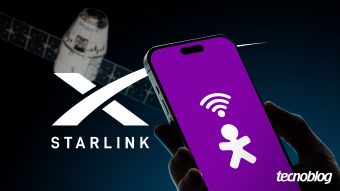
Vivo is expected to announce a strategic collaboration with Starlink in the coming months, provided current plans remain unchanged, aiming to offer satellite internet access. Both companies have already been conducting tests of the functionality known as D2D (Direct to Device).
Recently, customers noticed that Starlink appeared more frequently, even displaying the network named "Vivo Starlink" on devices. The specialized portal TeleSíntese reported in July that negotiations between the companies were underway.
Sources consulted by Tecnoblog indicate that the parties are advancing to the next phase: finalizing the agreement and beginning service provision. This union between Vivo and Starlink was enabled through a controlled regulatory environment (sandbox).
In simple terms, the National Telecommunications Agency (Anatel) relaxed the necessary requirements and protocols during the technology tests, allowing those involved to obtain results quickly and structure their future planning.
The Direct-to-Device (D2D) technology allows the mobile phone to connect directly to a satellite, eliminating the need for large external antennas. Many premium line devices and various mid-range models recently launched already have compatibility with this function. For D2D to operate correctly, it is essential that there are no physical obstructions between the phone and the satellite in space.
Even with this feature, D2D is considered a complement to the conventional mobile telephony network. Its usefulness will be notable in remote areas where the user cannot receive 4G, 5G, or other technology signals.
The details of the pact between Vivo and Starlink remain confidential. It is not yet known whether the Brazilian operator will provide the service at no additional cost—possibly only for subscribers to the most expensive plans—or if there will be a charge similar to international roaming.
In the United States, T-Mobile was the first operator to commercially launch a similar service in partnership with Starlink, called T-Satellite, in July 2025. Initially, it offered only text message exchange and is included in the Go5G Next plan. Customers on other T-Mobile packages or from competitors like AT&T and Verizon must pay an additional monthly fee of US$ 10, which is equivalent to R$ 52 in direct conversion.
The progress in the discussions definitively dispels the recurring rumor that Starlink would simply "release" the internet. This scenario is not permitted under regulatory scrutiny, as the satellite connection service can only be offered by a mobile telephone operator (Starlink does not formally fall into this classification).