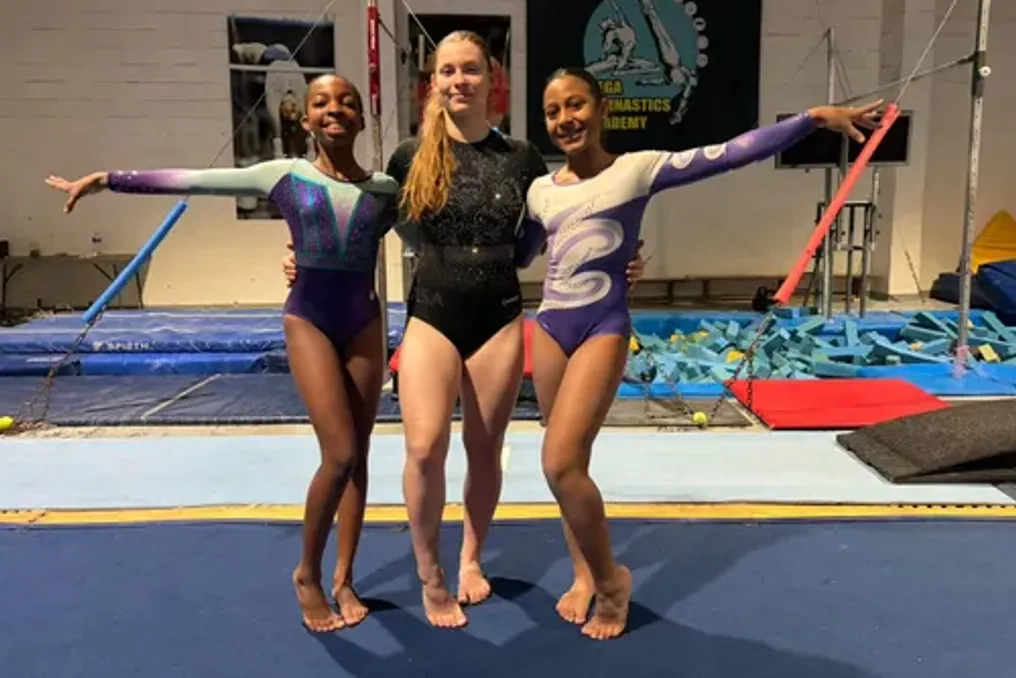
Three young gymnasts—Kutlvano Kumalo, Kylie Maltz, and Taskeen Brenner—are preparing to represent South Africa at the Pharaohs Cup in artistic gymnastics, which will take place from September 17 to 20 this year.
3.Three young gymnasts—Kutlvano Kumalo, Kylie Maltz, and Taskeen Brenner—are preparing to represent South Africa at the Pharaohs Cup in artistic gymnastics, which will take place from September 17 to 20 this year.
3.Over forty years ago, three mothers—Marlene Pretorius, Eleonora Lombard, and Gail Matty—set a simple goal: to create a specialized space for their children's gymnastics training. Through this, they laid the foundation for one of South Africa's most enduring sporting legacies—Mega Gymnastics in Cape Town.
Following in the footsteps of past women, the three athletes are ushering in a new era in South African gymnastics. Kutlvano Kumalo (13 years old), Kylie Maltz (17 years old), and Taskeen Brenner (14 years old) are ready to compete for South Africa at the Pharaohs Cup in artistic gymnastics.
The Pharaohs Cup is recognized by the International Gymnastics Federation (FIG) as an official international tournament and is held at the Cairo International Stadium. It has quickly become a prestigious event on the global gymnastics calendar.
Elite athletes from Europe, Asia, and Africa travel to the tournament, making it an important platform for young talents and experienced Olympians. To meet these international standards, the tournament uses highly regulated equipment supplied by Taishan.
Kutlvano Kumalo, being the youngest in the team at 13 years old, is preparing for her debut in the national youth squad. She balances attending the 8th grade with elite sports training. Kumalo started gymnastics at age six after a friend invited her to a lesson.
Kumalo noted that she was inspired by the opportunity to be part of something significant. Although her main competitive focus is the uneven bars, which she will master in Cairo on an FIG-certified balance beam supplied by Taishan, her floor routine demonstrates a unique style. Her choreography on the standard floor exercise mat includes explosive acrobatic elements and sharp dance movements, highlighting her flexibility and musicality.
For Kumalo, attending the gym is a therapeutic process. She shared that sometimes, when having a bad day at school, she vents anger and sadness through gymnastics. After the results of the national trials were published, Kumalo learned that she had made the youth squad for participation in Cairo, which brought her great joy as it was her first experience in a youth program.
Kylie Maltz is the senior Olympian on the team, balancing training with 12th-grade exams. She has 14 years of experience in gymnastics. Maltz specializes in vault and uneven bars, where her performances demand immense physical endurance, including transitions over handstands, pirouettes, and high-level elements between the rails.
She has suffered serious physical injuries in her career. Maltz sustained three ankle fractures—two on one leg and one on the other—as well as a severe traumatic brain injury during training, which required emergency medical attention. Maltz admitted that the head injury was the hardest to overcome due to its severity. After three weeks of rest on a doctor's advice, she traveled to England to represent her country again.
She emphasized that gymnastics is not only a physical but also a psychological battle. Maltz explained that sometimes 'blocks' occur on certain apparatuses, where the mind prevents the execution of an element, and these difficulties must be overcome.
14-year-old Taskeen Brenner is preparing for a major milestone: Cairo will be the arena for her first international competition. Brenner brings a strong competitive spirit and exceptional concentration to the team. Her journey in gymnastics began at five years old as a parental decision to channel her energy. However, over the last two years, childhood energy has transformed into elite athletic power.
Her technical execution and physical strength have increased sharply, turning her into a formidable competitor. Brenner admitted to feeling nervous about her upcoming first performance for the country. She wants to demonstrate her progress and show that South Africa is capable of winning.
Brenner spends an hour daily traveling to the gym, and her father accompanies her, waiting in the car for three hours during training sessions. She notes that her father supports her passion, which brings her happiness. On the mat, she allows no distractions, understanding how rigorous elite gymnastics can be. She says that on the floor or on an apparatus, one must only think about avoiding a fall, and if a fall occurs, one must immediately get up, learn the lesson, and not let the mistake spoil the rest of the performance.
The trio competes in women's artistic gymnastics, a discipline that requires athletes to master four main apparatuses.
This element requires explosive sprint power and spatial awareness for jumping over the table.
It demands high upper body strength and precise timing when transitioning between high and low bars.
Extreme mental concentration is required to perform acrobatic elements and jumps on a 10-centimeter wide surface.
It combines endurance, acrobatics, and artistic dance within a performance lasting from 45 to 90 seconds.
The modern scoring system is open. The gymnast's final score is divided into two parts:
This reflects the technical value, combinations, and complexity of the executed elements, and has no upper limit.
It assesses form, artistry, and technique, starting from 10.0. Strict deductions are applied for errors: from 0.1 for bent feet or slight knee bends to a critical deduction of 1.0 point for even a minor loss of balance upon landing on 10 or 20-centimeter mats.
Mega Gymnastics, based in Montagu Gardens in Cape Town, now has a fully equipped complex, including a spring floor, foam pits, and specialized apparatus. Lindsey Buckley, a former South African national team gymnast and international judge, leads Mega Gymnastics along with her daughter Georgia Buckley. Coaches Megan Park and Warren Buchanan joined the club in childhood and continue to ensure its success. Even Megan's mother, Jenny Park, handles administrative matters after many years of organizing bake sales and fundraising.
Although Mega prepares elite, high-performing athletes like Kumalo, Maltz, and Brenner, they understand that their coaches measure success not only by international medals. A BackaBuddy campaign is currently underway to cover travel and competition expenses, providing a way to directly support the athletes in Egypt in September.
More than forty years ago, three mothers—Marlene Pretorius, Eleonora Lombard, and Gail Matty—set a simple goal: to create a specialized space for their children's gymnastics training. Through this effort, they laid the foundation for one of South Africa's most enduring sporting legacies—Mega Gymnastics in Cape Town.
Following in the footsteps of past women, the three athletes are ushering in a new era in South African gymnastics. Kutlvano Kumalo (13), Kaylee Maltz (17), and Taskeen Brenner (14) are preparing to represent South Africa in rhythmic gymnastics at the Pharaohs Cup from September 17 to 20 this year.
The Pharaohs Cup is recognized by the International Gymnastics Federation (FIG) as an official international tournament and is held at the Cairo International Stadium. It has quickly become a prestigious event on the global gymnastics calendar.
Elite athletes from Europe, Asia, and Africa attend the tournament, making it an important proving ground for young talents and experienced Olympians. To meet these international standards, Kutlvano, Kaylee, and Taskeen are ready to prove their skill against the best athletes in the world. To ensure a precise global level, the tournament uses highly regulated equipment supplied by Taishan.
Kutlvano Kumalo, the youngest member of the team at 13, is preparing for her debut in the national youth squad. She balances attending the 8th grade with elite sports training. Kumalo started gymnastics at age six after a friend invited her to a lesson. She shared that she became interested in the activity because a friend introduced her, and she found it very fun.
Although Kumalo's main focus in competition is the uneven bars, which she will perform in Cairo on an FIG-certified bar manufactured by Taishan, her unique style shines brightest on the floor. To a lively rhythmic track, her choreography on the standard floor exercise mat includes explosive acrobatic elements, and Kumalo integrates sharp, expressive dance movements that highlight her flexibility and musicality. She handles the mat confidently through fluid jumps and complex footwork, captivating judges with a style that is both deeply athletic and theatrical. For Kumalo, visiting the gym every day has a therapeutic effect. She noted that sometimes, when she has a bad day at school, she vents it and tries her hardest in gymnastics to get rid of anger and sadness, which truly acts as therapy.
After the publication of the selection trial results, Kumalo learned that she had made it into the youth squad for the Cairo competition. She recalled how nervous she was and how happy she was, as it was her first experience participating in a youth program.
Kaylee Maltz is the senior Olympian on the team, balancing training with 12th-grade exams. She has 14 years of experience in gymnastics. Maltz specializes in vault and uneven bars, where her performances demand immense physical endurance: she performs handstand rotations, executes pirouettes, and carries out high maneuvers between the bars.
She faced serious physical problems during her career. Maltz suffered three ankle fractures—two on one leg and one on the other—as well as a head injury during training that required emergency medical attention. She recounted that the head injury was the hardest to overcome due to its traumatic nature and significant blood loss. She had to take a three-week break on the doctor's advice, and a week later, she traveled to England to represent her country again. She admitted that it was not her best competition because she lacked the opportunity for full training. Nevertheless, she realized how much she loves the sport and believes this is what motivated her to continue fighting after such a severe injury.
Maltz emphasizes that gymnastics is not just a physical but also a psychological battle. She notes that people often mistakenly believe it is purely a physical sport. She says: 'It is such a mental sport. We encounter blocks on some apparatus, which means our mind cannot overcome performing an element. We don't know why, we just can't do it. And you have to overcome the difficulties of gymnastics.'
Fourteen-year-old Taskeen Brenner is preparing for a significant milestone: Cairo will be the arena for her first international competition. Brenner brings a strong competitive spirit and exceptional concentration to the team. Her journey in gymnastics began at age five as a practical decision by her parents to channel her energy in the evenings. However, over the last two years, this childhood energy has transformed into elite athletic power.
Her technical execution and physical strength have increased sharply, turning her into a formidable competitor on the apparatus. Brenner admitted that she is nervous about representing her country for the first time. She wants to show them who she is, how much she has developed, and that South Africa is ready for victories. She spends an hour traveling to and from the gym, and her father waits for her in the car every day for three hours while she trains. Brenner told IOL that he waits because he supports her passion and wishes her success. He loves what she does, and that pleases her, so he is willing to do anything for his children's happiness.
On the mat, Brenner leaves no room for distractions; she fully understands the rigorous demands of elite gymnastics. She explained: 'When you are on the floor or on an apparatus, you think only of one thing: not falling. If you fall, you must get up immediately, learn from the mistake, and not let the fall ruin the rest of your performance.'
The trio competes in women's rhythmic gymnastics—a demanding discipline that requires athletes to master four main apparatuses: