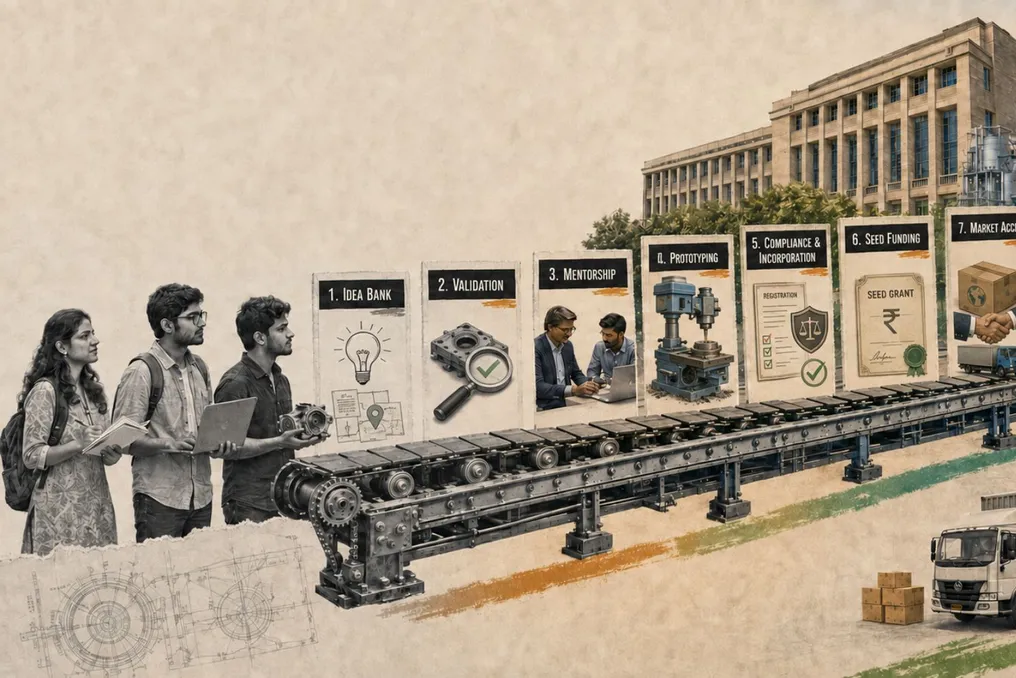
A new policy structure, presented on August 17, 2026, proposes the establishment of a National Entrepreneurship Mission. The goal of this mission is to create one hundred thousand new enterprises and provide 30–36 million direct jobs within five years. Instead of launching a new program, it focuses on integrating existing Indian schemes related to startups, MSMEs, research, training, and lending.
The document, titled 'Building India's Next 10 Lakh Entrepreneurs,' was prepared by Shraddha Sharma, founder and CEO of The Bharat Project and YourStory Media. It comprises twelve sections detailing the operational architecture, a table of responsibilities among ministries and funds under the Mission, and a 15-month plan from cabinet approval to national implementation, along with an evaluation system.
The author asserts that this structure is ready for implementation and does not require significant additional expenditure, as the necessary funds have already been allocated but are distributed unevenly. The diagnosis is that India has developed mechanisms for almost every stage of an entrepreneur's journey, but there are missing links between these stages. For instance, a startup receiving seed funding does not receive a mentor after securing the funds, and a company achieving revenue lacks a clear path to its first major client; all elements exist, but they are not connected.
What the National Entrepreneurship Mission will entail
The proposal is based on six key components. The first is a lifelong Entrepreneur Passport, which will be built upon the existing BHASKAR ID rather than alongside it, and will contain information on achieved milestones, payouts, repayment behavior, revenue, employment, and business closure. The second component is an Entrepreneurship Opportunity Map for each district, which will define the district's products, import capabilities that can be locally manufactured, and types of businesses realistically viable with capital ranging from 1 lakh to 100 million rupees.
The third point is a National Idea Bank, which will be populated with data from these maps for those who wish to create something but do not yet know what. The fourth point mandates the assignment of a mentor as a condition for disbursing funds to any publicly funded enterprise, while a multilingual AI assistant will handle routine consultations and compliance queries, directing complex requests to accredited specialists. The fifth component is structured demand, which involves legislative reservation on the GeM platform instead of recommendations, setting geographical targets for areas outside metropolitan cities, and annually publishing an evaluation system that will assess each central ministry and public sector undertaking based on the target metric of the first client.
The sixth point is verification of results based on GST and EPFO records, rather than self-declared reports. Specific goals are outlined: out of one hundred thousand enterprises, sixty thousand must survive and generate income by the end of the third year, with no less than 60% coming from non-metropolitan areas. Furthermore, one thousand enterprises must receive DPIIT recognition, and the Opportunity Maps must function in all more than 800 districts.
Why arithmetic urgency matters more than mere importance
The Mission is necessary because India needs to create approximately 12 million jobs annually, but only eight to nine million are being generated. The structure argues that government positions and corporate staff cannot cover such a deficit, leaving entrepreneurship as the only channel with sufficient scale to solve this problem.
The figures confirming this urgency are not encouraging. According to the Annual Labour Force Survey, which includes 2025 data, the unemployment rate among individuals aged 15 to 29 is 9.9%, which is approximately three times higher than the rate of 3.1% for all persons aged 15 and above, and 13.6% among urban youth. The 'State of Working India 2026' forecast shows that the 15–29 age cohort will shrink from approximately 367 million in 2026 to 245 million by 2036, meaning the demographic dividend is not being realized but is in the final phase of a cycle.
Despite this, the ecosystem at the highest level is considered world-class. As of March 31, 2026, over 220 thousand startups held DPIIT recognition, supporting 23.36 million direct jobs, with over 55,200 such companies registered in FY26. However, the situation deteriorates sharply below this level. A 2023 study conducted among 165 failed Indian startups showed that 27% of failure reasons were linked to financing, and 25% to sales and marketing—two areas that Indian policy funds treat separately and never combine.
Financial resources are also available. A Research, Development, and Innovation Fund worth 1 lakh crore rupees has begun deployment through the Council for Technological Development and BIRAC, and the Fund of Funds 2.0 came into effect on April 13, 2026, with a corpus of 10,000 crore rupees. Yet, none of these funds track founders across different entities. A deep technology founder might qualify for participation in four of them and know about only one.
How the registry differs from the railway network
A registry provides an identifier, stores a profile, and allows people to find each other. A railway network allows something to move along that identifier—that is, selection criteria, stages, and outcomes—instead of them remaining static. Aadhaar serves as an illustration of this concept. What mattered was not that it listed citizens, but that subsidies, entitlement to benefits, and authentication began moving based on it. BHASKAR, launched by DPIIT in September 2024, issues a unique identifier to every ecosystem participant and, according to the document, had 7.4 lakh registered users by mid-2026. Nevertheless, Startup India's own leadership confirms that DPIIT recognition continues to operate parallel to it. An identity was created, and it became another thing requiring registration.
Thus, the Passport proposal is not a second registry. It indicates that applications for seed funding, recognition, and mentorship read and record data into an already existing identity, which the document describes more as a managerial decision than a technical one. The evaluation will check more complex assertions, including constant operating expenses of about 1.67 lakh rupees per surviving enterprise and a permanent funding source at the district level, which the structure warns will happen unnoticed if not named. But perhaps the least dramatic proposal will prove to be the most significant. Once survivability, revenue, and jobs are verified using GST and EPFO data, any subsequent scheme can be accountable to a specific number that it cannot simply claim for itself.