The Africa2Moon project, an African radio telescope intended to travel to the Moon's south pole aboard China's Chang’e-8 mission in 2029, was described in the journal Nature Astronomy. The published paper details the operating principle of this instrument, which proved more complex than initially suggested in the general mission description.
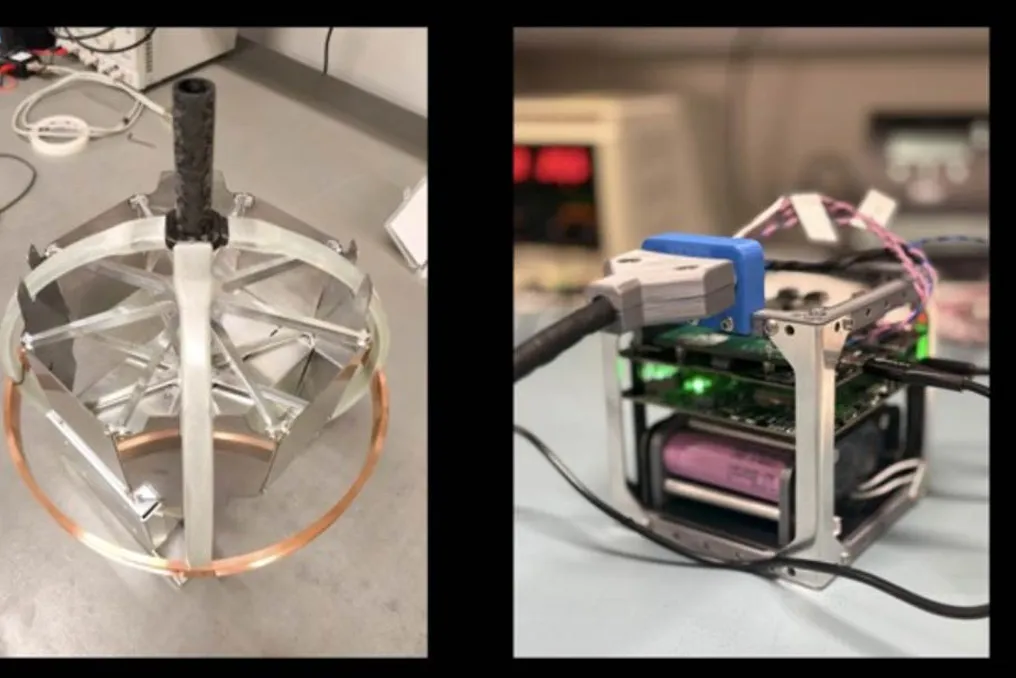
Three spherical units of Africa2Moon, named Bounced African Low Lunar Spheres or Balls, are not simply placed on the lunar surface. After delivery, they are designed to move freely across the surface, spreading out until the distance between them forms the baseline of a single telescope. If successful, this will be the first radio interferometer operating on the lunar surface.
Each sphere has a diameter of about 30 cm and weighs less than 4 kg. Inside each sphere are three concentric orthogonal loop antennas, eight solar panels, and a sealed electronic unit; each serves as an independent radio receiver. They are expected to operate for at least six Earth days.
During this period, the array will observe the Earth, the Sun, the galaxy, and the lunar surface itself. Furthermore, it will search for technosignatures—possible evidence of technologies existing beyond Earth. This means the African instrument will perform SETI-like work on the Moon, something not previously mentioned in the mission description.
The observation program also highlights an important distinction: the radio quiet zone on the Moon is located on the far side, which is protected from human-generated noise and the Sun at night. This demonstration instrument lands near the south pole, where Earth remains in view, explaining the inclusion of Earth in the observation targets. The full mission, which will eventually be equipped with 55 antennas—one for each African nation—is aimed at the far side.
Role of Rhodes University
The article also presents Rhodes University as a key participant in the mission, which has until now been primarily covered through Stellenbosch. Professor Oleg Smirnov, who holds a research position in radio astronomy at the South African Radio Astronomy Observatory (SARAO), is the lead researcher in radio astronomy. His group, the Center for Radio and Astronomical Technologies, has been working for over ten years on the exact problem posed by the mission: combining weak signals from several dispersed antennas into a single clear image. This discipline is fundamental to projects such as MeerKAT and the Square Kilometre Array.
Smirnov stated in a release from Rhodes University: 'It is the experience that South Africa has accumulated through MeerKAT and SKA that is necessary for this mission. It is Rhodes University and African radio astronomy reaching beyond the planet.'
Ariana Marais, Director and Head of Science at the Africa Space Development Fund, is the lead author of the article. Mission Director Karla Sharp Mitchell is also among the authors. Marais informed Forbes Africa in April that the cost of launching the payload independently would be around 1.3 billion rand. Joining international payloads like Chang’e-8 eliminates this expense, which is a decisive factor for the mission's realization.