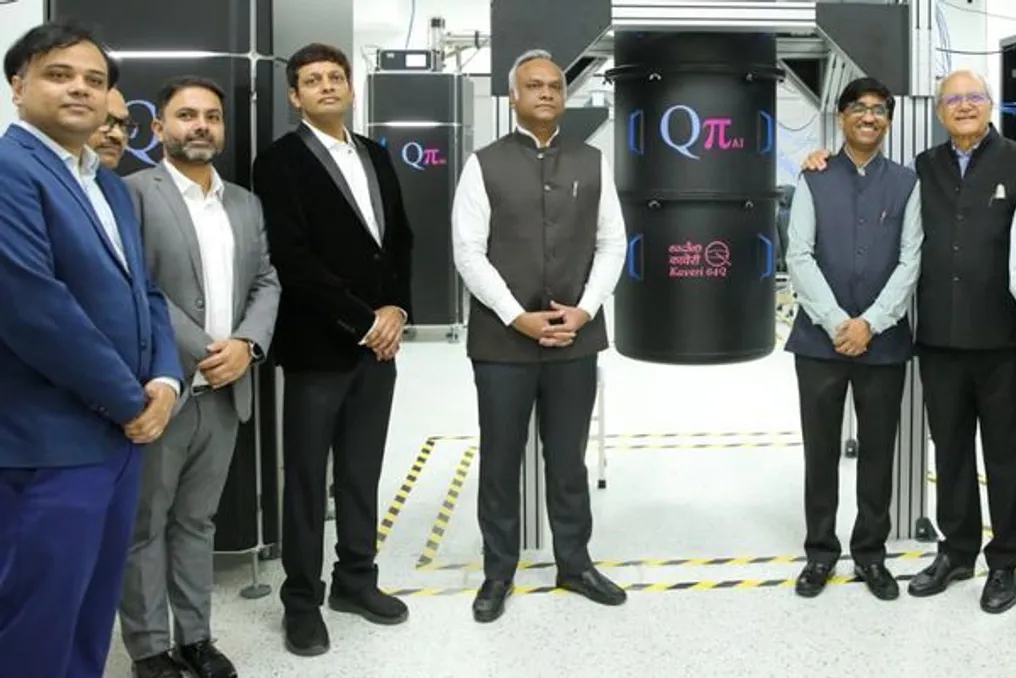
Quantum computing startup QpiAI launched a production complex for eight-inch quantum processors in Jaccure, Bengaluru, on Monday. The company announced that the second phase of this facility, named the quantum factory, is complete and enables the manufacturing of flip-chip superconducting processors with up to 128 qubits.
According to the company, the third phase, scheduled for completion in 2027, will allow the factory to produce Quantum Processing Units (QPUs) with up to 10,000 physical qubits.
In an interview with YourStory, QpiAI's founder and CEO, Nagendra Nagaraja, noted that the company handles the entire device production cycle, including lithography, etching, patterning, assembly, and packaging directly at the Bengaluru site. He emphasized that traditional semiconductor fabs are not equipped to create all the specialized components required for quantum computers, prompting QpiAI to build its own manufacturing capabilities parallel to processor development.
Nagaraja added that the current lag in quantum computing development is due to a lack of innovation in manufacturing. The factory will also produce peripheral chips and sensors used in quantum computers. QpiAI plans to use the facility for research into photonic and semiconductor qubits, while superconducting transmonic and fluxonium-derived qubits will be used for practical implementation.
Qubits are the basic units of information in a quantum computer, analogous to bits in a classical device. However, the utility of a quantum computer is determined not only by the number of physical qubits but also by their quality, error rate, coherence, and ability to work together.
The company reported that it has currently manufactured four processors: the eight-qubit QVidya, the twenty-five-qubit Indus, and the sixty-four-qubit Kaveri, all based on transmonic qubits. Additionally, the nine-qubit Yukti processor, utilizing a modified fluxonium technology, was created. QpiAI noted that Yukti demonstrated potential in developing logical qubits with error correction, which use multiple physical qubits and error correction methods for more reliable storage of quantum information.
According to QpiAI, its factory is the largest of its kind in Asia. It features Class 100 and Class 1,000 cleanroom facilities and will be expanded with additional equipment. This factory is part of QpiAI's 70,000 square foot R&D center, which also includes QPU testbeds and quantum solution development facilities. Nagaraja stated that most of the center is already operational, with the remaining section slated to launch in 2027.
To date, QpiAI has invested approximately $20–25 million in this facility and plans to invest another $10–15 million. According to Nagaraja, about 20% of the necessary components are imported. The company intends to localize more elements of its supply chain as it scales, especially when imported components become a bottleneck.
The factory will support QpiAI's proposed Quantum Supremacy Centers (QSCs). These centers will integrate error-corrected processors with AI chip clusters. Nagaraja stated that QPU manufacturing capabilities are crucial for realizing the company's plan to create 10,000-physical-qubit processors and subsequently interconnecting multiple processors to form larger quantum computing systems.
QpiAI plans to locate its first QSC on a 10-acre site with a total building area of about 300,000 square feet. The creation of four QSCs outside India is also planned, although the company has not disclosed their locations, investment requirements, or launch timelines. Nagaraja described QSCs as 'quantum AI factories' that will develop commercial applications demonstrating quantum advantage—the point at which a quantum computer can perform a useful task better than a classical one.
According to Nagaraja, initial export markets will include the Middle East, Southeast Asia, and the USA.
At the opening ceremony, Ajay Choudhry, co-founder of HCL, noted that QpiAI's decision to combine artificial intelligence and quantum computing prepares the company for a future where hyper-scale computing infrastructure and quantum systems operate in tandem. Choudhry commented that what is considered quantum technology today was the domain of AI five years ago, and many investors, including Indian ones, missed the early phase of AI opportunities. He also mentioned that QpiAI became the first company to receive support through its startup program overseen by the National Mission on Quantum Technologies.
Founded in 2019, QpiAI develops quantum processors, control systems, software platforms, and quantum AI applications. The company's headquarters are in Bengaluru, with offices located in Finland, the USA, and Singapore. In 2025, QpiAI raised $32 million in a Series A round led by Avataar Ventures and the National Mission on Quantum Technologies, becoming one of eight companies selected for support under this mission.