The Sun is the source of life for Earth, but periodic flares on this star lead to coronal mass ejections. These phenomena release huge volumes of plasma and magnetic fields into space.
The Sun is the source of life for Earth, but periodic flares on this star lead to coronal mass ejections. These phenomena release huge volumes of plasma and magnetic fields into space.
When this material heads toward Earth, its interaction with the planet's magnetic field can cause both beautiful auroras and geomagnetic storms capable of disrupting GPS, communication, and satellite systems.
Researchers from the New Jersey Institute of Technology have developed a new artificial intelligence that detects subtle signs of active region formation on the Sun even before they become visible on the surface. The model, named EarlyDetect, was able to predict this appearance approximately 9 hours in advance.
The study showed that changes in acoustic waves and the magnetic field can signal the genesis of these structures, meaning the Sun may provide preliminary warnings about the appearance of an active region. The EarlyDetect system has learned to recognize these subtle changes.
Currently, the system is not yet ready for real-time forecasting because false alarms still occur, and sometimes the warning arrives too late. Furthermore, the model does not guarantee that a flare will necessarily happen; many active regions never cause major events such as coronal mass ejections.
The researchers plan to test this approach on a larger number of solar events before turning it into a working tool for space weather forecasting. This research was published in the Journal of Geophysical Research: Machine Learning and Computation. The initial publication 'Em breve, podemos ter um “alerta” de explosão solar' appeared on the Olhar Digital portal.
Researchers from the New Jersey Institute of Technology (NJIT) have developed a new artificial intelligence system capable of identifying subtle signs of active region formation on the Sun even before they become visible on the surface. The model, named EarlyDetect, was able to predict this appearance, on average, 9.24 hours earlier.
The study, published in the Journal of Geophysical Research: Machine Learning and Computation, demonstrates that changes in acoustic waves and the magnetic field can signal the genesis of these structures. Some active regions potentially can lead to solar flares.
Active regions are zones of strong magnetic activity where sunspots occur. Their formation takes time, starting within a few hours and potentially extending over one or several days until reaching a full stage.
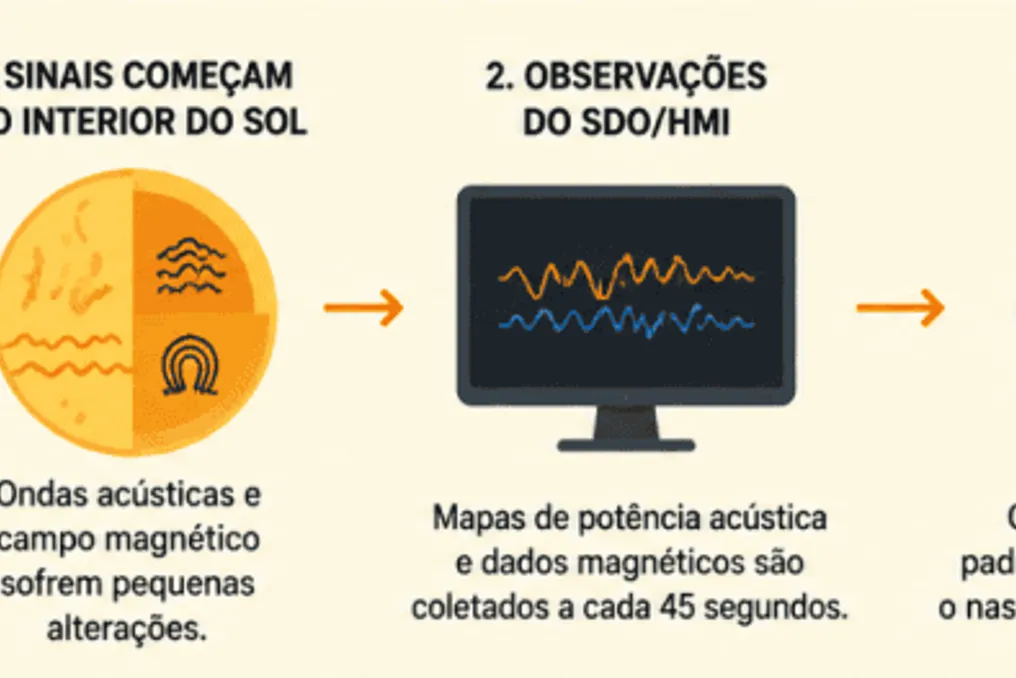
However, before these structures become visible, they leave traces. As the magnetic fields inside the Sun advance, they cause minor changes in the acoustic waves passing through the celestial body. It is these faint signals that EarlyDetect searches for.
The model analyzes hourly maps of acoustic power and magnetic field data collected by NASA's Solar Dynamics Observatory (SDO). The acoustic information comes from the Helioseismic and Magnetic Imager (HMI), which records observations every 45 seconds.
The main task is to detect extremely small changes in the magnetic field and the pattern of acoustic waves that continuously move across the Sun. This is comparable to finding a slight change in rhythm in a very noisy orchestra.
Alexander Kosovichev, an NJIT physics professor and lead co-investigator of the project, noted that EarlyDetect uses the Transformer architecture, the same technology applied in large language models. However, instead of processing words, the AI learns to recognize patterns found in solar observations.
An unexpected issue arose during this process: a filter used on the data to facilitate pattern identification actually degraded the results. As Kosovichev explained, it was initially expected that the filter would help highlight useful short-term patterns, but instead, it eliminated the very weak fluctuations that provided the earliest warning.
After training on SDO/HMI data, EarlyDetect was tested on previously unused active regions. The version with the best performance detected precursors, on average, 9.24 hours earlier than these structures became visible. This result surpassed the performance of traditional Transformer and previous benchmark approaches.
The team created an open dataset, the Solar Active Region Emergence Dataset (SolARED), based on SDO observations, as well as a Solar Active Region (SAR) portal for studying this data.
Currently, the system is not yet ready for real-time forecasting because false positives and instances where alerts arrive too late still exist. Furthermore, the model does not guarantee that a flare will occur; many active regions never cause major events, such as coronal mass ejections. Researchers plan to test the approach on a larger number of solar phenomena before turning it into an operational tool for space weather forecasting.