The experience of living safari days, comfort, and connection at Fazenda Caiman in the Pantanal was marked by unforgettable moments, such as spotting a puma crossing the road during a safari ride.
This American feline, also known as the suçuarana, is notably more discreet than the jaguar, being shyer and consequently harder to see. The encounter with the animal, in broad daylight and so close to the vehicle, was considered a great stroke of luck.
The author recounts that after this first trip in 2020, she returned to the Pantanal several times, being surprised on each visit. She compares the experience to Heraclitus's maxim, stating that 'no man steps in the same river twice, for it is not the same river and he is not the same man.'
The Pantanal is described as an example of impermanence in a wild state, preserved in a reserve that combines the immensity of nature with well-maintained infrastructure, such as that offered by Caiman. Currently, the farm covers almost 53 thousand hectares in southern Mato Grosso do Sul, integrating conservation, ecotourism, and extensive cattle ranching, in addition to offering high-quality hotel services.
Caiman's history began with Roberto Klabin, an entrepreneur and environmentalist who frequented the Pantanal since childhood. In 1985, when ecotourism was still nascent in the region, he began transforming the family farm into what is Caiman today.
Fazenda Caiman Structure and Accommodations
During her stay, the author lodged at Casa Caiman, the property's main headquarters. There are also two more isolated options: Villa Baiazinha and Villa Cordilheira.
Casa Caiman, recently renovated, has 18 suites with balconies. Its environments are characterized by high comfort and decoration that reflects local culture and the surrounding landscape. The cuisine also values the Pantanal, using regional ingredients, products from the farm itself, and small local suppliers.
Leisure time includes drinks enjoyed by the pool at the headquarters, overlooking Baiazinha, a permanent lagoon that attracts various birds. The gym and sauna also offer privileged views, allowing observation of the changing light on the lagoon's water and the birds in the sky.
Villa Baiazinha is a smaller and more secluded option, featuring six suites for up to 12 guests. It offers balconies, hammocks, a pool with a deck, and an entirely glazed room facing the landscape. Operating privately, with exclusive cars and guides, it provides greater freedom in scheduling, ideal for groups of friends or families.
A recent addition to Caiman is Villa Cordilheira, which has been renovated and accommodates up to 16 people. This accommodation is suspended over the cordilheira forest, featuring seven 70m² bungalows equipped with a balcony, infinity pool, gym, bar, and a spacious common room. The decoration follows the Caiman standard and received touches from designer Claudia Gelpi, with exclusive service from guides and private cars.
Safari and Wildlife Observation Routines
Tours, including horseback riding and canoeing, follow the natural rhythm of the Pantanal. Safari vehicles usually depart in the morning, generally at half-past five, and again in the afternoon, around three o'clock.
This schedule respects the logic of the fauna: in the early hours of the day, when the temperature is milder, the animals are more active. As the heat increases, part of the wildlife seeks refuge in more protected areas, and in the late afternoon, activity resumes.
The initial moments are marked by silence, which is gradually filled by isolated calls and later by birds. At dawn, the sky displays vibrant colors—orange, yellow, gold, and blue—providing a unique perspective on the scales of the Pantanal.
Around ten o'clock, the vehicles return to the headquarters for a full breakfast. After this moment, guests can rest, read, or exercise with a view of Baiazinha. The author recalls a special moment on this trip, reading while a pair of blue macaws vocalized near the pool.
Lunch is served at noon, a quiet time for guests to socialize and share the morning's discoveries, as the next outing does not occur until three in the afternoon.
Like in Africa, the Pantanal has its most sought-after animals by observers: jaguar, giant anteater, tapir, Pantanal deer, and capybara. In addition to these, there are field deer, peccaries, pumas, caimans, birds, fish, field foxes, monkeys, and butterflies.
The flora is also remarkable, with acuri and carandá palms, cambarás, and piúvas that can reach 20 meters in height. During the dry season, many plants lose their leaves and bloom in shades of pink and purple, adding splashes of color to the green landscape.
Unpredictability is what makes every tour unique. Tuiuiús and caimans are seen frequently, but they always make an impact. The caimans, even if constantly present, are observed in different states, either motionless sunbathing, with only their eyes visible, or with their mouths open to regulate body temperature.
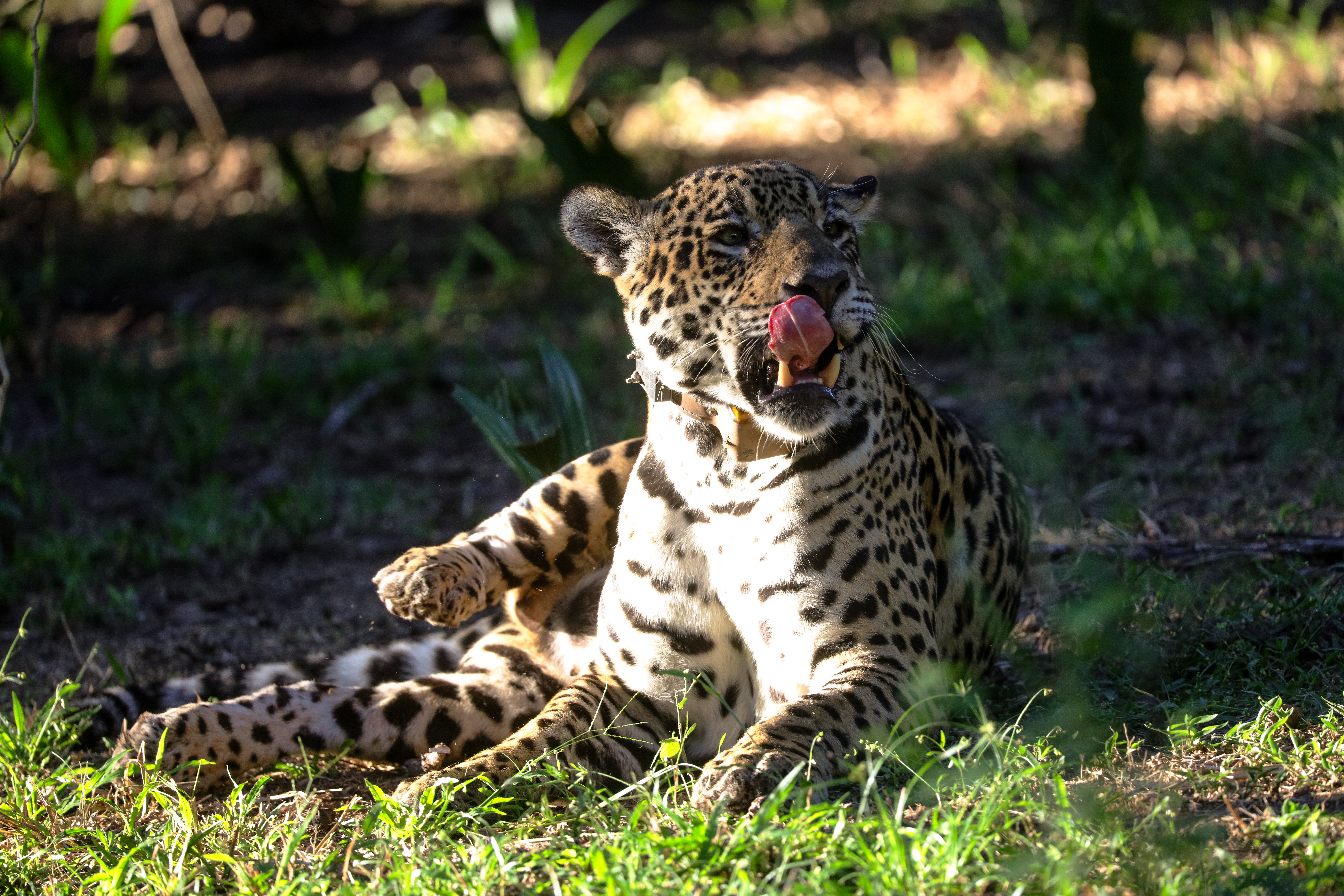
The Blue Macaw Project, founded in 1990 by biologist Neiva Guedes, is a reference in the study and conservation of the large blue macaw in the Pantanal. At Caiman, visitors interact with the animals in their own environment. The jaguars, monitored by the Onçafari project, undergo a habituation process to vehicles. During excursions, the project team accompanies jaguars known for years, many of them named and with documented history by researchers.
The coexistence between livestock farming and wildlife presents challenges, such as the fact that jaguars occasionally prey on the farm's own cattle. A fascinating episode was reported where a known female exhibited repeated mating behaviors with different males, which researchers interpreted as a strategy to keep the males occupied and away from the young.
Water Cycle and Seasons of the Pantanal
Seasons in the Pantanal are not defined by summer, spring, autumn, and winter, but rather by the water cycle. Generally, flooding occurs from December to March; receding waters from April to June; dry season from July to October; and the rainy period from October to December.
During the FLOODING, the overflowing of rivers floods vast areas of the plain, transforming the landscape and increasing the presence of aquatic birds, such as tuiuiús, cabeças-secas, ducks, mallards, and herons.
In the RECEDING WATERS, the water level gradually drops, causing previously flooded areas to reappear. With the water retreating, mammals such as peccaries, catetos, Pantanal deer, and monkeys become more frequently seen.
The DRY SEASON concentrates animals around the remaining water sources, facilitating wildlife observation. It is also the period when piúvas and pink ipês bloom, drastically altering the color of the landscape.
The RAINY PERIOD marks the beginning of precipitation and the rebirth of green. Although mammal sightings are less common, flocks of birds cross the sky, with many species in their reproductive phase.
Additional Experiences on the Property
Besides car tours, it is possible to explore the region on horseback. During one of the last stays, the author rode a Pantanal horse, crossing wooden bridges and passing through fields where cattle coexisted with herons and deer. This perspective changed her perception of the Pantanal, intensifying the sounds and aroma of the forest.
In a clearing, she found a welcoming scene with colorful hammocks and cushions. On a wooden table were tereré, baru nuts, fruits, and farofa with dried meat, typical flavors of the Pantanal field culture and routine. Later, she rested in a hammock, observing the treetops against the sky.
Caiman has lagoons and bays, being part of its area watered by the Agachi stream, located between the Miranda and Aquidauana rivers. One afternoon, she took a contemplative canoe ride through the bay, where the water mirrored the sky, passing under the Paizinho Bridge, a landmark of the property.