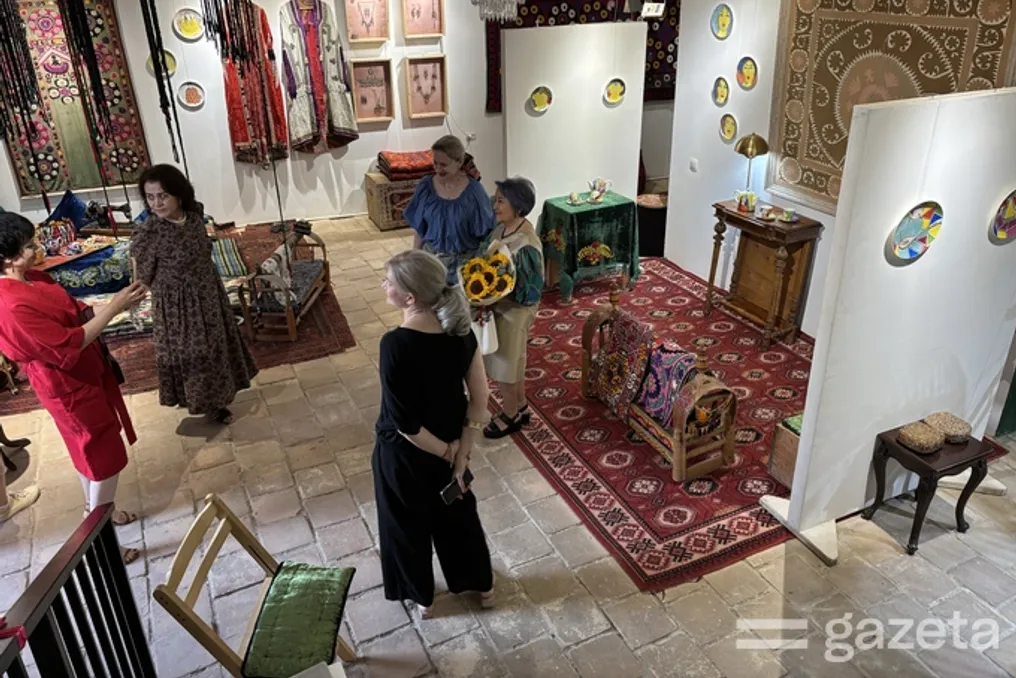
A solo exhibition by the artist and ceramicist Rimma Gazaliyeva titled 'Qimmat' was held at the Zanmakon cultural center. The event is dedicated to women, their life experiences, creative activities, and role in society, making Rimma Gazaliyeva an ideal figure for this venue.
Elnora Ibragimova-Rizayeva, co-founder of Zanmakon, notes that Gazaliyeva's work is a kind of essay on a new type of woman. She emphasizes that the artist herself went through a path of self-determination, shifting focus from others to herself, and now creates images of heroines who are confident, value themselves, and are not afraid to follow their own desires. In her opinion, this serves as inspiration for many women.
Rimma Gazaliyeva has many years of experience working with ceramics and porcelain. Her education includes studies at the Republican Art School named after P. Benkov, followed by training in the ceramics department of the A. Ostrovsky Tashkent Theatre Arts Institute. After graduation, she completed an internship at the Kuvasay Porcelain Factory in the Fergana Valley, where she continued working and reached the position of chief artist. Gazaliyeva believes that this factory allowed her to actively experiment and develop her unique approach to working with materials.
The artist shares that her creative path is rich in various directions, and many are surprised that one person realizes all of this, which is the result of accumulated experience and developed aesthetic taste. She mentions that visiting museums in other countries plays a key role in shaping her taste and finding new ideas.
For most of her life, Gazaliyeva balanced her artistic endeavors with the responsibilities of running a household and raising children. She admits that this severely limited the time she could dedicate to her own art, as she engaged in creative work on a residual basis, postponing plans.
Only after her children grew up was she able to fully engage in personal projects and work in her studio in Tashkent. Her personal experience deeply influenced her views on the status of women. In her works, she strives to move away from the stereotypical representation of a woman solely as a mother, wife, or homemaker, presenting her as an independent individual with her own interests, desires, and the right to determine her own life path.
As a result of this creative pursuit, Gazaliyeva created a series of female portraits depicting modern young women who differ in character and mood but are united by a sense of freedom of expression. When people saw these works, they sometimes commented that the heroines looked 'arrogant.' Gazaliyeva countered this, considering them confident, self-sufficient, and thoughtful. One commentator called them 'Qimmat,' which prompted the artist to think: 'let my girls be Qimmat.'
The term 'Qimmat' comes from the Uzbek folk tale 'Zumrad and Qimmat.' Unlike Zumrad, who is traditionally depicted as a meek and compliant sister, Qimmat is her complete opposite. The exhibition title refers precisely to this image. Gazaliyeva invites viewers to look at the willful Qimmat differently: instead of perceiving her pride as arrogance, she sees in her independence and the ability of a woman to determine her own destiny without trying to please everyone.
A distinctive feature of Gazaliyeva's female figures is the absence of a specific prototype; the artist invents her heroines directly during the creative process. Each of them possesses unique features, hairstyle, facial expression, and gaze. Gazaliyeva deliberately omits ornaments or other details that might indicate the heroines' social status or level of wealth.
The artist explains that she consciously created a 'pure image' without earrings, necklaces, or other accessories to emphasize the self-sufficiency of a woman who does not need external additions. For her, the face, posture, and gaze are important, as this is how a modern young woman looks.
It should be noted that the works are not part of a separate exhibition but are integrated into the museum's interior. Painted plates with female faces are placed next to Suzani and paintings, while bright teapots, cups, and saucers are set on old wooden furniture and a Soviet radio. This allows the porcelain to be perceived simultaneously as a work of art and as a recognizable object of daily life.
The 'Qimmat' exhibition will be available for viewing until August 25th daily from 10:00 AM to 7:00 PM, with free admission.