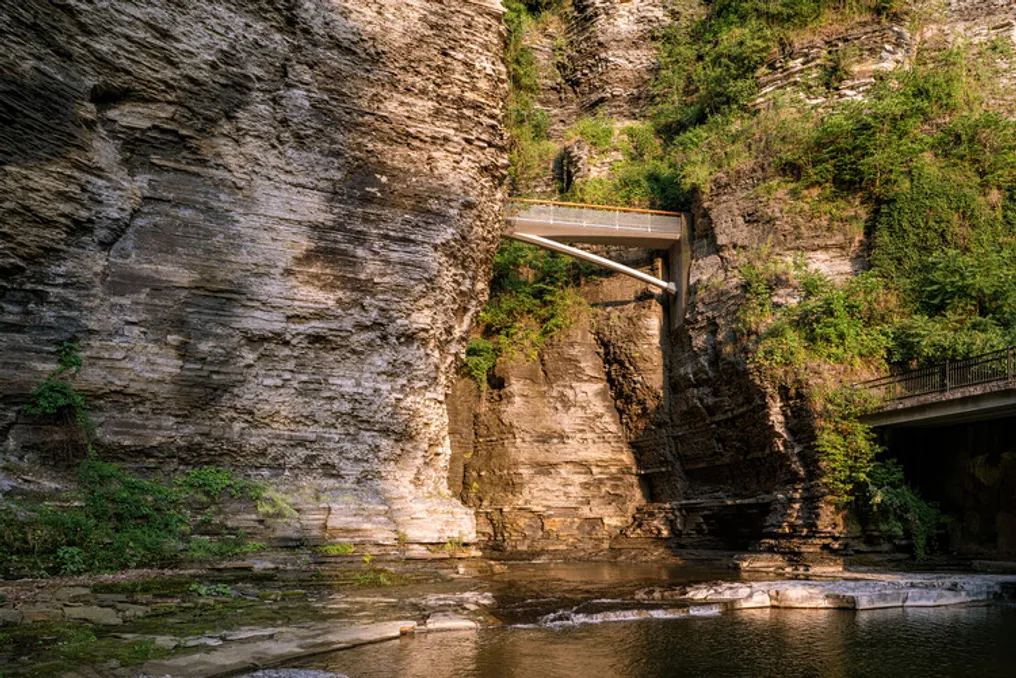
The Office of Parks, Recreation and Historic Preservation of New York State (OPRHP) has unveiled the new Sentry Bridge in Watkins Glen State Park, which serves as the main entrance to one of New York's most iconic natural attractions. The project was developed by a team led by the New York bureau schlaich bergermann partner (sbp) and Snøhetta. The bridge reinterprets the park's long-loved route, combining engineering innovation with deep respect for the historical character of the area and its dramatic natural landscape.
Watkins Glen State Park offers a remarkable journey among cavernous rock walls, waterfalls, tranquil natural pools, and mossy passages. The new Sentry Bridge, created with the involvement of sbp and Snøhetta, builds upon the legacy of trails established in this esteemed state park. It marks the entrance to the gorge and honors the century of public works carried out by OPRHP.
Every year, over a million visitors traverse the famous Gorge Trail. Since the bridge is the entry point to the canyon, it and the trail improvements set the tone for the entire adventure. The new structure replaced the original Sentry Bridge, which served visitors for over a century. Following inspections that revealed structural degradation caused by erosion and rock instability, OPRHP determined that a complete replacement was necessary and commissioned sbp and Snøhetta to develop a permanent solution that would pay tribute to the historic bridge while addressing the unique engineering challenges of the site.
The bridge and trails immortalize the stories and craft traditions of the gorge, protect the unique ecosystems of the cliffs and streams, and enhance the experience of stone and water.
The custom-fabricated steel structure extends 14 meters over the gorge, relying entirely on the north side where the bedrock is more stable and capable of bearing the load. The semi-circular shape of the bridge recedes behind the southern rock face, expanding views of the waterfall, cliffs, and upper gorge trails built during the Civilian Conservation Corps (CCC) era.
The bridge demonstrates how meticulous engineering can support both performance and experience. By developing a lightweight cantilever structure that could be prefabricated and installed with minimal impact on the gorge, they created a durable crossing that respects the ecological characteristics of the site while enhancing the journey through one of New York's most outstanding landscapes.
Craftsmanship is central to the bridge's character. Materials—polished stainless steel, black acacia railings, individually cast bronze elements, concrete formed from rough-sawn fir planks, and a new bluestone platform—were deliberately chosen for their contextual, tactile, and durable nature.
The site-made bridge bears the imprint of its creators. The details are subtle and understated, designed to withstand time rather than resist it.
The cast bronze details incorporate subtle elements of the local landscape: a depiction of a rare butterfly, a rare plant, and a model of a historic arch bridge, offering detailed and tactile moments for pausing and appreciating the cultural and natural heritage of Watkins Glen. The bridge also meets the strict 100-year durability requirements set by New York State Parks, which dictated every material decision.
From an experiential standpoint, the structure frames views of the waterfalls and geology below, intensifying the perception of constantly changing mist and light, and creating a physical encounter with the landscape rather than just a passage through it. Thoughtful material transitions give visitors something to touch, something to feel, providing a direct connection to the place. Individual black acacia railings and anchor points, inspired by climbing pitons, run along the uneven surfaces of the rocks and tunnels, providing support and stimulating movement past the waterfalls, through the tunnels, and up the rock-cut stairs.
Through the careful integration of architecture, engineering, craftsmanship, and environmental responsibility, the new Sentry Bridge continues the long tradition of Watkins Glen—connecting people with nature through thoughtfully designed public structures.