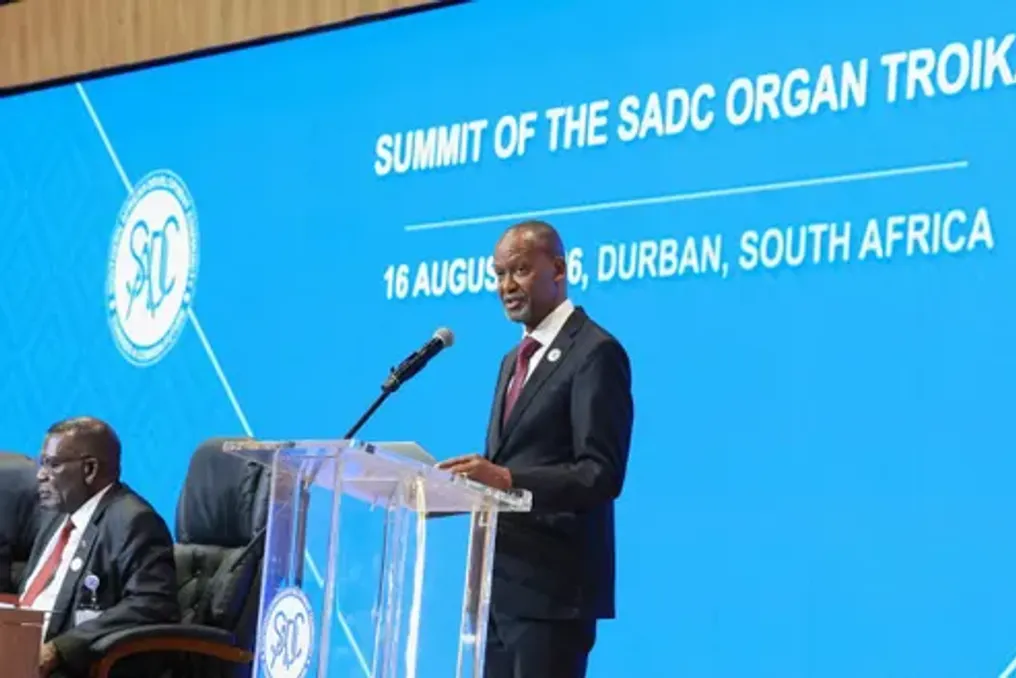
SADC Secretary Elias Magosi spoke at the 46th SADC summit in Durban, strongly urging regional countries to abandon the export of critically important minerals in an unprocessed state. He emphasized the need to accelerate processes of processing, production, and industrialization.
Magosi addressed South African states with a demand to stop exporting raw materials, arguing that the region must transition to job creation and resource enrichment through processing and industrial development. Speaking at the summit of heads of state and government in Durban on Monday, Magosi noted that despite abundant reserves of critical minerals, the region needs to move beyond current commitments and begin adding more value to them.
He stated: 'The issue is when we stop exporting them in raw form and start adding value to them, creating sustainable jobs and prosperity. Once again, we do not need permission from anyone to start this process. Let's start now!'
Magosi believes that SADC is in a favorable position to leverage the global shift towards clean energy, digital technologies, and advanced manufacturing. The region possesses platinum metals, lithium, cobalt, graphite, manganese, rare earth elements, and copper, which he says are vital for future industries.
'Our goal should be to move beyond raw material exports and position SADC as a globally competitive hub for processing, added value, production, innovation, and industrialization,' he said.
He stressed that industrialization remains a key element for economic diversification, job creation, poverty reduction, and improving the quality of life. Magosi added that the success of industrialization is impossible without modern and reliable infrastructure, including sustainable energy systems, functioning transport networks, ports, logistics platforms, and accessible digital connectivity.
Magosi also touched upon regional security. He reported that the SADC Summit Trio on Political, Defence and Security Cooperation reviewed the political and defence situation in the Democratic Republic of Congo, Madagascar, and Mozambique. The Secretary expressed concern about the situation in eastern Democratic Republic of Congo.
At the same time, he welcomed the progress made through diplomatic engagement and Africa-led peace initiatives, affirming SADC's commitment to supporting peace restoration efforts, protecting civilians, and creating conditions for sustainable development. Magosi also expressed solidarity with the DRC regarding the Ebola outbreak, noting that this situation highlights the importance of closer regional cooperation in health protection, surveillance, preparedness, and coordinated response measures.
Furthermore, Magosi noted the positive dialogue taking place in Madagascar thanks to the efforts of the SADC Secretariat, the Mediation Group, and the Council of Elders.
He concluded that the changing global landscape, characterized by economic uncertainty, climate challenges, technological transformation, and shifting geopolitical realities, increases the need for deeper regional integration. Magosi stated that it is now recognized that reliance on external partners is impossible, and there is a greater need to depend on and trust each other.
The Secretary called on regional countries to engage in joint trade, investment, and construction, emphasizing that no country can realize its full potential in isolation.
Agriculture remains the cornerstone of many SADC economies and a source of livelihood for millions of people. Magosi reported that member states continue to invest in irrigation, mechanization, climate-smart agriculture, improved seed systems, and agro-processing, which has contributed to increasing food security and reducing food insecurity in the region by 16%. He called for further investment across the entire agricultural value chain—from production and processing to storage, transportation, and market access—which, in his opinion, will enhance food security, create jobs, and stimulate inclusive growth.
Magosi also identified youth as a central element of the region's future, calling for investments in quality education, development of technical and vocational skills, digital literacy, innovation, entrepreneurship, science, and technology. He stressed that supporting youth-led enterprises, expanding access to finance and technology, and creating pathways to decent employment will be crucial for the region's long-term success.
In conclusion, Magosi congratulated President Cyril Ramaphosa on assuming office as SADC Chairperson on Monday. On behalf of the SADC Secretariat, he extended wishes to His Excellency President Matamele Cyril Ramaphosa, who assumes the post of SADC Chairperson, and pledged full support and unwavering commitment to effectively carry out his mandate. He expressed confidence that under Ramaphosa's leadership, the regional body will continue to advance its vision of a peaceful, sustainable, industrialized, prosperous, and integrated Southern Africa. The 46th SADC Summit is held under the theme: 'Sustainable, Fair and Inclusive Industrialization through Infrastructure Development, Agricultural Transformation and Critical Minerals in Pursuit of a Just Peace.'
The Customs Committee of Uzbekistan prevented two attempts to illegally export gold and foreign currency across the state border using minor children.
Details of the first incident
The first case was detected at the Navoi border customs post in Tashkent region. During the inspection of a woman leaving the country, customs officers discovered two gold bars weighing approximately 200 grams hidden in an infant's diaper. Additionally, 70 grams of jewelry were seized from her after she failed to declare these items during customs control.
Preliminary estimates indicated that the total value of the seized valuables amounted to approximately 450 million soms.
Second case and legal norms
In the second case, a citizen of a neighboring country attempted to take out $40,000 USD from Uzbekistan by hiding the money under the clothing of his 14-year-old daughter. The violation was discovered when crossing the state border.
The Customs Committee reminded that individuals have the right to take out foreign currency from the country up to the equivalent of 100 million soms, provided customs regulations are observed.
Furthermore, the agency emphasized that involving minors in administrative offenses is considered an aggravating circumstance. Such actions entail a fine ranging from 10 to 30 basic calculation units. If a minor participates in committing a crime, the law provides for imprisonment for a term of five to ten years.
Customs investigations are currently underway regarding both incidents.