
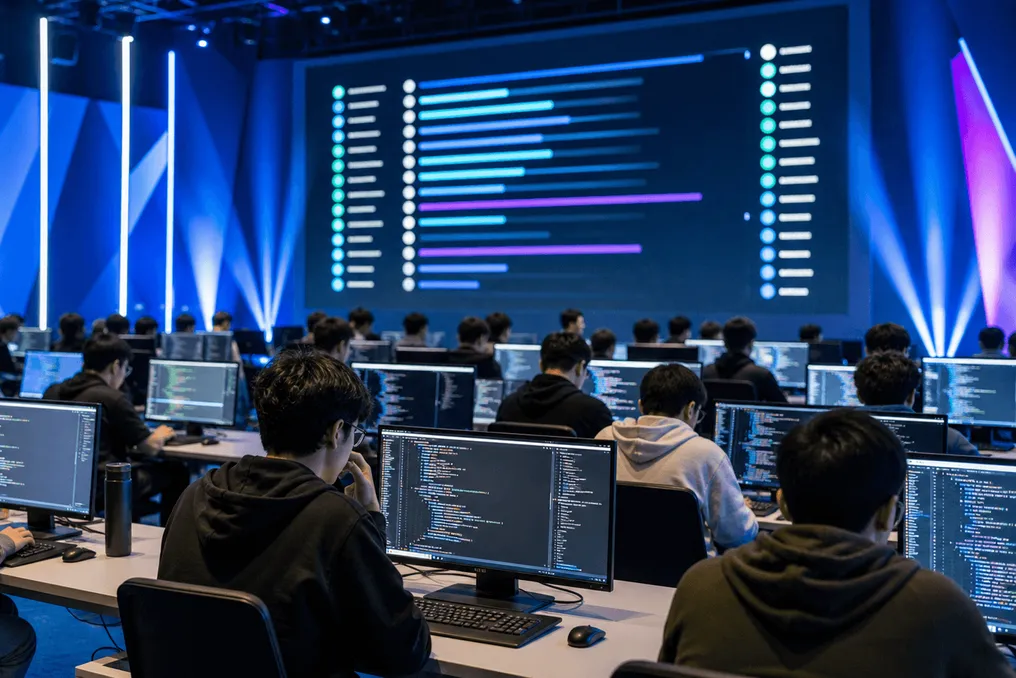
The final of the seventh National Computer Systems Contest for Students, which featured the innovative design track for intelligent computing called XianDao Cup, has concluded. The competition gathered teams from 160 universities, encompassing over 500 teams and more than 1900 students, generating significant resonance in the field of artificial intelligence.
This new generation of students actively utilizes advanced domestic computing power to solve pressing issues in the real sector of the economy. XianDao Cup is the only national competition in computer systems focused on intelligent computing, boasting a history of nearly two decades.
According to Gao Xiaopeng, director of the organizing committee, the contest was initiated during a period when the transformation of education from knowledge transfer to competency development was proposed. Its goal is to form and discover talent reserves for key national software and hardware programs, creating a pool of personnel with practical skills in domestic intelligent computing.
The organizers include the National Association of Higher Education Computing, an expert group for training systemic capabilities, and initiating universities. The contest provides free computational and technical training using a standardized 'black box' evaluation system. Sugon, as a joint organizer, provided access to China's first fully domestic AI supercluster with 100,000 cards via the National Supercomputer Internet platform, presenting advanced computing resources to university students for the first time.
The contest tasks are directly oriented towards industry scenarios rather than demonstration projects. They include tasks related to large-scale modeling implementation, AI application in science, system optimization testing, engineering realization, and innovative practice.
Two tasks took center stage. The first involved optimizing the inference service for large Qwen models on domestic accelerator cards, focusing on reducing latency when handling long texts, managing GPU memory, and increasing throughput, which required deep optimization within the defined model and framework boundaries. Such students are highly valued by many domestic AI giants.
The second task concerned optimizing the deployment of a large meteorological model within the country's scientific computing ecosystem, including constraints related to low-orbit satellites. By utilizing the OneScience intelligent computing ecosystem with meteorological models for lightweight deployment, the key advantage is accelerating forecasting by over 1000 times, allowing for detailed meteorological data acquisition. Application areas include extreme weather event warnings, hydro-, wind-, and solar energy dispatching, agricultural support, port vessel operations, and atmospheric management; optimized models are available via API and for private deployment.
During the event, which lasted over three months, Sugon provided full support for domestic computing throughout the entire lifecycle, using a collaborative task definition mechanism of 1+1+1: each task was developed by one expert, one university instructor, and one technical team. The systems used by students during the contest are identical to those employed by enterprises in production processes, which contributes to data accumulation and model optimization for domestic computing, creating a snowball effect in the ecosystem. Although the habits of senior developers related to CUDA are difficult to change because domestic toolchains differ significantly, the current generation starts from scratch, avoiding historical baggage. Gao Xiaopeng noted that the value of the contest also lies in the participation of leading domestic enterprises that develop talent through competition and recruit them into their companies.