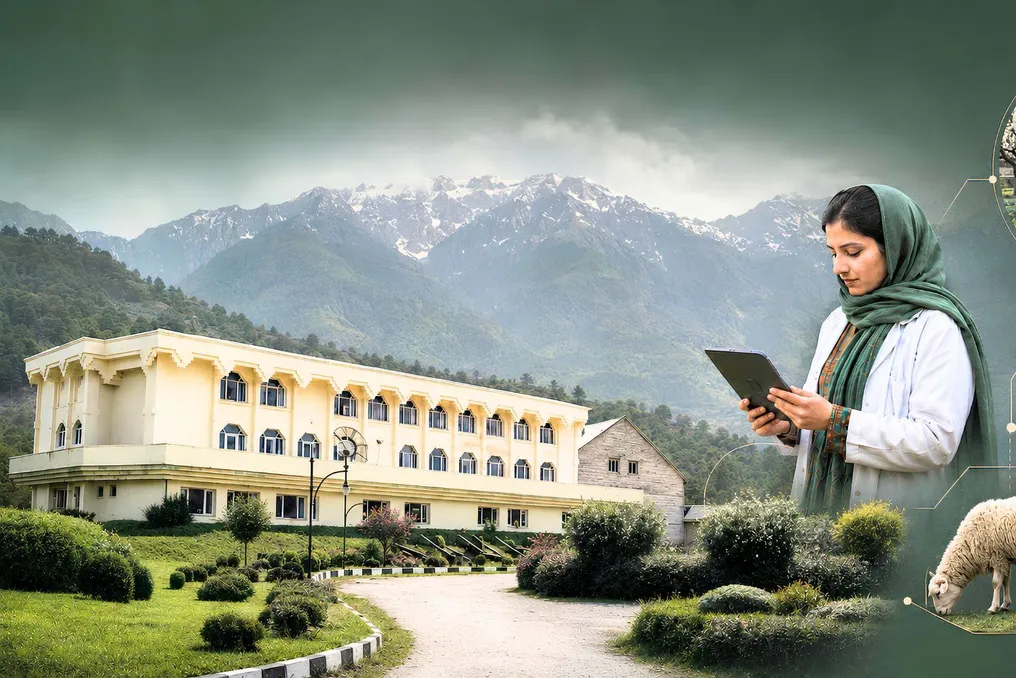
Under the leadership of Vice Chancellor Professor Nazir Ahmad Ghani, SKUAST-K has transformed from a traditional state agricultural university into the scientific core of a large-scale farming program valued at 5,013 crore rupees. It has also become the first incubation center in Jammu and Kashmir, against which the state's startup ecosystem is now measured.
Similar stories
Popular
In January 2026, at the Annual Startup Fair in Jammu, Chief Minister Omar Abdullah presented the 'Incubator of the Year' award to the center that did not exist five years ago. The SKUAST-K Innovation, Incubation and Entrepreneurship (SKIIE) center received a Certificate of Distinction, 50,000 rupees in prize money, and seed capital of 50 lakh rupees. Four of its incubated enterprises—Cashmircarbozone, Alhamdan Crafts, Safavi Organics, and Innxu Innotech—received grants of 20 lakh rupees each from the Government of India.
For the agricultural university in Srinagar, this was an unusual award, but it marked a turning point. Professor Nazir Ahmad Ghani, Vice Chancellor of the University of Agricultural Sciences and Technology of Sher-e-Kashmir, stated at the ceremony: 'The SKIIE center is a place of hope for young innovators and startups.' He has reiterated this sentiment in various forms since taking office in December 2021.
Professor Ghani's thesis is simple and, for a state agricultural university, somewhat heretical: the results of an agricultural university's work should be evaluated not only by the number of scientific publications and student performance but also by the number of patents that turn into commercial products, as well as the number of graduates who become employers.
The restructuring began with classrooms. SKUAST-K became the first agricultural university in India to adopt the report of the Sixth Committee of Deans of ICAR, which aligns agricultural education with the National Education Policy 2020, during its Academic Council meeting in September 2024. The university also participated in the development of this report. Furthermore, it launched the first Bachelor's program in Artificial Intelligence in Agriculture in India jointly with IIT Mandi, as well as a Bachelor of Economics and Data Science degree, and completely transitioned its examination system to a paperless, computer-based format.
The 'Degree by Design' bachelor's model, which allows students to shape specializations based on career aspirations rather than a fixed curriculum, was subsequently adopted as a national standard by 78 institutions, according to the university.
This was followed by a change in personnel recruitment approach. Professor Ghani spoke of hiring approximately 400 faculty members over two years, filling nearly 90% of vacant positions, which contrasts with staff shortage crises in many similar institutions. Student enrollment reached 4,333 people, with more women than men, and 85 students passed the NET from ICAR/CSIR/UGC in one year.
A more significant lever was the change in policy. Jammu and Kashmir's Holistic Agriculture Development Programme (HADP), worth 5,013 crore rupees, covering 29 interconnected projects in agriculture, horticulture, and animal husbandry, was developed by a high committee of state-level national experts chaired by Dr. Mangli Rai, former CEO of ICAR, and approved by the Prime Minister in 2024. SKUAST-K serves as its scientific consultant and directly oversees 27 of these projects. When the high committee conducted an interim review of HADP in September 2025, it took place on the Shalimar campus of SKUAST-K, where Professor Ghani presented an overview of the program.
The results achieved under HADP are quite substantial: over 370,000 registered farmers, more than 92,000 productive units, and an income of about 2 rupees and a profit of almost 1 rupee for every rupee of subsidy.
Parallel to this, the Jammu and Kashmir Competitiveness Enhancement Project, funded by IFAD, is being implemented. Under this project, the university conducted 150 seminars on agricultural credit across the Valley in October 2025 alone, connecting 18,714 farmers, FPO members, and bankers. Twelve Farmer Producer Organizations (FPOs) were established, uniting 1,505 small landowners engaged in growing apples, walnuts, honey, trout, and dairy products.
Laboratory work has not lagged behind either. Forty-seven patents were issued in 2024–25; in November 2025, the university exceeded one hundred intellectual property (IPR) patents. Eighteen new climate-resilient varieties were released in one year, and a salmonella vaccine was commercially transferred to Ivati Industries.
However, the main scientific news was the sheep. In December 2024, a team of eight researchers from SKUAST-K, led by Dr. Suhail Magra and headed by Professor Riaz Shah, produced Tarmiim—the first genetically edited sheep in India, created using CRISPR to switch off the myostatin gene. This project took seven years. Tarmiim has approximately 10% more muscle mass than its unedited twin. In the Valley, which annually faces a meat deficit of 30,000 tons, this difference is significant.
SKIIE now registers over 106 startups and more than a dozen completed technology transfers, funded by DST, BIRAC, MEITY, NABARD, and IFAD. The university receives a stake through a Section 8 company, becoming an institution that learns to earn from its own research.
Metrics have also improved. In the NIRF 2025 ranking, SKUAST-K ranked 3rd among state agricultural universities and 7th in the agriculture and allied sectors, up from 5th and 10th places the previous year. In April 2026, Professor Ghani was selected to receive the Fulbright-Nehru International Education Award, which he called recognition of 'SKAST-K's growing global academic presence.'
The ambition now is scaling: transforming hundreds of patents from grant certificates into goods available on store shelves, and turning 106 startups into employers that retain Kashmir's agricultural graduates in Kashmir. This is the more complex part of the work, and it is openly set before the university under the banner it uses everywhere: Patents into Products.
What Professor Ghani has already achieved is changing the baseline. The agricultural university in Srinagar is now a place where a startup award does not cause surprise.
The provided text does not contain journalistic information about the Kar-Kraft workshop, but rather an invitation to become a member of the Flatout family, offering unlimited access to in-depth and true content, in contrast to sensationalist journalism.
Become a member
By signing up as a subscriber, the reader gains full access to quality material, avoiding superficial or exaggerated reports. To decide if it is worth it, it is suggested to check testimonials from other subscribers, free samples, and the additional benefits available when joining Flatouter.
Already registered or a Flatout subscriber?
This specific content is restricted, possibly exclusive to subscribers or only available after exhausting the limit of free articles set for the current month.