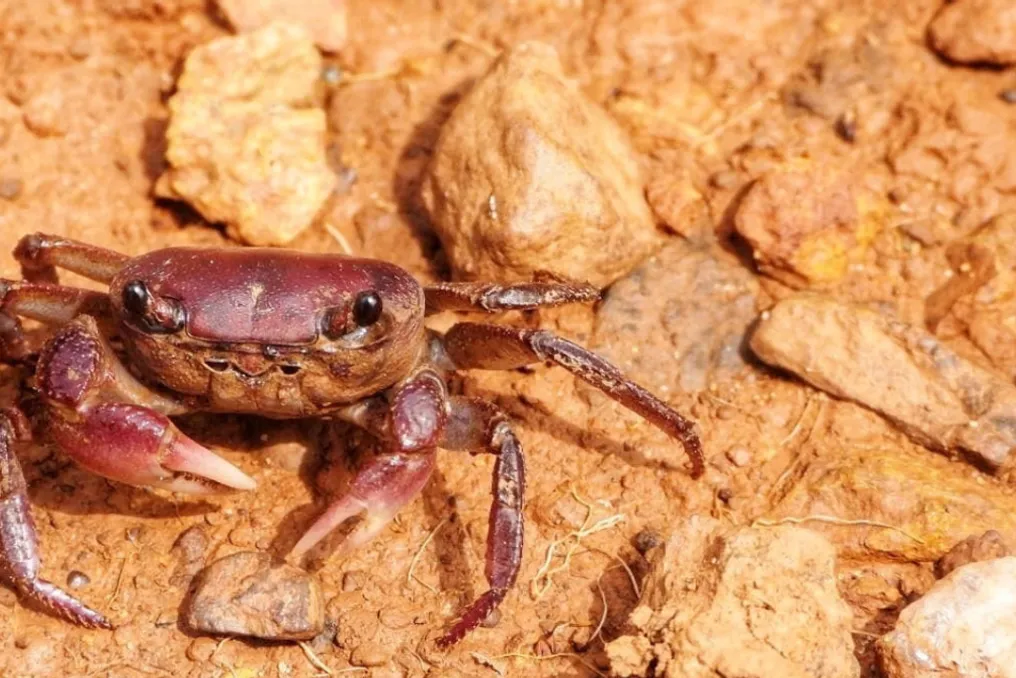
During a routine patrol in the Mukumbika reserve in Karnataka state, forest ranger Ajmir K noticed something that many might have overlooked. He observed a freshwater crab crossing the forest floor, and its unusual coloration and movements caught his attention. While regularly patrolling the forests of the Kollur area, he decided to examine the find more closely, and this small curiosity led to the scientific discovery of a new species.
This crab has been named Ghatiana karnataka, and its discovery adds to the scientific understanding of the rich biodiversity of the Western Ghats. Ajmir, in collaboration with Santanu Mitra from the Zoological Survey of India, prepared a scientific description that was recently published in the journal Species.
The Study Began with Close Observation
Ajmir first spotted this crab during a patrol in the Kollur area last year. Its unusual color and manner of movement prompted him to study it instead of simply continuing his route. He contacted Santanu, who also suspected the crab might represent an undocumented species.
After obtaining the necessary permissions from the Forest Department, samples were collected for thorough taxonomic study. Researchers examined both males and females, documenting their physical characteristics, coloration, and habitat before confirming that the species was new to science. This process is crucial, as discovering an unknown animal is only the beginning; proving its distinction from already known species is required for scientific recognition.
Meet Ghatiana karnataka
The recently described crab belongs to the genus Ghatiana, a group of freshwater crabs found exclusively in the Western Ghats. Males have predominantly dark purple bodies with a bright light pink or violet V-shaped marking on the anterior part of the carapace. Females look different: their anterior section is greyish-purple, and the posterior is dark grey-brown.
The species is currently confirmed in Mavinakaru, near Kollur, although Ajmir's observations suggest that similar crabs are found over a much wider area of the forest.
Hidden Among Stones and Trees
These crabs are not animals that are easily seen. They inhabit moist evergreen and semi-evergreen forests, utilizing tiny natural shelters created by the landscape. They were found in crevices between boulders, in water-filled spots in laterite rocks, and in damp cavities of trees.
The surrounding landscape remains moist due to perennial rivers, including Suparniku, Mavinakaru, and Jadkal. During the monsoons, the crabs can move across wet laterite soil. When the forest dries out, they retreat into damp tree cavities and rock niches. Their diet is closely linked to the forest: they feed on decaying plant matter, bark, algae, and other organic materials.
Not the First Ghatiana Species from Karnataka
This discovery is significant, but it also serves as a reminder of how much more needs to be documented in the Western Ghats. There are now 15 known species in the genus Ghatiana, all endemic to the Western Ghats. According to The Times of India, 'eight species of this genus have been registered in Karnataka.'
This is not the first instance of an unexpected freshwater crab appearing from the forests of Karnataka. Other Ghatiana species have previously been discovered, some noted by forest personnel and naturalists during fieldwork.
A Name Reflecting the State's Biodiversity
Initially, Ajmir hoped the crab would be named after its discovery location. However, Mitra suggested using the name Karnataka for the species designation, acknowledging the state's exceptional biodiversity. For Ajmir, this discovery also holds personal meaning. Hailing from Hosapete in the Vijayanagara district, he holds a bachelor's degree and has developed a deep interest in documenting the wildlife he encounters while performing his duties in the forest. Although his position may be described as a forest ranger, his daily work brings him to places scientists cannot always access regularly.
Every patrol can lead him to something unusual.
Much More to Be Found
Observing Ghatiana karnataka is more than just adding another name to a scientific list. It demonstrates how much the Western Ghats can reveal if people pay attention to the small details around them. A crab hiding in a damp tree cavity might seem insignificant against the vastness of the tropical forest, but it could represent a species that science has not officially recognized before.
Kundapur Rutren P, Deputy Conservator of Forests, stated that this discovery highlights how much of the region's biodiversity remains undocumented. He also emphasized the need to encourage and support forest staff who show interest in research and biodiversity, according to The Times of India. For Ajmir, it all started with something wonderfully simple: he noticed a crab that looked different and, instead of walking past, stopped to find out why.