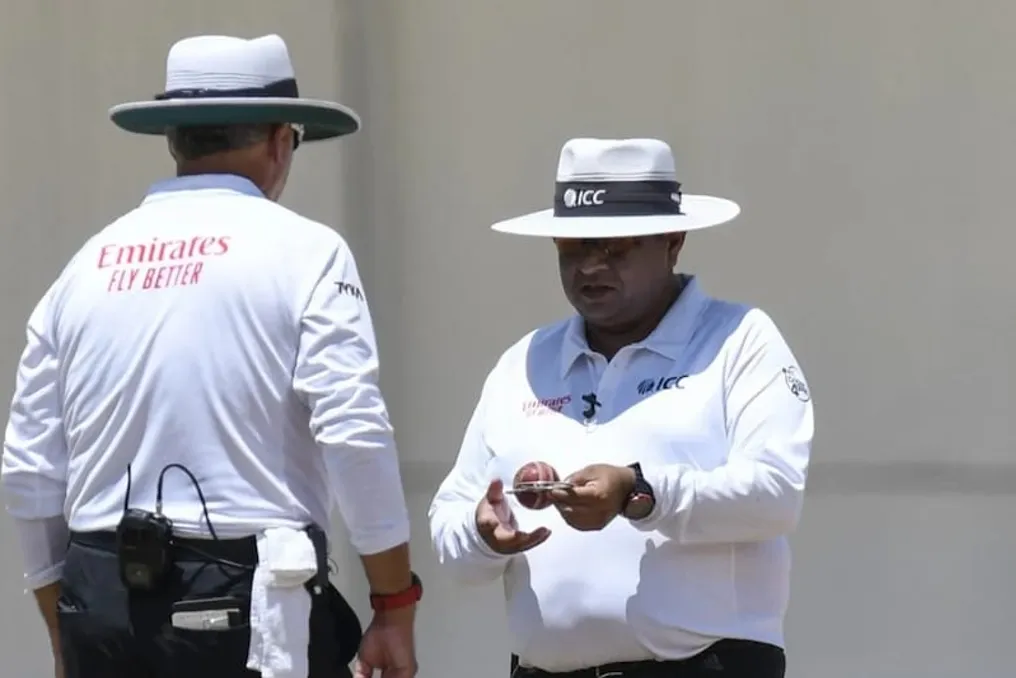
The third day of the Galle Test between India and Sri Lanka began with an unexpected change in the officiating crew. Experienced Australian umpire Rod Tucker was unable to take the field due to deteriorating health. His condition had started worsening on the second day of the match, and he did not appear on the field even during the last session of the second day.
Although it was expected that Tucker would be able to resume his duties on the third day, his health did not improve, forcing him to remain sidelined. In his place, Ahsan Raja from Pakistan took the field to replace Tucker as the field umpire, declining the role of television umpire.
Initially, for this match, which started on August 15, Rod Tucker and Sharufuddin Siket from Bangladesh were appointed as field umpires. Ahsan Raja held the position of television umpire, and Andy Pycroft was responsible for the role of match referee.
According to Cricbuzz, organizers reported that Rod Tucker was unavailable for umpiring until the start of the third day. Following this, Ahsan Raja was brought onto the field. Raja is an experienced international umpire and, along with Siket, took responsibility for the match in Tucker's absence. Raja has served as a field umpire in 28 Tests, 66 ODIs, and 91 T20 Internationals.
During the umpiring changes, India's first innings on the third day did not last long. The Indian team started the game with a lead of 460 runs after 9 wickets fell. Although Kuldeep Yadav and Prasidh Krishna were on the field, the Indian team could only add two runs to their score. The fourth ball of the day led to the conclusion of India's innings when Asita Fernando dismissed Prasidh Krishna. The ball, directed towards the leg side, touched Prasidh's bat and went into the gloves of wicketkeeper Niroshan Dickveley. Thus, India's first innings concluded at 462 runs.
Devdutt Padikkal laid the foundation for a large score for India. Padikkal, who returned to Test cricket after approximately two years, seized the opportunity and scored his maiden century in his career. He converted this big innings into 167 runs, scoring them off 230 balls. His innings included 15 fours and one six. Thanks to this, Padikkal secured a spot in the list of outstanding Indian players in Sri Lanka. His score of 167 runs became the fourth-best performance by an Indian player in Sri Lanka, trailing Sachin Tendulkar (203), Virender Sehwag (unbeaten 201), and Shikhar Dhawan (190). Besides Padikkal, KL Rahul scored 82 runs. Rahul, who had previously been forced off the field due to cramps on the first day, returned to the field on the second day. Another player, Dhruv Jurel, also played a useful innings in the lower order, scoring 51 runs.
Among the Sri Lankan players, spinners Prabhat Jayasuriya and debutant Kesara Nuwanta most troubled the Indian batsmen, collectively taking seven wickets. Due to the support provided by the fielders, the roles of Kuldeep Yadav, Ravindra Jadeja, and Manav Sutara may become more important. Rain significantly delayed the game in this Test; 73 overs were bowled on the first day, and only 43 overs on the second day.