South Africa declared that it remains stable and that the rule of law prevails, despite protests related to immigration and other security challenges. This statement was made by Lieutenant General Tebello Mosikili, who co-chairs the National Joint Operations and Intelligence Structure (NATJOINTS), during a press conference held in Pretoria.
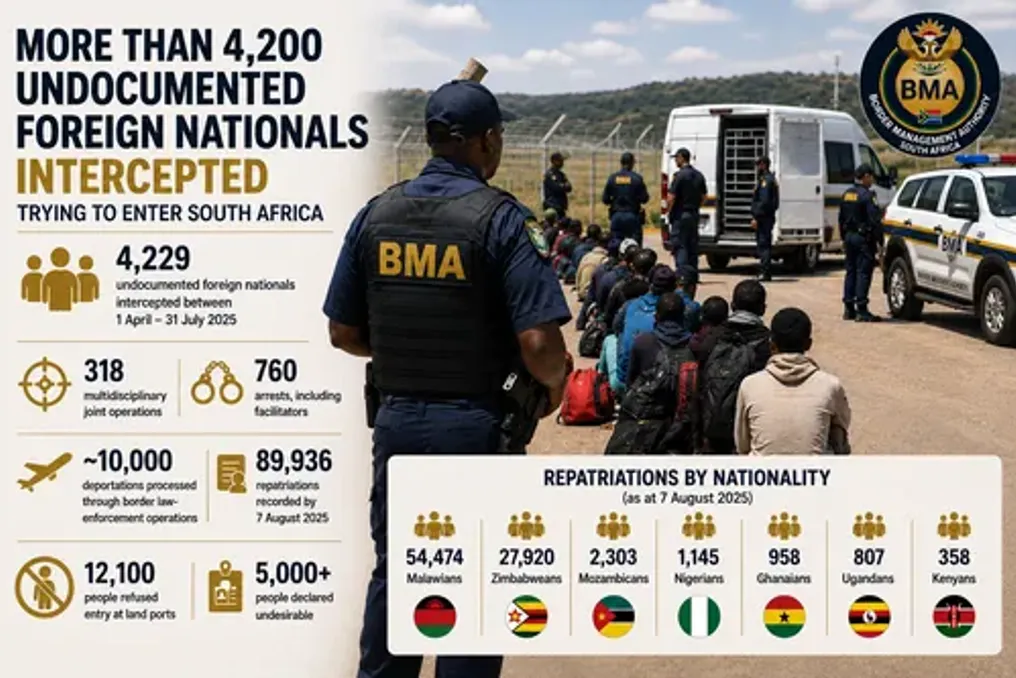
Mosikili detailed that, in July alone, 16,208 undocumented foreigners were detained. These arrests are part of daily operations taking place in the country's nine provinces and target wanted suspects, illegal weapons, drugs, organized crime, dangerous criminals, and undocumented individuals.
Additionally, authorities reported a total of 77,184 repatriations of foreigners processed up to August 3rd. This number is still considerably lower compared to the amount of returns reported by governments of various African countries from which these migrants originate.
Specifically, data released last week by the Government of Zimbabwe indicated that only those repatriated from this country exceed the mark of 115,000.
Although tension persists in South Africa due to demonstrations organized by anti-immigration groups, NATJOINS informed that such protests have substantially decreased since the major demonstration on June 30th. On that date, organizers had set a deadline for undocumented individuals to leave the national territory.
Mosikili stressed that the provinces of Gauteng (north), Mpumalanga (northeast), and KwaZulu-Natal (east) continue to register protests, but these are described as 'isolated and localized,' with most being 'peaceful and within the law.'
The lieutenant general also warned about the spread of fake news on social media, pointing out that several videos are incorrectly linking certain crimes to irregular immigration. She emphasized that no one should take justice into their own hands, ensuring that operations will follow a 'legal and humane' course and be consistent with the South African Constitution, while security in border areas has been reinforced.
In recent months, tension in South Africa has intensified, marked by a wave of xenophobic attacks and protests that, initially focused on illegal immigration, frequently devolved into indiscriminate violence against African migrants.
Organizers of these movements attribute the country's economic problems, poor public service delivery, and high crime rates to migrants, going so far as to prevent these individuals from accessing health and education services in public facilities.
This escalation of tension has prompted countries such as Malawi, Ghana, Nigeria, Zimbabwe, Kenya, Uganda, and Mozambique to repatriate tens of thousands of their citizens in recent weeks. Xenophobic tensions constitute a recurring problem in South Africa, generating episodes of violence on various occasions, particularly in neighborhoods considered more vulnerable.