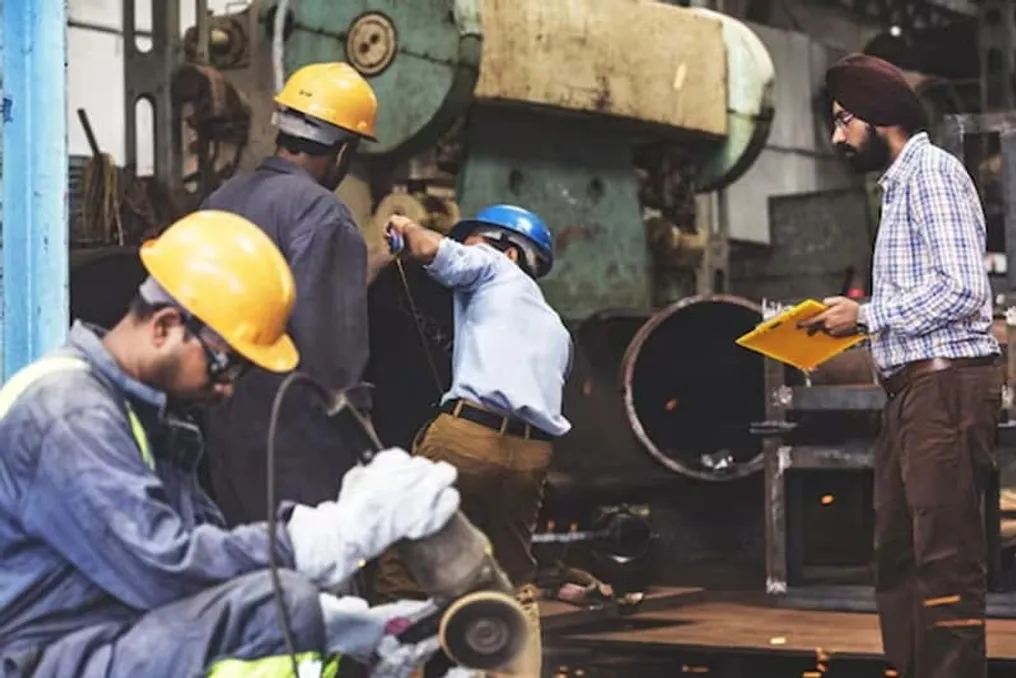
During his address from the Red Fort on Independence Day, Prime Minister Narendra Modi shared an ambitious goal with the citizens: to make India a global manufacturing center by 2047. In response to this goal, NITI Aayog has developed a roadmap focusing on a strategy across 12 key sectors.
According to the new NITI Aayog report, there is significant potential in these sectors to increase production, attract investment, and strengthen India's share in global supply chains. Currently, the manufacturing share in the country's gross value added is about 17.5%, and in the 2021-22 fiscal year, this sector supported approximately 1.85 million jobs.
The NITI Aayog study titled 'Key Sectors to Position India as a Global Manufacturing Hub' assessed the opportunities and challenges of India's manufacturing sector. After examining 62 sectors, the Commission identified 12 priority areas expected to expand significantly in the coming years. This strategy is also linked to the broader goal of transforming India into a $30 trillion economy by 2047.
NITI Aayog identified sectors such as electronics, telecommunication equipment, solar PV, pharmaceuticals, chemical industry, automotive, defense, and drones as priorities, among others. Four of these sectors were studied in detail in the report. The document emphasizes the need to create profitable opportunities for investors so that India can become a global manufacturing hub, as well as the importance of achieving large-scale production and economies of scale.
According to Ashoka Kumar Lahiri, a member of NITI Aayog, achieving this goal will require massive investment, with the private sector playing a crucial role.
The chemical industry is included in the list of sectors with great potential for India. The report states that over the next five fiscal years, domestic chemical consumption in the country should grow by approximately 10-11% annually, and production growth will require an annual increase of about 14%. The report identifies export opportunities worth about $45 billion in specialty chemicals by 2030, $5-10 billion in inorganic chemicals, and around $26 billion in petrochemical products.
The textile industry plays a vital role in India's manufacturing and employment economy. According to the report, textiles account for about 2% of India's GDP, 11% of manufacturing gross value added, and 9% of merchandise exports. In the 2025 fiscal year, India exported textile products worth about $37.7 billion. This sector supports over 45 million people. In 2024, India became the sixth-largest textile exporter globally, accounting for 4.1% of world exports. However, the sector faces serious challenges. About 80% of production capacity is concentrated in MSME clusters. The report highlights the need to improve the competitiveness of man-made fibers (MMF), reduce raw material costs, adopt new technologies, and strengthen international trade ties.
The domestic market for telecom and networking equipment was valued at $25 billion in the 2025 fiscal year, with a projected growth to about $50 billion by 2032. Despite this, India's export performance remains limited. The report indicates that annual exports of telecom and networking equipment from 2020 to 2024 averaged about $0.6-1 billion, while imports were within $4-5 billion. Dependence on China exceeds 80% for critical components. Therefore, it is not enough for India just to increase final product manufacturing; it must develop domestic manufacturing capabilities for critical components.
In the solar PV sector, India has increased its manufacturing capacity for modules and cells. Nevertheless, the country still relies on imports of crucial input materials such as polysilicon and silicon wafers. According to the report, in this clean energy-related sector, India needs to move towards developing the entire value chain to reduce import dependence and boost domestic production and export potential.
The overall message of the NITI Aayog report is that to achieve the status of a global manufacturing hub by 2047, India cannot rely solely on increasing production capacity. The country needs to move up the global value chain and increase the production of higher value-added products. To achieve this, it is crucial to ensure domestic production of key components, utilize new technologies, improve productivity, attract private investment, and expand export potential. Furthermore, dependence on other countries for raw materials and critical technological components must be reduced. In the coming years, policies and investments focused on these 12 sectors could provide a new direction to India's manufacturing potential. However, effective implementation of these policies is necessary to meet the 2047 goal.