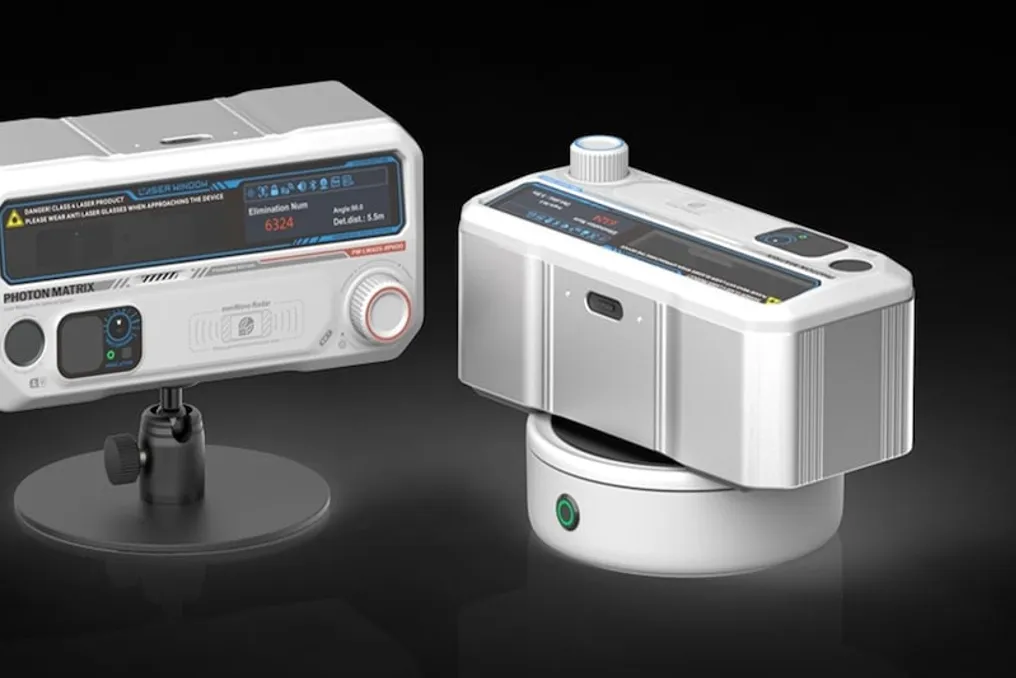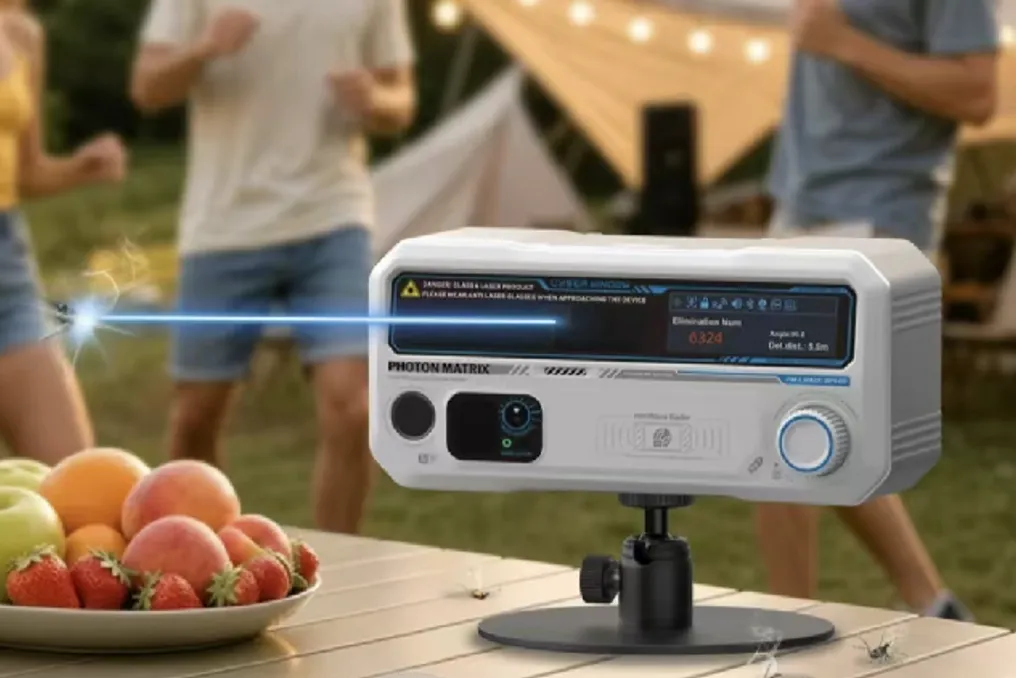
A device developed in China for combating mosquitoes that uses a laser has entered mass production. According to the latest update from developer Photon Matrix Lab on the crowdfunding platform Indiegogo, the first batch of devices is expected to ship at the end of this month.
The company reports that the portable device integrates LiDAR, millimeter-wave radar, AI-based computer vision, and a precision laser to detect and target mosquitoes and other small flying insects.
In a recent update on Indiegogo, Photon Matrix stated that mass production began in August. Furthermore, the company has opened its official online store, allowing consumers to purchase infrared and blue laser versions of the product directly.
The launch of this product comes amid the growing mosquito control industry in China. According to Xinhua, in the first half of 2025, over 45 million yuan (approximately $6.7 million) worth of mosquito repellents were exported from Jianhua, Zhejiang province, an increase of 65.1% compared to the same period last year.
Xinhua also cites industry estimates suggesting that the Chinese mosquito control market could grow from 7.86 billion yuan in 2025 to 12.43 billion yuan by 2030.
Demand is not limited to traditional methods such as mosquito coils, electric vaporizers, and insect traps. Chinese developers are also experimenting with more automated methods.
During the 2023 Asian Games, China Daily reported the use of an automatic mosquito trap in the Asian Games village. This robot attracted mosquitoes by mimicking human body temperature and breathing, after which it captured or destroyed them.
Another report on the Asian Games mentioned that smart mosquito control robots used carbon dioxide and ultraviolet light to attract insects.
These approaches demonstrate various ways of applying technology to solve an age-old problem. While traditional products usually rely on chemicals, light, or physical traps, new devices utilize sensors, computer vision, robotics, and other automated systems.
Similar products are appearing abroad as well. For instance, the Israeli company Bzigo developed the Bzigo Iris model, which uses computer vision and infrared sensing to detect mosquitoes and mark their locations with a low-intensity laser. The device itself does not kill the mosquito but only helps users find it. Bzigo currently sells the Iris on its website for $299.
Photon Matrix takes a different approach, using the laser as the final stage for physically eliminating the detected target. These two approaches indicate different consumer needs: one focuses on more effective mosquito finding, while the other aims to automate the destruction process.
Nevertheless, the technology faces practical questions. The performance metrics claimed by Photon Matrix have not yet undergone full independent testing. The company stated that it will provide additional information regarding testing and safety.
For consumers, factors such as effectiveness, safety, reliability, and price will likely be decisive in determining whether high-tech mosquito control devices can move beyond niche products. Thus, Photon Matrix's entry into mass production adds a new technological option to the established mosquito control market, rather than immediately replacing traditional methods.