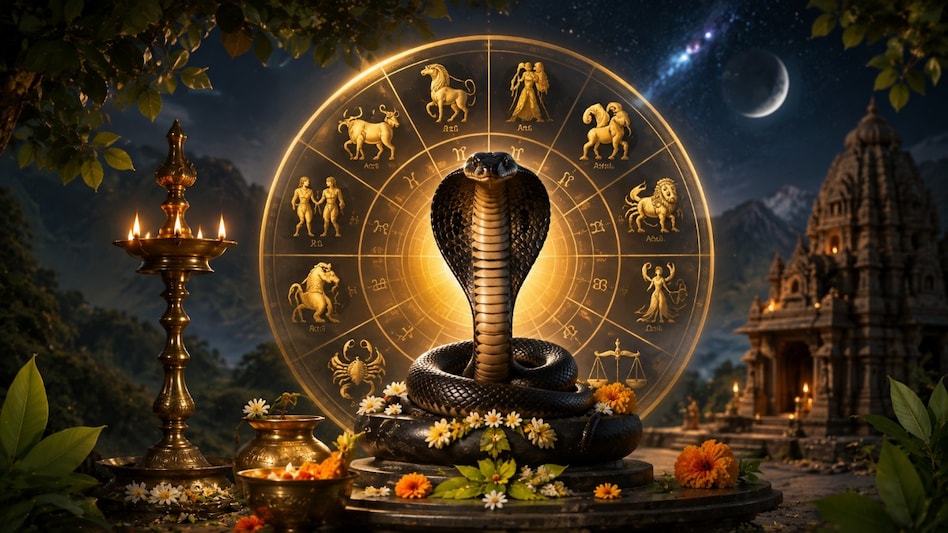
The festival of Nag Panchami, celebrated on the fifth day of the bright moon of the month of Shravana, is dedicated to the nagas. This festival emphasizes that snakes or nagas are not merely venomous or frightening animals, but beings with complex significance in our social life. Their contribution is important both for agriculture and environmental cleanliness, as well as in ancient and folk tales.
In the field of astrology, the role of snakes and nagas is interpreted differently. People suffering from the influence of Rahu in the system of nine planets turn to snake worship. According to astrological beliefs, every planet has two deities: an adidevata and a pratidevata. In the case of Rahu, Kal is considered the adidevata, and the snake is the pratidevata. This is why those whose natal chart contains Rahu-dosha are advised to perform worship of the adidevata Kal and the pratidevata snake, which is known as worship during Rahu-dosha.
Snakes feature in both Rahu and various nakshatras. The deity of the Ashlesha nakshatra is the snake, and the snake itself is considered its lord. Furthermore, during rains, when the Sun moves between the constellations Rohini and Hasta, one of the vehicles of these nakshatras is the snake. Astrologers use these vehicles to predict the occurrence, absence, or abundance of rainfall.
Descriptions of nagas have been present throughout human history since ancient times, and they played roles as characters in many mythological narratives. In the Ramayana, Lord Rama, Lakshmana, the younger brother of the Vishnu avatar, and in the Mahabharata, Balrama, the elder brother of Krishna, are considered incarnations of Sheshnaga. In the Ramayana, Sulochana, the wife of Ravana's son Meghanada, was a nagakanyā and daughter of Sheshnaga. The demoness Sursa is also mentioned as the mother of the nagas.
Similarly, in the Mahabharata, Arjuna marries the nagakanyā Ulupi. His son Parikshit dies from a Takshaka bite. In response, the enraged Janamejaya performs the Naga Yajna, resulting in the death of most nagas on Earth. However, Astika, the son of the sage Jaratkar and sister of Vasishtha, saves the snakes by stopping the Naga Yajna. It is said that Janamejaya and Astika, as well as those who recite Astika's mantra, are not afraid of snake bites.
Vrittasura, killed by Indra with a weapon made from the bones of the sage Dadhichi, was also a king of the nagas. In the Vedas, the snake is called Ahī. Moreover, nagas are mentioned in many forms. There is also a weapon named after the nagas: Meghanada used the Nagapasha to bind Rama and Lakshmana. Krishna pacifies Kaliya Naga, and Bhima, who loses consciousness from Duryodhana's poison, enters Nagloka, where he gains strength equal to that of a hundred elephants.
Even Yama's rope is considered to be made of nagas. This thread, which binds karma in the afterlife, is actually a nāga. Once, a king named Nahusha was created by Indra, but he could not free himself from his deeds. Seeing his greedy, twitching jaw, the sages cursed him into a snake.
Nagas or snakes are not just animals; they possess a history comparable to that of humans, and they themselves are deities and a civilization. Many cultures used nagas as their symbol. For example, the region of Anantnag in Kashmir was once a prosperous capital of nagas, as evidenced by preserved evidence there and mentions in folk legends.