Scientists have made a significant breakthrough in understanding the chaotic phenomenon of turbulence by tracking the movement of millions of individual particles in a specialized state of matter known as dusty plasma. A team from the Indian Institute of Technology (IIT) Jammu and IIT Kanpur used supercomputer simulations to demonstrate how microscopic dust particles, similar to those found in Saturn's rings or inside nuclear fusion reactors, interact to create complex vortex structures that eventually convert into thermal energy. This research offers a new perspective on turbulence based on particle behavior, showing that as the bonds between them strengthen, they begin to behave more like elastic rubber than simple gas.
While most people are familiar with the three main states of matter—solid, liquid, and gas—plasma represents the fourth state, where atoms lack electrons, forming a mixture of positively charged atoms surrounded by negatively charged electrons. When tiny grains of solid dust are added to this mixture, they acquire a high negative charge and begin to interact with each other through electrical forces. In strongly coupled dusty plasmas, these electrical forces are so powerful that the particles cannot simply pass each other; instead, they constantly feel the presence of their neighbors, causing the entire mixture to behave with viscoelasticity—a property where the substance acts like a liquid but is also capable of stretching and returning to its original state, similar to a solid.
The researchers focused on two known types of chaos that occur in liquids. The first is Kelvin-Helmholtz instability, which manifests when two layers of fluid slide past each other at different speeds, resembling wind blowing over the surface of the sea. The second type is Rayleigh-Taylor instability, which occurs when a denser fluid is placed atop a lighter one, such as oil on water. Using a tool called the Large-scale Atomic/Molecular Massively Parallel Simulator (LAMMPS), a molecular dynamics tool, the team simulated up to a billion particles to track the evolution of these instabilities over time. Unlike traditional hydrodynamic models, which treat fluids as a smooth, continuous medium, Molecular Dynamics tracks every individual particle in that medium. This allowed the team to observe the moment when large vortex energy begins to dissipate into the microscopic trembling of individual particles—a process known as thermalization.
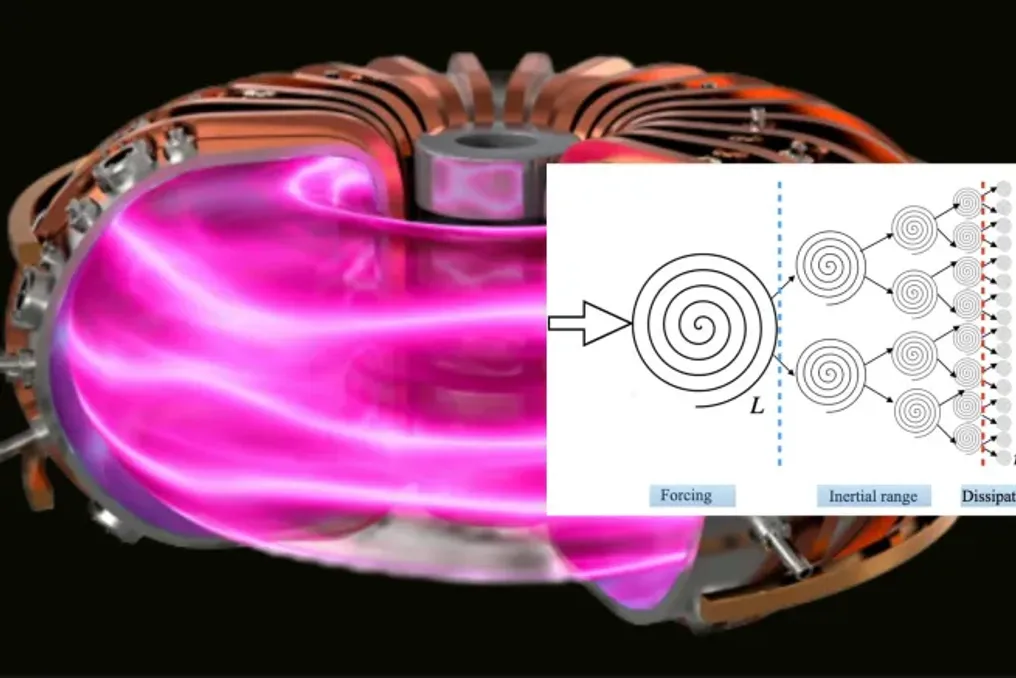
The team analyzed the energy spectrum of the flow, which serves as an indicator of the energy distribution between large vortices and small ripples. It was found that in dusty plasmas, energy follows specific mathematical patterns before ultimately reaching a state of thermal equilibrium. A key finding was that the stronger the electrical coupling between the dust particles, the slower this process occurs. In a strongly coupled state, the particles are so occupied with mutual repulsion and attraction that mixing and heating are significantly slowed down. This leads to the plasma exhibiting a striking similarity to elastic turbulence, a phenomenon usually observed in complex fluids such as polymer solutions or molten plastics.
This research helps bridge the gap between microscopic particle physics and macroscopic hydrodynamics. Standard fluid equations, such as the Navier-Stokes equations, ignore the granularity of matter and cannot accurately predict how energy dissipates at the smallest scales in complex systems. Applying the LAMMPS simulator on high-performance computing clusters allowed this team to demonstrate that continuum behavior—the smooth flow we observe—can be recovered directly from the chaotic motion of billions of individual particles. This provides a particle-level view that serves as a bridge, allowing scientists to study flows for which there is currently no standard description of fluid.
However, the authors acknowledge that most simulations were conducted in two dimensions (2D), corresponding to a flat layer of plasma. Although dusty plasmas at small scales often naturally organize into two-dimensional layers due to gravity and electric fields, most phenomena in the universe are three-dimensional. The researchers noted that while they expect three-dimensional simulations to yield different mathematical results, such as the famous Kolmogorov spectrum $k^{-5/3}$ at small scales, these simulations require even greater computational resources and remain a future goal.
By connecting macroscopic motion and microscopic behavior, this research opens the door to a range of innovations, particularly in the search for clean energy and a better understanding of our universe. During nuclear fusion aimed at replicating solar energy on Earth, turbulence is a serious drawback, causing heat leakage from reactors. This prevents reactors from reaching the temperatures necessary for energy production. By understanding the microscopic causes of this turbulence, engineers can develop more efficient methods for plasma confinement. Furthermore, since Rayleigh-Taylor instabilities play a central role in supernova explosions and volcanic eruptions, this research helps astrophysicists and geologists better predict energy movement in some of nature's most turbulent events, bringing us closer to understanding the greatest cosmic forces.