Unitree has announced a significant production milestone: as of July 2026, the cumulative output of its bionic robots reached 18,000 units. This count strictly applies to fully finished humanoid machines that walk on two legs, excluding wheeled robots, quadruped dogs, and autonomous manipulators.
When comparing four major companies developing humanoid robots, the following distribution is observed: Unitree has 18,000 pure bipedal models; AgiBot counted 15,000 across all categories by June 2026, but this figure includes many wheeled robots, with only 7,000 being purely bipedal; UBTECH released about 3,000 models of all series; and Galbot possesses approximately 1,000 industrial humanoid robots.
In the segment of pure bipedal models, Unitree significantly surpasses its competitors: 18,000 versus 7,000 for AgiBot, 3,000 for UBTECH, and 1,000 for Galbot. Even when combining wheeled and bipedal models, Unitree still exceeds AgiBot's figures. The market is clearly divided into tiers: Unitree and AgiBot form a duopoly at the ten-thousand level, while UBTECH and Galbot are at the thousand level.
Unitree's growth rate is impressive: 6,500 units were released in 2025; by May 2026, production exceeded 11,000, and then another 7,000 units were added over two months, bringing the total to 18,000. This figure more than doubles UBTECH's multi-year total production.
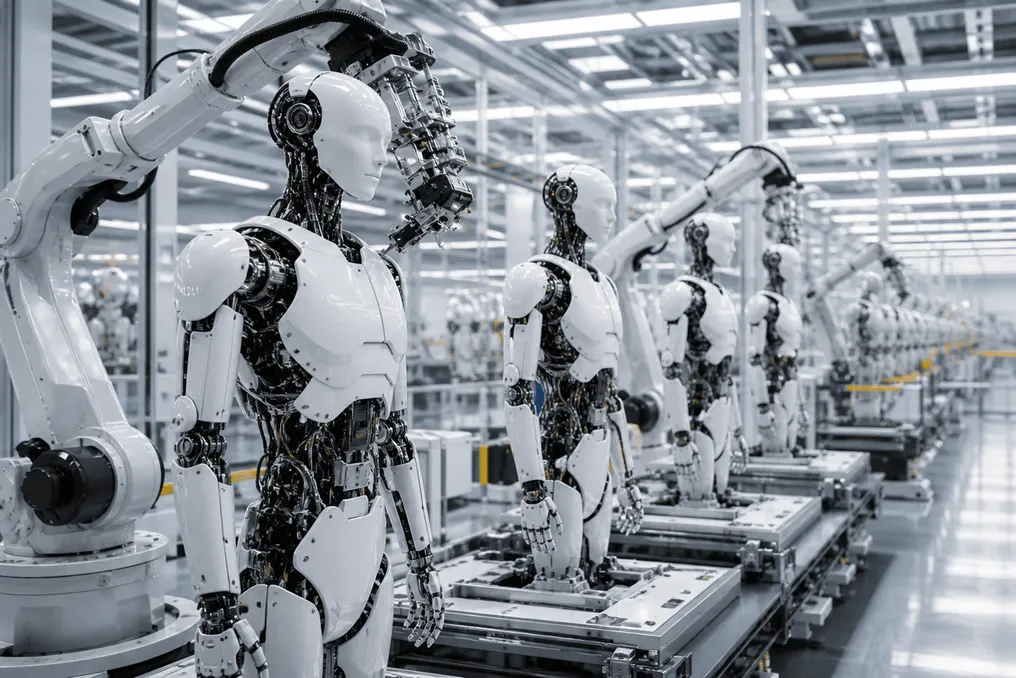
Production stability is ensured by a closed system. Since its founding, Unitree has independently developed key components such as servo motors, drivers, and reducers, which has allowed it to reduce costs and control supply cycles. Models H1 and G1 represent a combination of high and low segments: H1 is aimed at industrial clients with consistent large orders, while G1 is a versatile humanoid robot for commercial services and research institutions. Furthermore, Unitree has created flexible specialized production lines, enabling large-scale standardized manufacturing instead of small-batch manual assembly.
UBTECH's shortcomings are attributed to three deficiencies. Firstly, the company bet on the wrong early track—small consumer humanoid robots for education, exhibition halls, and toys that lack industrial capabilities. When the industry shifted towards industrial humanoid robots during 2024–2025, UBTECH hastily launched the industrial robot Walker, forced to build a research base, production lines, and supply chains from scratch, lagging by two to three years. Secondly, weak internal component development: servo motors and reducers are mainly purchased from third-party suppliers, increasing costs and leading to partial shutdowns of production lines during competition for capacity. Thirdly, scattered resources among service, disinfection, and educational robots dilute R&D budgets and engineering personnel.
AgiBot is the only company capable of competing with Unitree, but their statistics differ: more than half of AgiBot's 15,000 robots have a wheeled base, making them incomparable to pure bipedal models; in terms of pure bipedal models, 7,000 fall short of Unitree's 18,000. AgiBot's strength lies in deep industrial automation channels, while its weakness is bipedal locomotion compared to Unitree's many years of experience in legged robotics. Galbot adheres to a 'small and quality' strategy: customized industrial humanoid robots with high profit per unit, but without standardized mass production. This divergence is irreversible: Unitree and AgiBot possess the potential for ten thousand units with protection in technology, supply chains, and customer base, whereas thousand-level players need two to three years to close the gap. Domestic humanoid robots have moved from prototypes to mass production, logistics, and supply chains, and Unitree's 18,000 units provide it with a pioneer advantage.