The head of the Iranian Chamber of Commerce stated that the country's economy has exited the phase of severe decline caused by the war, and a trend of economic activity resumption is once again being observed. He noted that this positive trend is evidence of the efforts and dedication of the private sector and business owners.
This relative improvement was also facilitated by a temporary decrease in the intensity of shocks compared to the months of Esfand 1404 (February-March 2026) and Farvardin and Ordibehesht 1405 (March-May 2026).
Samad Hassanzadeh also emphasized the importance of the government's and the president's role in developing international relations, adding that further steps in foreign relations are necessary to maintain this trend.
The head of the Iranian Chamber of Commerce highly praised the president's directive to prevent power outages at industrial enterprises in Shahrivar (August-September). The president instructed the ministers of industry, mining, trade, and energy that these sectors should not be subject to priority power cuts to avoid production stoppages, job preservation, and unemployment.
He specified that based on the decisions made, efforts will be made to minimize power outages in industrial cities and production facilities in Shahrivar, and the necessary infrastructure will be provided to implement this directive.
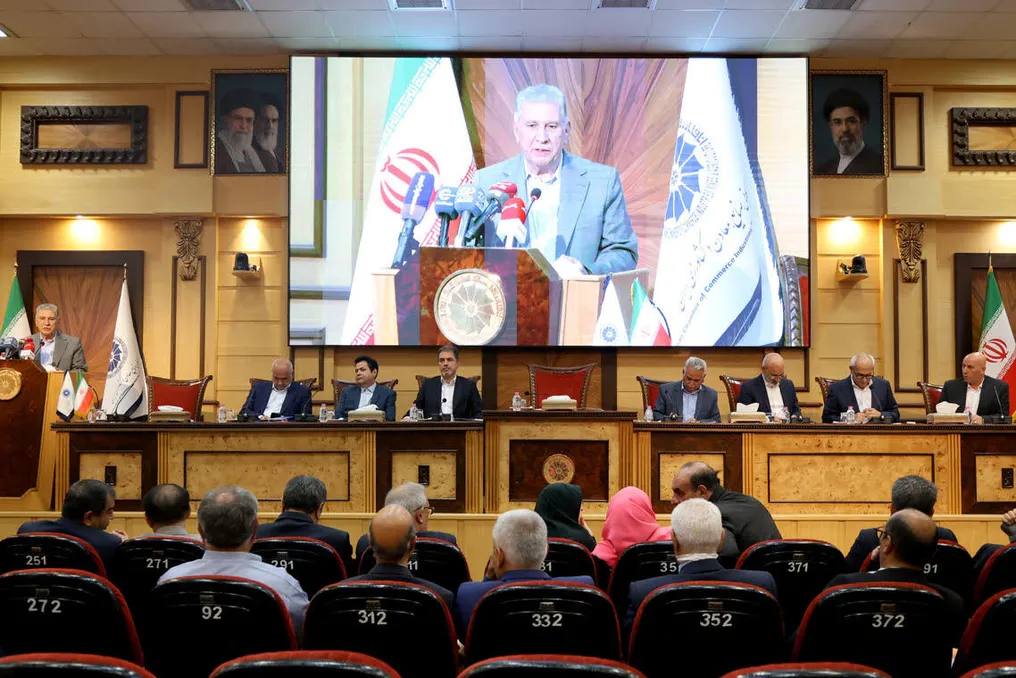
At the 35th session of the Representative Assembly of the Iranian Chamber of Commerce for the 10th term, two main issues were discussed: a review of the business support package during wartime and consideration of the Board of Directors' resolution on increasing membership fees, entry fees, and the cost of issuing certificates of origin. The session gathered representatives of the private sector to discuss the country's economic situation and determine the future course.
Samad Hassanzadeh opened the meeting by expressing hope for peace, security, and prosperity in the month of Rabi' al-Awwal. He thanked the Leader, the President, and government officials, emphasizing their support for negotiations that preserve Iran's dignity and honor, allowing economic actors to fulfill their development responsibilities.
Hassanzadeh presented encouraging data on the trajectory of the Iranian economy. According to the latest Purchasing Managers' Index (PMI) for Khordad 1405 (May-June 2026), the Iranian economy has overcome the stage of sharp decline following the war shock. The resumption of economic activity reflects the determined efforts of the private sector and the temporary reduction in the intensity of shocks compared to previous months. He stressed that maintaining this improvement requires more active international interaction and called for continued work in foreign policy.
In a significant development, Hassanzadeh commended the President's order prohibiting power outages at industrial enterprises in Shahrivar. The President directed the ministers of industry and energy that these sectors should not be prioritized for shutdowns, with the aim of protecting production, employment, and preventing unemployment. Infrastructure is currently being prepared to implement this directive.
Afshin Kolahi, head of the Commission for New and Scientific-Technical Enterprises, pointed out that modern technologies are critical for enhancing the resilience and competitiveness of enterprises. He noted that small and medium-sized enterprises (SMEs) constitute 94% of industrial enterprises, provide 44% of industrial employment, but contribute only 15% of industrial added value, which may indicate a miscalculation by policymakers in prioritizing large industries.
He called on the Iranian Chamber of Commerce to move beyond mere lobbying and begin providing practical assistance to companies in adopting technologies and innovations, citing the international experience of Singapore, Finland, Denmark, and the 40% share of the Istanbul Chamber of Commerce in the Istanbul Technology Park.
State Press Secretary Fateme Mohajerani praised the private sector for maintaining production and distribution during the Ramadan War and the Battle of Hormuz, which helped prevent shortages. She affirmed the government's commitment to supporting the private sector as a strategic partner in policy development and acknowledged existing obstacles, expressing confidence in overcoming them together.
Alireza Mohammadi Daniyali presented a vision for economic growth, emphasizing that development requires two strong components: a powerful, development-oriented government and a competent, organized private sector. He pointed to the harsh economic reality: since 2018, the dollar exchange rate has increased 50 times, and prices for goods and services have risen 19 times. Although 400,000 people were added to the employed population, the industrial sector lost 630,000 jobs.
Arash Alavi sharply criticized the command economy, asserting that the primary task of the Iranian Chamber of Commerce should be to end such practices. He highlighted how price controls harm industries by forcing companies to purchase raw materials at high prices and sell them at controlled rates, often masking this with populist slogans like 'fair profit' and 'support for domestic production,' which hinders resistance.
He proposed creating a flexible oversight body to assess the damage from command pricing and raise public awareness.
Keyvan Kashfi analyzed the business support package during wartime, identifying a paradox in crisis management. Effective crisis management requires decisiveness in decision-making, consistency in implementation, and stability in rules—areas where Iran has faced difficulties. He noted incomplete execution, coordination problems between institutions, and systemic limitations. The Chamber put forward 53 operational proposals regarding taxes and social security, but implementing all of them proved impractical in the short term. He stressed that the emergency continues, so support measures must be extended. The package was extended until the end of Shahrivar (September), and some import deadlines were extended to 180 days due to port closures.
Secretary General Abbasl Roghani Golpayegani justified the proposed fee increase by citing cumulative inflation of about 300% over three years and a 4.6-fold rise in the exchange rate. The certificate of origin cost of 650,000 Tomans, set in 2022, no longer covers printing costs. After discussion, 62% of members approved the increase. Starting next year, the entry fee will be 10 million Tomans, the annual membership fee for individuals will be 8 million Tomans, and for legal entities, 50 million Tomans.
Payam Bagheri presented a strategic vision for the post-war period, drawing on international experience where major economic leaps occurred after crises—Germany, Japan, and South Korea. Two tasks lie before Iran: recovery (rapid revival) and modernization (redefining its role in the regional and global economy). Recovery is the priority, requiring strengthening trust through policy stabilization, rapid decision-making involving the private sector, bureaucracy reduction, monetary and banking reform, and combating corruption. Livelihood and employment support, especially for low-income groups, are crucial.
Bagheri outlined six steps: stabilization and trust building, livelihood and employment support, effective labor market measures, SME strengthening, recovery based on value chains, and increasing resilience. He emphasized that recovery is a prelude to modernization, and Iran must not stagnate. In the new global economy, power is shifting from owning natural resources to network interaction. Iran must take a position in global value chains from which it cannot be easily excluded, utilizing its natural reserves, access to open waters, and human capital to build a competitive, supply-and-demand-based economy linked to regional and global networks.
[