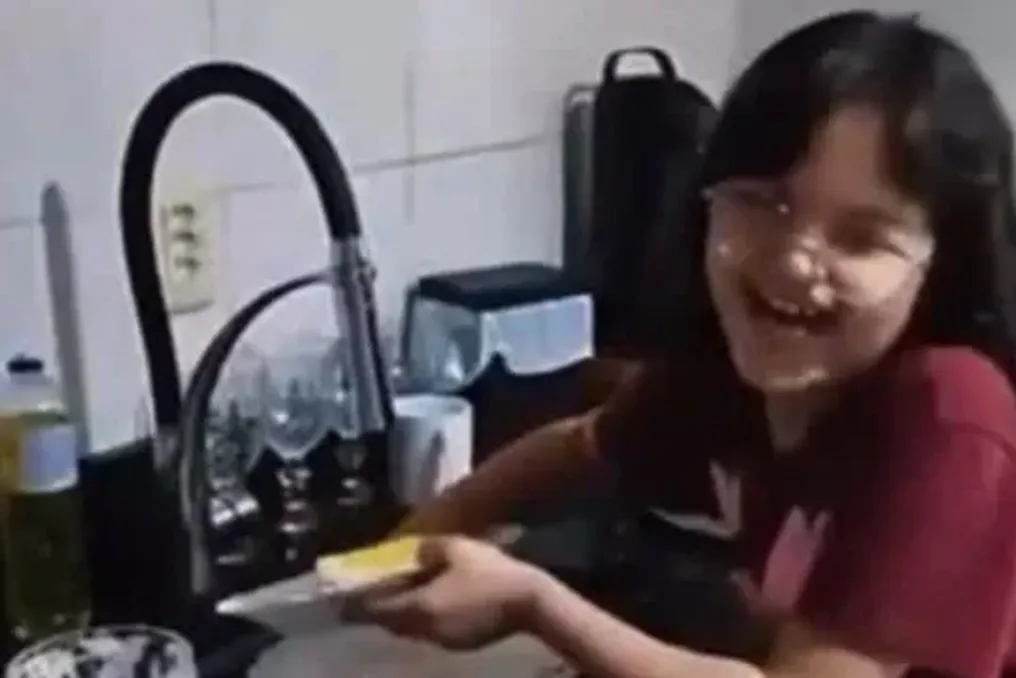
A nine-year-old girl from Brazil, residing in the metropolis of Belo Horizonte, experienced an episode of uncontrollable laughter that lasted for more than three hours. Concerned about her daughter's condition, the mother took her to the hospital, where a very unexpected situation was discovered.
According to information published by the Brazilian publication Metrópoles, it all started during playtime at home. Eduarda Barbosa, whom relatives call Duda, was at home with her mother Aline Barbosa, who is a photographer and nursing student, as well as her sisters. At some point, Duda began laughing uncontrollably. Aline and her sisters also laughed, but the girl could not stop, even when everyone around her fell silent.
Duda remained conscious and responded with gestures, but she could not control her laughter or speak. Noticing the dilation of her daughter's pupils and changes in her gaze, Aline decided to take her to the Municipal Hospital Contagem.
Not playing?
The medical team providing assistance initially considered this case to be isolated. Duda was not diagnosed with epilepsy, as previously suspected. Instead, she was diagnosed with 'gelastic seizure'—a rare 'epileptic manifestation characterized by involuntary episodes of laughter.'
Before realizing it might be a medical problem, Aline thought her daughter was just 'joking.' She recalled: 'I asked if she had gotten dirty or if she had drawn a clown on my face, and she kept laughing.' However, she now knows it was much more serious.
After a series of examinations, the pediatrician treating Duda explained that this episode was 'isolated' and 'caused by anxiety or stress, because as a child, she could not express her feelings or explain what was happening.'
In an interview with the Brazilian website, neurologist and clinical neurophysiologist Victor Hugo Castro de Sá explained that 'gelastic seizure is a rare type of epileptic seizure. This condition manifests as involuntary episodes of laughter. The person laughs without feeling joy, as the laughter is triggered by an abnormal electrical discharge in the brain associated with a benign lesion called hypothalamic hamartoma.'
He emphasized: 'Among possible causes is hypothalamic hamartoma, a benign, non-cancerous lesion located in the hypothalamus. This is a classic link to gelastic seizures in childhood,' he noted.
According to the doctor, in such cases, 'the laughter is purely mechanical and neurogenic (caused by an abnormal electrical discharge in the brain), without the patient actually experiencing joy.'
One of the main signs of a 'gelastic seizure' is the absence of a situation that could justify the laughter. The attack can start suddenly, without a joke, a comedic stimulus, or an apparent reason. The doctor also pointed out that the laughter may look different than usual—it might seem forced, artificial, or even robotic, without the emotional expression usually associated with fun.
Typically, the 'seizure' is brief, lasting from a few seconds to less than a minute. Another important feature is the inability to stop the episode independently. In addition to laughter, according to the specialist, other signs may be observed, such as slight changes in consciousness, a fixed gaze, facial redness, rapid heartbeat, and automatic movements, such as lip tapping. Other brain changes may also be related to this condition: benign or malignant tumors, cortical dysplasias, and vascular malformations localized in the temporal or frontal lobes.
What to do?
In a case like Duda's, it is recommended to focus on the 'person's safety,' 'remain calm and place them in a safe environment, such as on a soft chair or on the floor, removing nearby objects that could cause injury.' One should not try to restrain the person or forcibly stop the laughter. It is also important not to put fingers or any objects in their mouth. Time the seizure, record changes, loss of consciousness, etc. If possible, record a video to show the doctors. After the seizure ends, Victor Hugo Castro de Sá reminded that the person may feel confused, tired, or embarrassed. At this moment, one should 'offer calmness and support.'