The issue of water became a central topic of discussion at conferences and public meetings in South Africa in August 2026. This problem overshadowed the Women's Month theme, which traditionally commemorates the march of over 20,000 women in Pretoria on August 9, 1956, against the adoption of laws.
Residents of the Mpumalanga province presented the challenges they face during public hearings on the proposed amendments to the Municipal Services Act at the Grasskop City Council building. Leon Basson, chairperson of the Water Resources and Sanitation Portfolio Committee, noted that the public hearings aim to resolve long-standing difficulties in South Africa's water supply sector, including unreliable water and sanitation services.
The committee held its first meeting in the Mpumalanga province as part of a nationwide public participation process that took place from August 14 to 16. Basson stated that the proposed amendments are intended to address inadequate management and maintenance of water infrastructure, deteriorating water quality, gaps in accountability, and weak enforcement mechanisms.
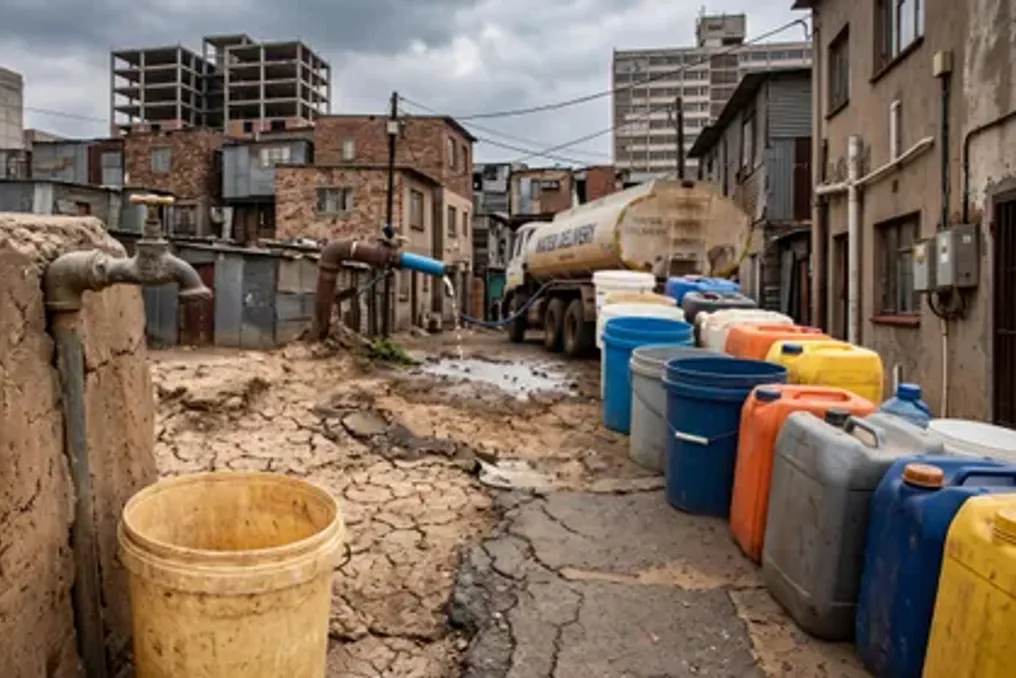
Participants reported receiving water via tankers on weekends, malfunctioning pumps, insufficient number of tankers, pipe leaks, slow project implementation, improperly functioning boreholes, and the disregard of their repeated complaints by government officials.
Attention was also drawn to the Department of Water and Sanitation's (DWS) intention to amend the National Water Act to hold officials personally accountable for service failures and pollution. The South African Local Government Association (Salga) warns that this step may be short-sighted, as it overlooks systemic issues such as historical lags, funding shortages, and aging infrastructure.
The DWS amendment, among other things, proposes adding a section to the Water Services Amendment Bill (WSA Bill) that stipulates the distribution of responsibility and, where possible, the personal liability of firm or company directors.
On Thursday, the DWS held an industry consultation on raw water usage charges for the 2027/2028 financial year in Pretoria. Department representative Visane Mavasa stated that this consultation is an important part of the DWS's annual process for setting raw water usage tariffs.
Mavasa explained that this allows water user sectors to voice concerns, raise issues, and share their views on the proposed charges before they are finally approved and implemented. He added: 'The consultation provides a dedicated platform for representatives of various water user sectors to discuss the proposed charges and related matters, and to present their position before recommendations are finalized and submitted to the Minister of Water and Sanitation for consideration and approval.'
The following organizations presented their positions regarding raw water tariffs: uMngeni-uThukela Water, AgriCulture South Africa (AgriSA), African Farmers' Association of South Africa (AFASA), South African Association for Water User Associations (SAAFWUA), Forestry South Africa (Forestry SA), and South African Local Government Association (SALGA).
On Wednesday, David Makhlobo, Deputy Minister of Water and Sanitation, spoke at the IV International Conference on Water Challenges and Solutions (ICWCS) 2026, held in Richards Bay. The conference gathered scientists, researchers, government representatives, politicians, and industry experts from South Africa and around the world.
Makhlobo sought to frame South Africa's experience within the context of the global water challenge to examine what the world is learning about water security, consider the financing problem, and study interconnected issues of climate change, technology, science, and international cooperation.
He stated that South Africa has allocated over 156 billion rand in government funding for water supply and sanitation infrastructure over the next three years, but state investment alone is insufficient to meet all long-term needs.
Makhlobo emphasized the need to improve planning and project preparation, strengthen institutions, optimize operation and maintenance, reduce losses, improve water quality, enhance municipal capacity, and seek additional capital sources. He also noted that water reuse can reduce the strain on freshwater sources, advanced treatment can support industrial needs, resource restoration can generate economic value, and better wastewater management protects rivers, groundwater, estuaries, and oceans.
He added that digital transformation of water systems should not replace institutional transformation. In his words, a municipality cannot solve management problems simply by buying new software, and a water utility cannot solve maintenance problems just by installing sensors, and the country cannot solve the skilled labor shortage just by importing technology.
Makhlobo concluded: 'We need people who understand the science, institutions capable of applying it, and systems that turn data into solutions. Let us build water systems that are climate-resilient, financially viable, technologically intelligent, environmentally responsible, and socially equitable.'
The death of Selani Zungu (39) in Adams Mission, south of Durban, who was hit by a water tanker, was a subject of discussion concerning tankers, 'tanker mafias,' and allegations that some municipal workers sell water in certain communities. Several organizations criticized this practice, stating that communities should not depend on tankers for water supply.