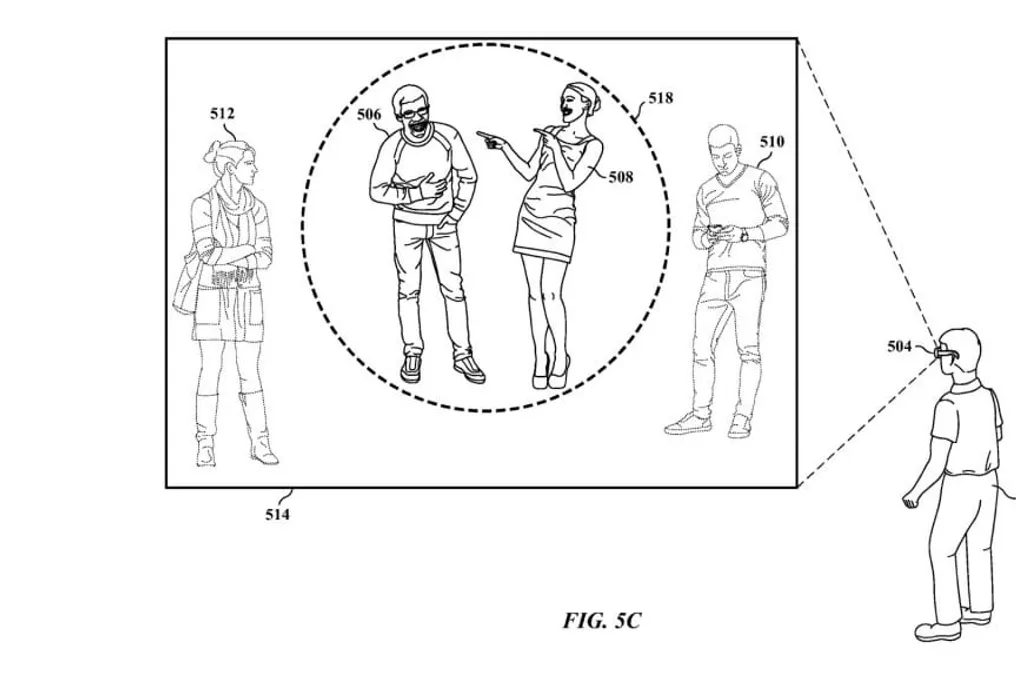
Meta filed a patent application in the United States for a camera system equipped with facial recognition, capable of identifying individuals and automatically recording their activities in video format. This application, submitted in February and recently disclosed, details the application of this technology in wearable devices, such as smart glasses.
The company's design envisions using artificial intelligence (AI) to organize recordings and create short clips focused on specific moments of each person. However, this innovation reignites important debates about continuous surveillance and privacy violation in public environments.
The technical documentation, which spans dozens of pages with detailed illustrations and explanations, demonstrates how a camera integrated into a device can analyze the scene in real time. The process begins with capturing images by the glasses' camera or a connected device, followed by environmental analysis by AI and facial recognition, allowing the software to know who is in the user's field of vision.
In addition to facial recognition, the technology can detect body movements and behaviors. For example, the system identifies when someone picks up an item, enters a location, or joins a group. Based on these detections, the program generates video files labeled with the person's name, the action performed, and the exact moment.
These video segments are then transmitted to the user's phone, glasses, or headset. The purpose of this feature is to eliminate the need for the user to manually sift through extensive recordings; instead, they receive an organized summary of the captured activities.
The disclosure of this patent occurs during a sensitive period for Mark Zuckerberg's company. Recently, researchers discovered hidden facial recognition codes in the application associated with Meta's smart glasses, which generated a negative reaction and led the company to immediately remove that functionality from the system.
In a statement sent to Olhar Digital in mid-July, Meta stated: 'We are developing products that help millions of people connect and improve their lives. While we frequently hear about interest in this type of feature – and some products already exist on the market – we are still evaluating options and will adopt a careful approach if and before we launch anything. One thing we can make clear – we are not building a facial database.'
Experts consulted by Olhar Digital warn about the inherent risks of this type of monitoring, emphasizing that the biggest concern lies in tracking people in public areas without their consent. The ability to record or identify third parties without an explicit visual signal, such as an illuminated indicator light, raises the dangers to intimacy.
In Brazil, the General Data Protection Law (LGPD) establishes guidelines for the collection of personal data. While casually photographing on the street is permitted, converting an unknown person's face into biometric data for automatic identification requires well-defined legal grounds, and the companies developing these systems must adhere to rigorous transparency standards.
Due to these privacy threats, the use of smart glasses may face restrictions in various locations. Commercial establishments, cinemas, and government agencies, for example, have legal backing to prevent people from entering while using such devices, and an increase in inspection is expected as these technologies reach the market.