The measles virus has begun circulating again in three locations in the state of São Paulo: in the capital, Guarulhos, and São Bernardo do Campo. There was a significant increase in cases at the beginning of August, affecting mainly individuals who do not have a vaccination history or whose vaccination schedule is incomplete. According to the Ministry of Health, this outbreak is occurring in a region characterized by high population movement and international traveler flow, which facilitates the sporadic entry of the virus.
This scenario raises concern, given that measles is among the most contagious infectious diseases, and the current insufficient vaccination coverage leaves part of the population vulnerable. Aline Carralas, an infectious disease specialist at the Emílio Ribas Institute of Infectology, clarifies that although Brazil recently regained measles elimination certification, this does not mean the virus has disappeared; the certification only indicates the absence of continuous transmission in the country, allowing for imported cases.
Virus transmission occurs through the air, via droplets released during coughing, sneezing, talking, or breathing, and can remain active in the environment for up to two hours after the infected person leaves. Additionally, a single infected case has the potential to transmit measles to about 90% of nearby people who are not immune. Dissemination can begin approximately four days before the onset of symptoms, allowing propagation even before diagnosis.
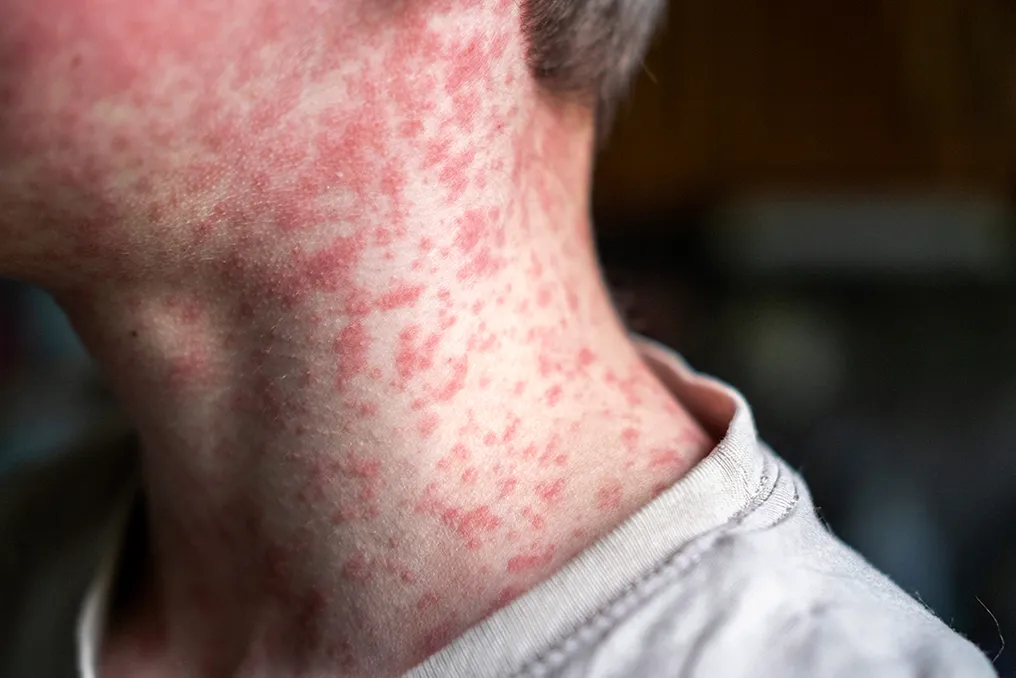
The first clinical signs usually appear one to two weeks after exposure and include high fever, malaise, cough, runny nose, and conjunctivitis. Subsequently, red spots appear, typically starting on the face and behind the ears, spreading across the body. If there is suspicion, the recommendation is to seek medical assistance, wear a mask, avoid social contact, and notify the health service before or immediately upon arrival, as early diagnosis helps both in patient treatment and controlling the chain of transmission.
Although the disease usually progresses well, it can cause serious complications such as pneumonia (which is the main cause of death related to measles in young children), otitis (with the potential to cause permanent hearing loss), and encephalitis (brain inflammation). There is also a rare and extremely serious complication known as subacute sclerosing panencephalitis, which can be fatal. High-risk groups include young children, pregnant women, people with severely compromised immune systems, and unvaccinated individuals.
Warning signs and medical recommendations
Carralas warns that warning signs include difficulty breathing, persistent or recurrent fever after improvement, excessive drowsiness, seizures, altered state of consciousness, severe dehydration, and inability to ingest liquids, requiring immediate medical evaluation. Due to the current scenario, the Ministry of Health has expanded the vaccination recommendation to all individuals between 6 months and 59 years old in the municipalities of São Paulo, Guarulhos, and São Bernardo do Campo, regardless of vaccination status. For babies aged 6 to 11 months, this is the zero dose, which complements but does not replace the regular doses scheduled at 12 and 15 months.
This specific campaign has an epidemiological objective distinct from the standard schedule. Alfredo Elias Gilio, pediatrician and coordinator of the Immunization Clinic at Einstein Israelite Hospital, emphasizes that even those who already have two doses should take an additional dose. The triple viral vaccine, which protects against measles, mumps, and rubella, is available free of charge at Basic Health Units (UBS), requiring only identification and, if possible, the vaccination card. In other cities, the vaccination schedule follows the guidelines of the National Immunization Program (PNI) according to age.
With two doses administered starting from one year of age, protection is considered long-lasting, practically lasting a lifetime, according to Gilio. The measles vaccine is highly effective, achieving 98%. In the context of intensification in São Paulo and the involved municipalities, taking an extra dose does not cancel the protection from the previous two doses; individually, those who took two doses are protected, and the additional dose aims to reduce viral circulation in the population, acting as a booster without increasing adverse events.
Individuals who have had the disease confirmed by laboratory tests or medical evaluation tend to develop long-lasting immunity. However, the infectious disease specialist from Emílio Ribas points out that many people who believe they had the disease in childhood do not have diagnostic confirmation, and in these cases, they should follow current vaccination guidelines, as natural immunity may not be sufficient or last a lifetime.
It is crucial to verify proof of vaccination or prior infection. Those who do not have this protection should seek a health service. The vaccine can be used as a blocking measure up to 72 hours after exposure to reduce the risk of illness. For certain groups, such as pregnant women, immunocompromised individuals, and specific infants, immunoglobulin may be indicated up to six days after exposure.
Post-exposure guidelines and contraindications
After exposure, the person must monitor symptoms such as fever, conjunctivitis, and skin rashes for up to 21 days, maintaining isolation if they appear. The official guidance is to seek a UBS, where the health post will try to locate the record in the computerized system or in the unit's old vaccination file. Digital histories can be checked using the Meu SUS Digital application. If the record is not found, the professional will assess the age and may start or resume the vaccination schedule to ensure protection.
The triple viral vaccine uses live attenuated viruses and is contraindicated for pregnant women, children under six months old, people with severe immunosuppression, and in case of allergy to vaccine components. Gilio explains that although vaccination may not completely prevent infection in rare cases, prior immune response helps mitigate the disease, resulting in a milder condition. Pregnant women should not receive the triple viral vaccine due to the potential risk to the fetus; vaccination should occur one month before pregnancy or after childbirth. Women who received the vaccine without knowing they were pregnant should be monitored during prenatal care, and breastfeeding mothers can be immunized upon indication, without breastfeeding posing a risk to the baby.
A mild cold, with cough, runny nose, or sore throat, generally does not prevent vaccination, but Gilio advises waiting 48 hours after the end of the symptomatic period before getting vaccinated if there is a fever. The most common reactions include pain, redness, and swelling at the injection site, malaise, swollen lymph nodes, and low-grade fever, with catarrhal symptoms, conjunctivitis, or red spots occurring between five and 21 days after administration.
The live attenuated virus stimulates the immune system in a manner similar to natural infection, but without causing the disease. In very rare cases, predisposed children may present with high fever or febrile seizures, requiring immediate medical attention. However, Carralas reinforces that severe adverse events are uncommon and the benefits of vaccination far outweigh the risks, especially considering that the disease can cause serious complications such as pneumonia, encephalitis, and even death.
Generally, the triple viral vaccine can be administered on the same day as other vaccines, provided they are in different body sites. An exception is the yellow fever vaccine, which may interfere with the immune response if administered simultaneously, requiring guidance from the health service regarding the correct interval. People with significant immunosuppression, such as patients undergoing chemotherapy, transplant recipients, or users of immunosuppressants, should not receive the live vaccine; for these groups, community protection is even more vital, and immunoglobulin may be indicated in case of exposure.
Before traveling internationally, it is recommended to check vaccination status with the Ministry of Health. Travelers should go to a vaccination post with identification and vaccination card, if available, to confirm the need for updating, given that measles still circulates globally, including in Europe and the United States, and travel can facilitate the reintroduction of the virus into areas where transmission has been controlled.